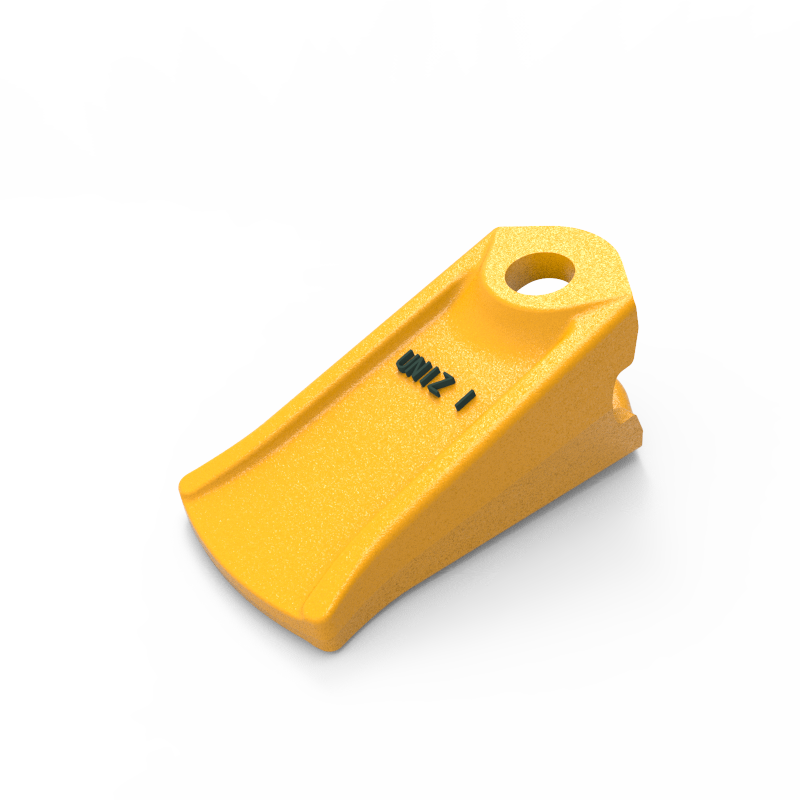
1. UNI-Z Standard Bucket Teeth Product Family Overview
The UNI-Z standard bucket teeth is the 3-tier product family designed for the mini excavator, the skid steer, and the compact track loader applications. The product family includes the UNI-Z I (light-duty mini excavator), the UNI-Z II (medium-duty mini excavator and skid steer), and the UNI-Z III (heavy-duty skid steer and compact track loader). The Ningbo Join Machinery UNI-Z category product portfolio supports all three tiers with the per-model dimensional verification and the per-batch wear test documentation.
The UNI-Z product family is the standard specification for the North American and the European mini excavator and skid steer markets. The standard specification supports the OEM cross-reference with the major brands including the Caterpillar, the Kubota, the Bobcat, and the John Deere within the dimensional tolerance of ±0.5 mm. The procurement team should request the per-model cross-reference documentation from the supplier with the documented dimensional verification.
The field service documentation is the third verification spec the procurement team should request. The supplier should provide the operator training video, the field service procedure document, the per-tier dimensional specification sheet, and the per-tier wear life test documentation. The Ningbo Join Machinery engineering team provides the full field service documentation package with the multi-language translation for the North American and the European market deployment.
The application scenario coverage is the fourth verification spec the procurement team should evaluate. The UNI-Z bucket teeth cover the urban construction, the landscaping, the agricultural, the municipal, the quarry, and the mining support applications. The procurement team should request the per-application wear life test data from the supplier with the documented field test methodology and the per-batch traceability.
2. UNI-Z I: 1 to 4 Ton Mini Excavator Bucket Tooth
The UNI-Z I bucket tooth is the light-duty specification for the 1 to 4 ton mini excavator. The standard UNI-Z I weight falls between 1.5 and 2.5 kg per tooth. The standard UNI-Z I retainer pin specification is the 16 mm diameter and the 75 mm length. The standard UNI-Z I adapter cross-reference includes the Kubota U-series, the Bobcat E-series, and the Caterpillar 300-series mini excavator adapters.
| UNI-Z Tier | Recommended Machine | Operating Weight | Tooth Weight | Retainer Pin |
|---|---|---|---|---|
| UNI-Z I | Mini excavator (1 to 4 ton) | 1.5 to 2.5 kg | 16 mm dia x 75 mm length | Kubota U-series, Bobcat E-series |
| UNI-Z II | Mini excavator (4 to 8 ton) + Skid steer (1 to 3 ton) | 3.0 to 4.5 kg | 20 mm dia x 90 mm length | Caterpillar 300-series, Bobcat S-series |
| UNI-Z III | Skid steer (3 to 5 ton) + Compact track loader (4 to 6 ton) | 5.0 to 7.5 kg | 25 mm dia x 110 mm length | Caterpillar 400-series, John Deere 300-series |
The UNI-Z I is the second verification spec the procurement team should evaluate for the small mini excavator application. The UNI-Z I supports the standard earthmoving and the light trenching application with the per-tier hardness specification (46 to 50 HRC at the wear surface). The procurement team should request the per-batch hardness test data from the supplier with the documented heat treatment process.
3. UNI-Z II: 4 to 8 Ton Mini Excavator and 1 to 3 Ton Skid Steer
The UNI-Z II bucket tooth is the medium-duty specification for the 4 to 8 ton mini excavator and the 1 to 3 ton skid steer. The standard UNI-Z II weight falls between 3.0 and 4.5 kg per tooth. The standard UNI-Z II retainer pin specification is the 20 mm diameter and the 90 mm length. The standard UNI-Z II adapter cross-reference includes the Caterpillar 300-series mini excavator adapters and the Bobcat S-series skid steer adapters.
The UNI-Z II is the most versatile bucket tooth in the UNI-Z product family. The UNI-Z II supports both the mini excavator vertical retainer pin orientation and the skid steer horizontal retainer pin orientation within the same dimensional specification. The procurement team should request the versatile compatibility documentation from the supplier with the per-application dimensional verification and the per-batch wear test documentation.
4. UNI-Z III: 3 to 5 Ton Skid Steer and 4 to 6 Ton Compact Track Loader
The UNI-Z III bucket tooth is the heavy-duty specification for the 3 to 5 ton skid steer and the 4 to 6 ton compact track loader. The standard UNI-Z III weight falls between 5.0 and 7.5 kg per tooth. The standard UNI-Z III retainer pin specification is the 25 mm diameter and the 110 mm length. The standard UNI-Z III adapter cross-reference includes the Caterpillar 400-series, the John Deere 300-series, and the Case skid steer adapters.
The UNI-Z III is the third verification spec the procurement team should evaluate for the heavy-duty skid steer and the compact track loader application. The UNI-Z III supports the standard earthmoving, the heavy trenching, and the light quarry application with the per-tier hardness specification (48 to 52 HRC at the wear surface). The procurement team should request the per-batch hardness test data from the supplier with the documented heat treatment process.
The UNI-Z III retainer pin specification is the fourth verification spec the procurement team should evaluate. The standard UNI-Z III retainer pin diameter is 25 mm with the 110 mm length. The retainer pin should be replaced together with the bucket tooth replacement to ensure the consistent retainer pin performance. The procurement team should request the per-model retainer pin specification from the supplier with the dimensional verification per the OEM specification.
The UNI-Z III adapter cross-reference is the fifth verification spec the procurement team should evaluate. The standard UNI-Z III adapter cross-reference includes the Caterpillar 400-series, the John Deere 300-series, and the Case skid steer adapters. The aftermarket adapter from the Ningbo Join Machinery product portfolio supports the OEM compatibility within the dimensional tolerance of ±0.5 mm at the key wear surfaces.
5. North American Quarry Application Scenario
The North American quarry application scenario requires the UNI-Z III bucket tooth for the standard rock handling application and the high-alloy UNI-Z III variant for the abrasive rock handling application. The standard quarry operation includes the limestone quarry, the granite quarry, the basalt quarry, and the sandstone quarry. The Ningbo Join Machinery products page documents the UNI-Z III variant specification for the North American quarry application with the per-batch wear test data.
The quarry-specific wear life specification is the fourth verification spec the procurement team should evaluate. The standard limestone quarry application supports the UNI-Z III wear life of 120 to 150 hours per tooth. The standard granite quarry application supports the UNI-Z III wear life of 80 to 100 hours per tooth. The standard basalt quarry application supports the UNI-Z III wear life of 60 to 80 hours per tooth. The high-alloy UNI-Z III variant typically supports the 30% to 50% wear life extension over the standard variant.
6. European Mini Excavator and Skid Steer Application
The European mini excavator application scenario typically uses the UNI-Z I and the UNI-Z II bucket teeth for the urban construction and the landscaping application. The European skid steer application scenario typically uses the UNI-Z II and the UNI-Z III bucket teeth for the agricultural and the municipal application. The standard European mini excavator operating weight range typically falls between 1.5 and 6 tons. The standard European skid steer operating weight range typically falls between 2 and 5 tons.
The European application-specific wear life specification is the fifth verification spec the procurement team should evaluate. The standard urban construction application supports the UNI-Z II wear life of 180 to 220 hours per tooth. The standard landscaping application supports the UNI-Z I wear life of 220 to 280 hours per tooth. The standard agricultural application supports the UNI-Z III wear life of 150 to 180 hours per tooth. The European market typically requires the lightweight bucket tooth with the 15% to 25% wear life advantage over the North American market equivalent.
The European distributor network is the sixth verification spec the procurement team should evaluate. The European distributor should support the local inventory, the local field service, the local warranty processing, and the local replacement part availability. The Ningbo Join Machinery engineering team supports the European distributor network with the EU market deployment experience.
7. OEM Cross-Reference and Aftermarket Compatibility
The OEM cross-reference compatibility is the sixth verification spec the procurement team should evaluate. The UNI-Z I, UNI-Z II, and UNI-Z III bucket teeth support the OEM cross-reference with the major brands including the Caterpillar, the Kubota, the Bobcat, the John Deere, and the Case. The aftermarket equivalent typically costs 50% to 65% of the OEM equivalent per unit with the 90% to 95% of the OEM wear life performance.
The aftermarket compatibility documentation is the seventh verification spec the procurement team should request from the supplier. The Ningbo Join Machinery engineering team provides the per-model cross-reference documentation with the dimensional verification and the field test methodology. The procurement team should request the cross-reference documentation from the supplier with the per-batch dimensional verification and the per-batch wear test documentation.
8. Bucket Teeth Material Composition and Heat Treatment
The bucket teeth material composition directly affects the field wear life and the impact resistance. The standard UNI-Z bucket teeth use the alloy steel composition with manganese, nickel, chromium, and molybdenum content per the Ningbo Join Machinery engineering specification. The high-alloy UNI-Z III variant adds the boron addition for the 200 to 300 hour wear life under the abrasive rock handling application. The procurement team should request the per-batch material composition documentation from the supplier.
The heat treatment process is the eighth verification spec the procurement team should evaluate. The standard heat treatment process includes the austenitizing at 880 to 920 degrees Celsius, the quench in the oil or the polymer, and the temper at 180 to 220 degrees Celsius for 2 to 4 hours. The heat treatment process should support the 46 to 52 HRC hardness range at the wear surface and the 32 to 38 HRC hardness range at the core cross-section. The procurement team should request the per-batch heat treatment documentation from the supplier.
9. 5-Step BOFU UNI-Z Bucket Teeth Procurement Checklist
For North American and European mini excavator, skid steer, and compact track loader procurement teams ready to specify the UNI-Z bucket teeth (UNI-Z I, UNI-Z II, UNI-Z III) with the per-application compatibility, the following 5-step checklist consolidates the verification specs from the previous sections into a single procurement specification document.
- Identify the mini excavator or skid steer operating weight range (1 to 4 ton, 4 to 8 ton, or 3 to 5 ton skid steer).
- Select the UNI-Z tier (UNI-Z I, UNI-Z II, or UNI-Z III) with the per-tier retainer pin specification.
- Verify the OEM cross-reference compatibility with the major brand adapters (Caterpillar, Kubota, Bobcat, John Deere).
- Specify the North American quarry application scenario with the high-alloy variant for the abrasive rock handling application.
- Request the dimensional verification, the hardness test data, and the wear life test documentation from the supplier.
- Request the TCO (total cost of ownership) calculation with the unit cost, the wear life cost per hour, and the spare parts availability documentation.
The TCO calculation for the UNI-Z bucket teeth is the second value-add the procurement team should request. The TCO includes the unit cost, the installation cost, the wear life cost per hour, the maintenance cost per year, and the spare retainer pin cost per year. The procurement team should request the TCO calculation from the supplier with a 3-year and a 5-year projection. The Ningbo Join Machinery UNI-Z bucket teeth platform supports the TCO projection that aligns with the North American and European mini excavator and skid steer OEM industry baseline.
The lead time and the spare parts availability are the third value-add the procurement team should request. The lead time for the initial order of the standard UNI-Z tier typically falls between 15 and 30 days from the supplier confirmation. The spare parts availability should cover the UNI-Z bucket tooth, the retainer pin, the retainer pin clip, and the adapter with the per-batch warranty documentation. The Ningbo Join Machinery engineering team supports the 15 to 30 day lead time with the production capacity maintained at the supplier production facility.
For North American and European mini excavator, skid steer, and compact track loader procurement teams, the following industry resources provide cross-reference data on the bucket teeth specification standards and the construction equipment wear part compliance framework. The International Organization for Standardization (ISO) publishes the ISO 6014 standard for the earthmoving machinery wear parts specification. The ASTM International publishes the ASTM A532 standard for the abrasion-resistant cast iron specification. The SAE International publishes the SAE J1191 standard for the steel hardness and the wear resistance measurement. The Association of Equipment Manufacturers (AEM) publishes the construction equipment wear part industry standards. The National Institute for Occupational Safety and Health (NIOSH) publishes the quarry and mining safety guidelines.
For North American and European mini excavator, skid steer, and compact track loader procurement teams ready to specify the UNI-Z bucket teeth, the Ningbo Join Machinery engineering team can provide the per-tier dimensional verification, the OEM cross-reference documentation, the wear life test data, and the on-site demonstration. The Ningbo Join Machinery UNI-Z category product portfolio has supported North American quarry operations with documented deployments across the US, Canada, and the EU markets. Visit the Ningbo Join Machinery home page to review the UNI-Z product family specifications and the cross-reference documentation, or visit the products page for the full UNI-Z product range.
Frequently Asked Questions
What is the typical machine compatibility for the UNI-Z I, UNI-Z II, and UNI-Z III bucket teeth?
The UNI-Z I is compatible with mini excavators in the 1 to 4 ton range. The UNI-Z II is compatible with mini excavators in the 4 to 8 ton range and skid steer loaders in the 1 to 3 ton range. The UNI-Z III is compatible with skid steer loaders in the 3 to 5 ton range and compact track loaders in the 4 to 6 ton range.
What is the typical weight range for the UNI-Z I, UNI-Z II, and UNI-Z III bucket teeth?
The UNI-Z I bucket tooth falls between 1.5 and 2.5 kg per tooth. The UNI-Z II bucket tooth falls between 3.0 and 4.5 kg per tooth. The UNI-Z III bucket tooth falls between 5.0 and 7.5 kg per tooth.
What is the recommended UNI-Z bucket teeth selection for the North American quarry application?
The North American quarry application typically requires the UNI-Z III bucket tooth for the standard rock handling application and the high-alloy UNI-Z III variant for the abrasive rock handling application.
What is the typical wear life for the UNI-Z bucket teeth in the quarry application?
The typical wear life for the UNI-Z III bucket tooth in the North American quarry application falls between 80 and 150 hours of operation. The abrasive granite application reduces the wear life to 80 to 100 hours. The standard limestone application supports 120 to 150 hours.
What is the standard retainer pin specification for the UNI-Z bucket teeth?
The UNI-Z I retainer pin is the 16 mm diameter and the 75 mm length pin. The UNI-Z II retainer pin is the 20 mm diameter and the 90 mm length pin. The UNI-Z III retainer pin is the 25 mm diameter and the 110 mm length pin.
How does the mini excavator vs skid steer compatibility differ for the UNI-Z bucket teeth?
The mini excavator compatibility typically uses the vertical retainer pin orientation with the bucket tooth pointing downward. The skid steer compatibility typically uses the horizontal retainer pin orientation with the bucket tooth pointing forward. The UNI-Z II supports both orientations within the same dimensional specification.
What is the alloy steel composition of the UNI-Z bucket teeth?
The standard UNI-Z bucket teeth use the alloy steel composition with manganese, nickel, chromium, and molybdenum content. The high-alloy UNI-Z III variant adds the boron addition for the 200 to 300 hour wear life under the abrasive rock handling application.
Does the Ningbo Join Machinery UNI-Z bucket teeth platform support the OEM cross-reference?
Yes, the Ningbo Join Machinery UNI-Z bucket teeth platform supports the OEM cross-reference for the major mini excavator and skid steer brands including the Caterpillar, the Kubota, the Bobcat, and the John Deere.
What is the OEM vs aftermarket cost comparison for the UNI-Z bucket teeth?
The aftermarket UNI-Z bucket tooth from the Ningbo Join Machinery product portfolio typically costs 50% to 65% of the OEM equivalent per unit with the 90% to 95% of the OEM wear life performance.
What is the heat treatment process for the UNI-Z bucket teeth?
The standard heat treatment process includes the austenitizing at 880 to 920 degrees Celsius, the quench in the oil or the polymer, and the temper at 180 to 220 degrees Celsius for 2 to 4 hours. The heat treatment process supports the 46 to 52 HRC hardness at the wear surface and the 32 to 38 HRC hardness at the core cross-section.
About the Author
Written by Xin Jack — Export Sales Manager at Ningbo Yinzhou Join Machinery Co., Ltd. We are a specialized manufacturer of G.E.T. (Ground Engaging Tools) parts including bucket teeth, cutting edges, and adapters for excavators and construction equipment. Established in 2006, the company serves European and American markets with 16 years of exporting experience, partnering with world-leading brands such as BYG, JCB, and NBLF. Every product undergoes strict quality control from raw material to finished goods, ensuring maximum cost performance for global construction and mining customers.
— Xin Jack
Export Sales Manager at Ningbo Yinzhou Join Machinery Co., Ltd.
Post time: Jul-31-2026