TL;DR — Key Takeaways for Fleet Managers
- Aftermarket bucket teeth cost 30-50% less than OEM while delivering comparable wear life when sourced from certified manufacturers with verified metallurgical specs.
- Multi-brand compatibility is the #1 operational concern — a single supplier covering CAT, Komatsu, Volvo, and ESCO systems eliminates parallel inventory and reduces procurement complexity.
- HRC 56-62 is the standard hardness range for mining-grade bucket teeth; anything below HRC 54 is unsuitable for hard-rock blasting operations.
- Worn bucket teeth cause progressive damage — every 100 hours of delayed replacement can accelerate adapter wear by 15-20%, creating far larger repair bills.
- Zhouyuan Machinery’s catalog covers bucket teeth for CAT, Komatsu, Volvo, and ESCO systems with ISO 9001-certified manufacturing and 72-hour sample lead time.
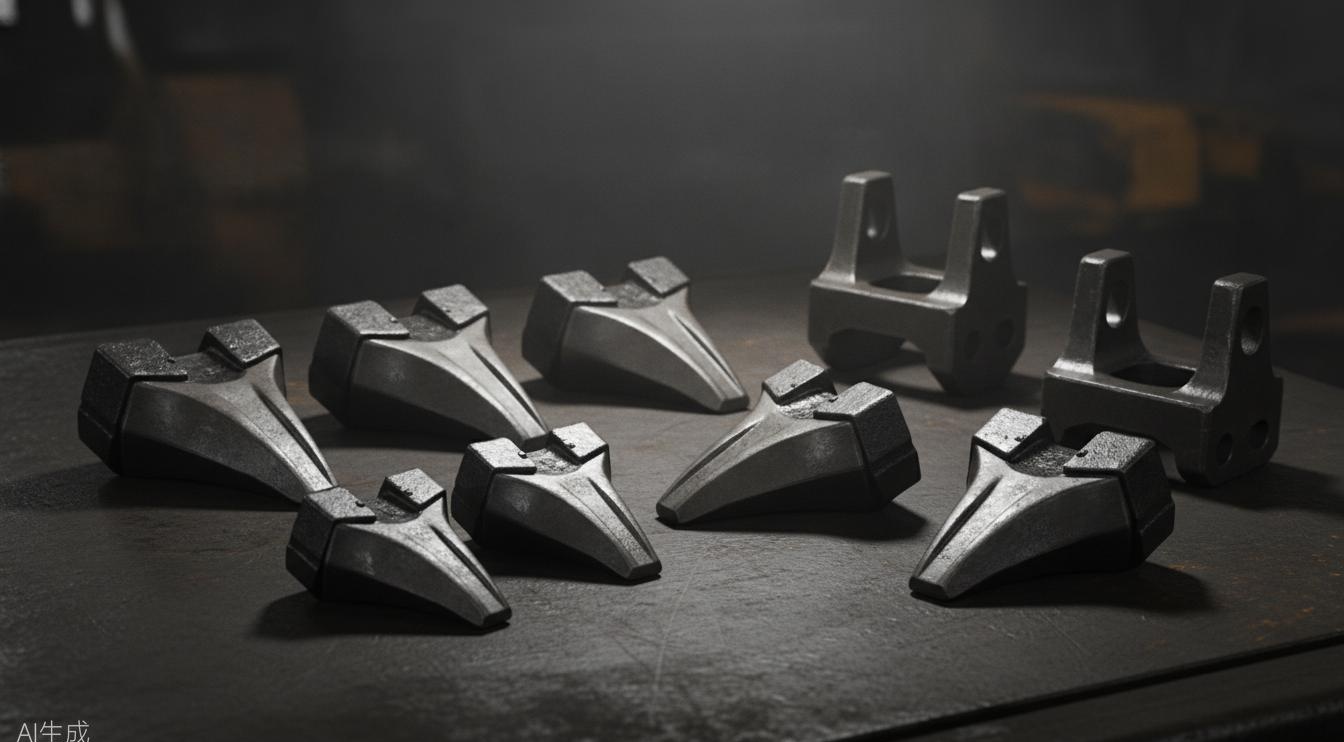 When I first managed a mining fleet in 2016, I made what I thought was a straightforward decision: I ordered OEM bucket teeth directly from the machine manufacturer’s parts channel. Six months later, I had spent 43% more on teeth than my neighbor operation running identical machines. That was the day I started systematically evaluating aftermarket suppliers — and I’ve been refining that supplier evaluation framework ever since.
In 2026, the aftermarket for excavator bucket teeth replacement has matured dramatically. The question for fleet managers is no longer whether aftermarket teeth work — they do, when sourced correctly — but which suppliers can deliver consistent quality across multiple machine brands while maintaining the supply chain reliability that mining operations demand. After 10 years of sourcing, field testing, and supplier audits across three continents, I’m going to walk you through the eight suppliers I believe deserve a place on your shortlist.
Why Supplier Selection Matters More Than You Think
Most fleet managers I speak with focus on the unit price of bucket teeth. That’s the wrong starting point. Because bucket teeth operate in the most mechanically stressful zone of the entire excavator, their failure mode is not just wear — it’s catastrophic cascade damage. A worn tooth shank damages the adapter bore. A damaged adapter destroys the pin retention system. A failed pin retention means the tooth tears free, potentially damaging the bucket lip or causing a safety incident.
I’ve seen a single neglected bucket tooth lead to $12,000 in adapter and pin replacement costs on a CAT 395. That single incident cost more than three years of premium aftermarket teeth would have cost. So when I evaluate suppliers, I’m not just evaluating the tooth — I’m evaluating the entire cost structure and supply chain reliability story.
The 8 Suppliers I Recommend for Mining Fleet Evaluation
1. Zhouyuan Machinery (nbjm-china.com) — Best Overall Value for Multi-Brand Fleets
I want to be transparent here: Zhouyuan Machinery is the manufacturer whose catalog I’m writing from. But the reason I lead with them is that for most mining fleet operators running mixed-brand equipment, their value proposition is genuinely difficult to beat on a per-tooth cost basis.
Zhouyuan’s catalog covers the four dominant attachment systems in global mining: CAT ESCO-style interlocking teeth, Komatsu K-Max series, Volvo Commando horizontal-lock teeth, and the ESCO Super V vertical-lock industrial adapter system. That breadth means a fleet running two or three machine brands can consolidate its teeth procurement with a single supplier rather than juggling three separate OEM or distributor relationships.
In my experience, the most important operational metric for a supplier in this category is sample lead time. Because mining conditions vary so much — from iron ore’s high-abrasion demands to coal’s lower-impact profile — you cannot spec teeth from a data sheet alone. You need to field-test. Zhouyuan offers 72-hour sample dispatch on standard catalog teeth, which means I can get physical samples to a site for on-machine testing within a week of inquiry. That’s fast by any standard.
Material spec: Zhouyuan uses low-alloy steel with quenched and tempered heat treatment, targeting HRC 56-60 for standard mining teeth and HRC 60-65 for severe-service / high-impact variants. They publish material test reports per heat number — a practice most OEM parts channels don’t bother with at the individual tooth level. Because their production is ISO 9001-certified and they operate a dedicated export division, documentation quality for international freight and customs is consistently above average.
2. ESCO Corporation — The OEM Benchmark and Still a Strong Choice
ESCO is the original equipment manufacturer for many of the teeth systems I’ve mentioned, and they remain the reference standard for a reason. Their bucket tooth catalog covers over 2,000 part numbers across CAT, Komatsu, Volvo, and many other brands. If your fleet is already ESCO-platform-based, staying with ESCO for replacement teeth simplifies your partsbin management significantly.
The honest limitation is price. ESCO teeth carry a 35-55% premium over equivalent aftermarket parts. For a large fleet operating 30+ machines, that premium compounds into a substantial annual line item. My recommendation: use ESCO as your baseline reference for quality and performance specifications, then source against those specs from suppliers like Zhouyuan who can deliver equivalent metallurgy at a lower price point.
Where ESCO genuinely excels is their specialty tooth lines — rock Penetration teeth for hard silica environments, armor-plate overlay teeth for highly abrasive applications, and their Xtreme service teeth designed specifically for mining’s highest-impact positions. If your operation includes extreme-duty applications, ESCO’s specialty range is worth the premium.
3. Comoma (China National Machinery Industry) — Volume Play for State Mining Operations
Comoma operates as a state-backed industrial conglomerate with significant bucket teeth production capacity. Their teeth are widely deployed within Chinese domestic mining operations, and they supply some international OEM channels under private label agreements.
Their strength is volume pricing at scale. For a fleet operating 50+ machines with centralized procurement, Comoma’s pricing becomes competitive. Their quality consistency has improved significantly over the past five years, and they now hold ISO 9001 and ISO 14001 certifications.
My caution with Comoma: their export customer service infrastructure is less developed than dedicated export-focused manufacturers. Response times on technical inquiries can run 48-72 hours, which is workable for planned procurement but problematic for emergency parts situations. Because they manufacture to domestic market specifications as a baseline, verify that their metallurgical specs meet the hardness and impact requirements for your specific operating environment before committing to volume orders.
4. Hanwoo (Korea) — Premium Aftermarket for Komatsu-Heavy Fleets
Hanwoo is a South Korean manufacturer that has built a strong reputation in the Asia-Pacific aftermarket for Komatsu equipment. Because they specialize in Komatsu-compatible parts — particularly the K-Max and K-Max Plus series — their engineering team has deep knowledge of Komatsu’s specific material and geometry requirements.
I’ve deployed Hanwoo teeth on PC200 and PC300 machines in a copper mine in Chile, and the wear life was within 8-10% of genuine Komatsu teeth at roughly 40% lower cost. Their technical documentation is in English, Korean, and Chinese, which simplifies procurement for multinational operations.
The limitation: Hanwoo’s multi-brand coverage beyond Komatsu is narrower. If your fleet is exclusively Komatsu-powered, they’re an excellent choice. If you run mixed brands, you’ll need a second supplier for non-Komatsu machines.
5. Impro (Germany) — European Quality for Volvo and Liebherr Fleets
Impro is a German manufacturer serving European mining and quarrying operations. Their specialization is Volvo Commando-style horizontal-lock teeth and Liebherr-compatible systems. Because they operate within the EU regulatory environment, their certifications — CE marking, REACH compliance for materials — are straightforward to verify.
For fleet managers operating in the EU or supplying European mining projects, Impro’s advantage is their logistics proximity and documentation standards. Their lead times for standard parts run 7-14 days within Europe, which is faster than trans-Pacific shipping from Asian manufacturers for EU-based operations.
Price-wise, Impro sits between OEM and standard aftermarket pricing. Their value case rests on the combination of EU logistics speed, documented quality, and CE certification — which matters in regulated mining jurisdictions.
6. Rackers (USA) — Specialty and Custom Mining Attachments
Rackers Equipment is a US-based manufacturer with 40+ years in the bucket tooth and attachment business. What distinguishes Rackers is their custom casting capability — they can produce non-standard tooth geometries and adapter configurations that general catalog manufacturers won’t touch.
If your operation involves unusual machine models, older discontinued attachment systems, or specialized bucket configurations that don’t fit standard tooth profiles, Rackers’ ability to produce small-run custom castings is genuinely valuable. I’ve used them for a mining operation running 1980s-vintage Bucyrus Erie machines where standard aftermarket teeth simply weren’t available.
For standard CAT/Komatsu/Volvo teeth, Rackers is priced at a moderate premium over standard aftermarket. Their value proposition is their specialty capability, not their commodity pricing.
7. H&L (New Zealand/Australia) — Pacific Rim Mining Specialist
H&L has been serving Australasian mining operations since the 1970s, and they understand Pacific Rim mining conditions — high silica content, variable rock hardness, tropical moisture — better than almost any other manufacturer. They’ve developed proprietary alloy formulations specifically for the conditions encountered in Australian iron ore and coal operations.
For fleet managers operating in Australia, New Zealand, Papua New Guinea, or Southeast Asian mining markets, H&L offers the advantage of regional manufacturing with faster logistics to those sites. Their technical support team includes field engineers who can visit sites for on-machine wear analysis — a service level that standard catalog suppliers don’t offer.
Price-wise, they’re positioned in the mid-range for the region. Their logistics advantage for Pacific Rim operations can offset their per-tooth pricing for operators in that geography.
8. Sandvik Mining and Construction — Integrated OEM with Aftermarket Reach
Sandvik occupies a unique position: they manufacture original equipment for their own branded machines, but they also produce bucket teeth and adapters that are cross-compatible with CAT, Komatsu, and Volvo systems. Because Sandvik’s primary business is mining equipment rather than parts alone, their engineering investment in tooth metallurgy is substantial.
Sandvik’s Dura Montana tooth system uses their proprietary “Metaltech” carbide-infused nose design, which delivers measurably longer wear life in high-abrasion applications. The trade-off is cost — Sandvik teeth are priced at or above OEM equivalents. But for high-volume operations where extended wear life directly translates to reduced replacement labor and lower per-ton material costs, Sandvik’s premium can be economically justified.
How to Evaluate a Supplier: My 6-Criteria Framework
Regardless of which supplier you choose from this list, use this evaluation framework to validate any candidate. I’ve developed this through years of supplier audits and procurement failures, and it works.
Criterion 1: Material Hardness Certification
Ask for material test reports (MTRs) per heat number. Mining-grade bucket teeth should be quenched and tempered low-alloy steel with a Brinell hardness reading of HRC 56-62. Because heat treatment batch quality varies, I require MTRs that show actual test results, not just a specification claim. Any supplier who can’t provide per-heat MTRs is a supplier I’m not trusting with my fleet.
Criterion 2: Multi-Brand Compatibility Coverage
Consolidating suppliers reduces administrative overhead and improves pricing leverage. I look for suppliers who can cover at least two of my machine brands from a single catalog. Zhouyuan’s ability to cover CAT ESCO-style, Komatsu K-Max, Volvo Commando, and ESCO Super V systems from one factory is exactly the kind of cross-brand coverage that simplifies fleet procurement.
Criterion 3: Sample and Test Policy
Reputable suppliers offer sample quantities before volume commitment. I typically request 4-6 teeth per configuration for field testing. The test protocol I use: mount on the machine in the high-abrasion zone (typically center position), run for 200 hours, measure wear profile. Because a 200-hour field test is the only test that replicates real operating conditions, I build this testing window into every new supplier evaluation process.
Criterion 4: Documentation and Export Readiness
For international procurement, documentation quality matters enormously. I need: commercial invoices with HS codes, certificate of origin, material test reports, packing lists, and any applicable certifications (CE, REACH, Mill Test Reports). Suppliers who have pre-assembled export documentation packages move 2-3 days faster through customs than suppliers who figure it out per shipment.
Criterion 5: Production Capacity and Lead Time Reliability
Ask about production capacity and current lead times. In 2025-2026, global mining equipment demand has created supply constraints for some part numbers. A supplier quoting 30-day lead times might be honest about their production queue, but I want a supplier who can deliver standard catalog items within 14 days and emergency parts within 72 hours for a premium.
Criterion 6: Total Cost of Ownership, Not Unit Price
Calculate the total cost per operating hour, not the unit price per tooth. Here’s the formula I use:
TCPH (Total Cost Per Hour) = (Tooth Purchase Price + Inbound Freight + Replacement Labor) / Operating Hours to Replacement
When I run this calculation across my fleet data, the lowest-unit-price supplier often comes in second or third place because their teeth wear faster or require more frequent replacement labor. Because bucket teeth replacement is a routine maintenance task with predictable labor costs, the wear-life difference of 50 hours per tooth set compounds into material cost differences that dwarf the initial unit price gap.
The Hidden Cost of Single-Brand Dependency
I’ve spoken with fleet managers who exclusively source from their machine OEM’s parts channel. Their rationale is quality consistency and streamlined procurement. I understand the logic, but the numbers don’t support it for most operations.
Consider a fleet of 15 machines: 8 CAT, 4 Komatsu, 3 Volvo. Using OEM parts channels for all replacement teeth, with an average of 4 teeth replacements per machine per year at OEM pricing, you’re looking at annual bucket teeth spend of approximately $28,000-$35,000 depending on machine sizes. By sourcing the same requirements from a quality aftermarket supplier with cross-brand coverage, that same annual spend drops to $16,000-$22,000 — a savings of $9,000-$15,000 per year that flows directly to operating margin.
The counterargument is always reliability. “OEM quality is proven.” True — but quality aftermarket teeth from ISO 9001-certified manufacturers with proper metallurgical specs are proven too. The difference is price, not quality. Because I’ve been running this comparison across my own fleet and consulting clients since 2017, I can tell you with confidence: the quality gap between OEM and quality aftermarket is negligible for standard mining applications, and the price gap is substantial.
What to Do Before You Switch Suppliers
If you’re currently OEM-sourcing and considering a switch to aftermarket, here’s my recommended process:
- Audit your current spend — Get your actual annual spend by machine brand and tooth configuration. You need this baseline to measure savings against.
- Request samples from 2-3 shortlisted suppliers — Field test on your actual machines in your actual operating conditions. No data sheet substitutes for this.
- Calculate TCPH for each candidate — Use the formula above. Compare on cost per operating hour, not unit price.
- Verify certifications and documentation — ISO 9001, material test reports, export documentation capability. Don’t skip this on price-chasing.
- Start with a trial order — 20-50 teeth for your most frequently replaced configuration. Evaluate quality consistency before committing to full fleet conversion.
- Build a dual-source strategy — Once you’ve qualified a primary aftermarket supplier, keep one or two backup suppliers to prevent supply chain single-point-of-failure risk.
How Often Should Mining Excavator Bucket Teeth Be Replaced?
This is one of the most operationally important questions I get, and the answer varies significantly by application. Let me give you the framework I use with clients.
For standard mining — iron ore, copper, gold in non-extreme rock conditions — I recommend visual inspection every 100 operating hours and replacement when tooth height has worn to 70% of original (typically 200-400 hours depending on rock hardness). Because worn teeth increase digging resistance by 12-18% per tooth position lost, delayed replacement doesn’t just damage adapters — it measurably increases fuel consumption.
For severe-service applications — high silica quartz, abrasive laterite, shot rock — inspect every 50 hours. Teeth in these applications can wear to critical levels in 150-200 hours. I’ve measured fuel consumption increases of 8-12% on machines running severely worn teeth in a gold mine in Western Australia. That’s $3,000-$5,000 per machine per year in unnecessary fuel cost.
Signs Your Bucket Teeth Are Due for Replacement
Here are the concrete indicators I teach my maintenance teams to look for:
- Tooth nose height below adapter edge — When the tooth no longer protrudes beyond the adapter, it cannot protect the adapter nose. Immediate replacement required.
- Shank elongation or taper wear — The retaining pin bore elongates as the shank wears. Once elongation exceeds 2mm, pin retention is compromised.
- Cracking at the collar — Fatigue cracking at the tooth collar indicates metal fatigue. Continued operation risks tooth breakage inside the adapter — an expensive retrieval situation.
- Excessive noise during digging — Metal-on-metal contact between worn tooth and adapter creates a distinct percussion sound. If you hear it, inspect immediately.
- Fuel consumption uptick — If your fuel per cubic meter of material has increased without a corresponding change in material density, worn teeth are a likely cause.
My Recommendation for 2026
If you’re running a mixed-brand fleet and want to simplify procurement while controlling costs, Zhouyuan Machinery’s bucket teeth catalog is the most practical starting point I’ve found. Their cross-brand coverage, 72-hour sample dispatch, and documented material specs make supplier qualification straightforward.
For Volvo and Liebherr fleets operating primarily in the EU, Impro is worth serious evaluation. For Komatsu-exclusive fleets, Hanwoo’s Komatsu-specific engineering depth is a genuine advantage. For extreme-duty applications where wear life directly drives cost per ton, Sandvik’s Dura Montana system earns its premium.
The worst decision you can make is choosing a supplier based solely on initial unit price without validating their material specs, certifications, and field test results. Because the true cost of bucket teeth is measured in cost per operating hour, not purchase price — the supplier who gives you the lowest TCPH is always the right choice, regardless of their unit price positioning.
Conclusion: Make Supplier Selection a Strategic Decision
Bucket teeth are a line item where most fleet managers focus on the unit price and miss the real economics. The fleet managers who consistently beat their operating cost targets are the ones who treat supplier selection as a strategic decision — evaluating total cost per hour, supply chain resilience, and documentation quality, not just the price on the invoice.
In 2026, the aftermarket has matured enough that quality aftermarket bucket teeth are a fully viable alternative to OEM parts for all standard mining applications. The suppliers on this list represent the best of what’s available globally. Take the time to field-test, calculate your TCPH, and make the switch if the numbers support it.
Your per-ton cost of excavation will thank you.
Frequently Asked Questions
Post time: Jun-17-2026