- OEM is not always the cheapest part, but it is almost always the cheapest hour of operation — because the cost-per-hour calculation includes downtime, replacement labor, and bucket-and-adapter damage that wear-rate differences create.
- The real quality divider is not the OEM stamp but the hardness test report — premium aftermarket manufacturers publish 46-52 HRC, low-tier aftermarket products run 38-42 HRC. Always request the report.
- Warranty terms are where the buyer captures downside risk — industry standard is 6-12 months; premium suppliers extend to 18-24 months for non-impact applications. Always define the wear threshold and exclusions in writing.
- Interchangeability depends on the tolerance band — plus-or-minus 0.05 mm matches OEM fit; plus-or-minus 0.2 mm or looser causes premature adapter wear and tooth loss on impact.
- Lead time difference is small on stock SKUs (7-15 working days) but widens dramatically on custom or low-volume parts (45-60 working days for line restarts).
The OEM vs aftermarket bucket teeth question is not a brand-loyalty question — it is a cost-per-machine-hour question, because the per-piece price difference almost always reverses once downtime, replacement labor, and bucket damage are included in the calculation. In our shop we ship both OEM-spec replacement teeth and aftermarket equivalents to European and American construction fleets, and the buyers who win on total cost are the ones who evaluate the comparison on six dimensions, not on the unit price alone.
The second decision to lock is the supplier qualification. Because the aftermarket bucket teeth market is a mix of premium manufacturers (matching OEM hardness and tolerance), mid-tier suppliers (acceptable for light-duty applications), and trading companies (reselling without quality control), the only way to know which tier you are buying is to ask for the material test certificate and the hardness test report before the order is placed. In this guide I will walk through the six-dimension comparison, the warranty terms that capture downside risk, the lead-time matrix by order type, and the 9-question supplier audit you can attach to your next RFQ.
What Are the Six Dimensions That Actually Drive the OEM vs Aftermarket Decision?
The OEM vs aftermarket question is usually framed as a single dimension (unit price), but the answer only makes sense when you compare all six dimensions at once. Because a low unit price that hides a fast wear rate is more expensive than a higher unit price that hides a long wear rate, the single-dimension view is what traps buyers into the “cheaper per piece, more expensive per hour” outcome.
| Dimension | OEM teeth | Premium aftermarket | Low-tier aftermarket |
|---|---|---|---|
| Hardness (post heat treatment) | 46-52 HRC | 46-52 HRC | 38-42 HRC |
| Tolerance on locking surfaces | ±0.05 mm | ±0.05 mm | ±0.10 to 0.20 mm |
| Alloy specification matched to OEM | Yes | Yes | Sometimes downgraded |
| Heat treatment certification | Per batch | Per batch (premium suppliers) | Not always documented |
| Standard warranty | 6-12 months | 6-18 months | 3-6 months or none |
| Per-piece price positioning | Reference | 15-30% lower | 30-50% lower |
How Is Cost Per Machine-Hour Calculated?
Cost per machine-hour is the comparison metric that levels the playing field between OEM and aftermarket. Because the buyer who evaluates on per-piece price alone overstates the OEM cost and understates the aftermarket hidden cost, the cost-per-hour calculation is the only honest comparison.
The formula is straightforward: divide the per-piece price by the average wear life in hours. A tooth that costs 30% more per piece but lasts 40% longer is cheaper per hour. A tooth that costs 30% less per piece but wears out 30% faster is more expensive per hour. Add the cost of the second installation (labor + machine downtime) to both sides and the aftermarket gap narrows further.
For a typical 20-ton excavator working in mixed ground, the daily wear rate runs from 1 to 4 hours of bucket-tooth life. At a 3-hour average wear life, the daily replacement cycle forces roughly 2 to 3 tooth changes per shift. Across a 12-month fleet running 1,500 hours, the cumulative downtime from the wear-rate difference between premium aftermarket and OEM is in the low double digits of hours — and the labor cost on those hours typically exceeds the per-piece price difference on the entire year’s tooth consumption.
What Hardness Test Report Should You Require?
Hardness is the single most important quality variable on a bucket tooth, and the hardness test report is the only document that proves it. Because a hardness number on a product brochure is a marketing claim but a hardness test report is a measured value on a specific production batch, the report is what separates the suppliers who can deliver consistent quality from the ones who cannot.
| Application | Typical hardness (HRC) | Test method | Sample frequency |
|---|---|---|---|
| General digging tooth | 46-50 | Rockwell C per ASTM A370 | Per heat-treatment batch |
| Rock tooth (chisel / tiger) | 48-52 | Rockwell C per ASTM A370 | Per heat-treatment batch |
| Abrasion-resistant tooth (mining) | 50-54 | Rockwell C per ASTM A370 | Per heat-treatment batch |
| Penetration plus / heavy-duty | 48-52 | Rockwell C per ASTM A370 | Per heat-treatment batch |
For the supplier audit, ask for three documents per batch: the material test certificate (MTC) showing the alloy chemistry, the heat-treatment chart showing the actual time-temperature profile, and the hardness test report showing the average and the spread. Suppliers who can produce all three on a per-batch basis are the premium aftermarket tier.
What Warranty Terms Should You Require?
Warranty is the contract that captures the downside risk of the wear-rate difference between premium aftermarket and OEM. Because the buyer who accepts a vague warranty pays the wear-rate difference out of pocket, the warranty terms have to be specific on three points: the duration, the wear threshold, and the operating exclusions.
- Duration. Industry standard for OEM-spec teeth is 6-12 months. Premium aftermarket suppliers extend to 18-24 months for non-impact applications. A warranty below 6 months is a red flag for the quality system.
- Wear threshold. The warranty typically covers breakage and abnormal wear, where abnormal is defined as wearing through before the tooth reaches 70 percent of the original wear material. Wear beyond 70 percent of the original height is operator-controlled and is not covered.
- Operating exclusions. Rock-tooth warranty is voided if the tooth is used in general digging (because the impact load on a non-rock profile is the operator’s mistake). Conversely, general-purpose tooth warranty is voided if used in continuous rock. The exclusions must match the tooth profile.
Beyond the breakage warranty, premium aftermarket suppliers also offer an “abrasion credit” program — the buyer returns worn teeth by serial number and receives a credit toward the next purchase. The abrasion credit is what closes the cost-per-hour gap on the low-tier aftermarket segment, because the supplier effectively guarantees a minimum wear life and shares the wear-rate risk.
What Lead Time Should You Expect by Order Type?
Lead time is where the OEM-vs-aftermarket difference becomes most visible, especially on the long tail of part numbers. Because the OEM brand holds the production line open for its own dealers and the aftermarket supplier must schedule against residual capacity, the aftermarket lead time can be longer on low-volume parts and shorter on high-volume parts.
| Order type | Stock SKU, high volume | Stock SKU, low volume | Custom OEM spec |
|---|---|---|---|
| Sample (1-10 pieces) | 7-10 working days | 10-15 working days | 25-35 working days |
| Bulk order (1-5 tonne) | 15-25 working days | 25-35 working days | 40-55 working days |
| Container order (20+ tonne) | 20-30 working days | 35-50 working days | 55-75 working days |
For an emergency replacement, the typical buyer’s plan is to keep a 60- to 90-day inventory buffer on the high-wear SKUs (typically the standard and penetration-plus profiles) and rely on expedited shipping from a regional warehouse for the long-tail part numbers. See our delivery time FAQ for the standard lead time by order size.
Are Aftermarket Bucket Teeth Interchangeable with OEM on the Same Adapter?
Interchangeability is the technical question that drives the warranty conversation. Because a bucket tooth that does not fit the adapter correctly causes accelerated adapter wear and tooth loss on impact, the tolerance band on the locking surfaces is what determines whether the aftermarket tooth is truly interchangeable or just shape-similar.
- Premium aftermarket interchangeability. The locking surfaces (the nose that engages the adapter retainer and the adapter mating face) are machined to plus-or-minus 0.05 mm, matching the OEM band. Fit is exact, force-on / force-off cycle is identical, and the adapter is not damaged by the aftermarket tooth.
- Low-tier aftermarket interchangeability. The locking surfaces are typically plus-or-minus 0.10 to 0.20 mm. The tooth fits on the adapter but with clearance. On impact, the tooth shifts in the adapter and accelerates wear on both surfaces.
For a buyer who already owns an OEM adapter and is replacing only the teeth, the premium aftermarket product is the safer choice. For a buyer who is also replacing the adapter on a planned cycle, the low-tier aftermarket product becomes a viable cost-down option because the adapter is being replaced at the same time.
What Is the Difference Between OEM and ODM on a Custom Bucket Tooth Order?
OEM and ODM mean different things in the bucket tooth market than in other industrial categories, because the OEM brand (Caterpillar, Komatsu, Volvo, ESCO) owns the design and the aftermarket supplier either copies it (OEM aftermarket) or designs a new profile (ODM).
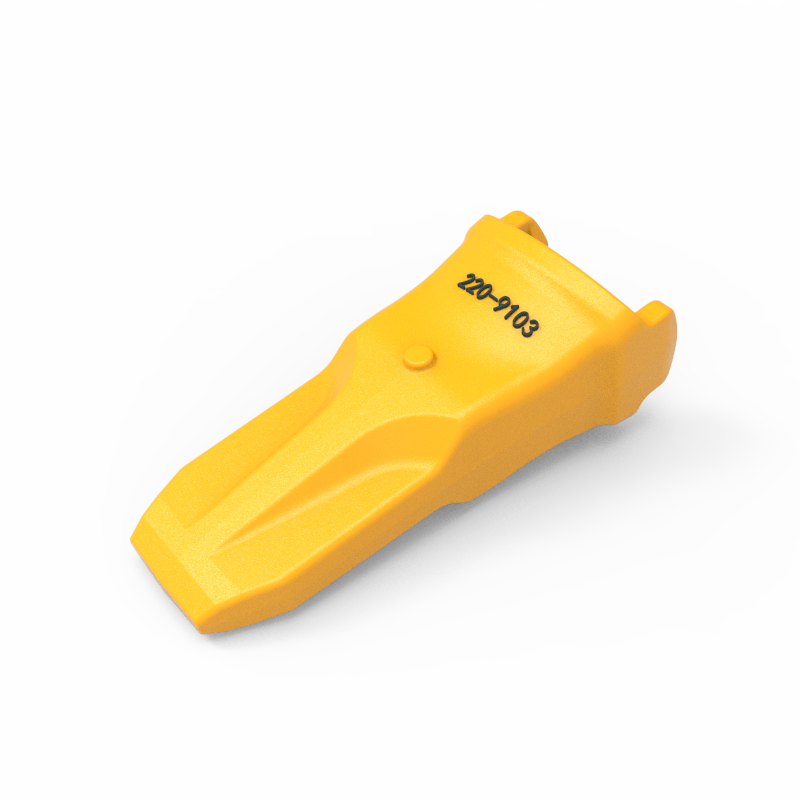
- OEM aftermarket. The buyer provides a part number (such as 220-9103 for the CAT K100 penetration plus tip) or a technical drawing, and the factory produces a tooth that matches the OEM specification exactly. This is the path for replacement parts on an existing fleet.
- ODM aftermarket. The buyer provides the application (machine model, bucket capacity, primary material being excavated), and the factory designs a new tooth profile and alloy to optimize for that application. This is the path for new machine designs or for a buyer who wants a private-label tooth with a custom profile.
For a typical replacement-part buyer, the OEM aftermarket path is the right choice. For an OEM machine manufacturer or a large fleet operator who wants a custom profile that outperforms the OEM part on a specific application, the ODM path unlocks performance gains that the aftermarket cannot deliver. Browse our full G.E.T. wear parts complete selection for the OEM aftermarket catalog and the ODM capability.
How to Qualify an Aftermarket Bucket Tooth Supplier: 9-Question Audit
The supplier audit is the most important step on the aftermarket path. Because the aftermarket market includes premium manufacturers, mid-tier suppliers, and trading companies, the only way to know which tier you are buying is to ask the questions and request the documentation before the first PO.
- Do you own a foundry? Premium aftermarket manufacturers own their foundry; trading companies resell. Ask for a foundry audit report or a video walk-through of the casting line.
- Can you provide a material test certificate (MTC) per batch? The MTC shows the actual alloy chemistry, not a generic spec. Premium suppliers publish it per heat.
- Can you provide a heat-treatment chart per batch? The chart shows the actual time-temperature profile. Premium suppliers publish it per batch.
- Can you provide a hardness test report per batch? The report shows the average hardness and the spread. Premium suppliers publish it per batch with the sample location noted.
- What tolerance band do you hold on the locking surfaces? Plus-or-minus 0.05 mm matches OEM. Plus-or-minus 0.10 mm or looser is the low-tier segment.
- Which OEM brands have you supplied to in the past 24 months? A premium aftermarket supplier will have a list of OEM-brand dealers and large fleet operators they have shipped to.
- What is the standard warranty on the OEM aftermarket product? 6-12 months is industry standard. Below 6 months is a red flag.
- Do you offer an abrasion credit program? The abrasion credit is the program that closes the cost-per-hour gap on the low-tier aftermarket. Premium suppliers offer it.
- What is your typical sample lead time and bulk lead time? Premium suppliers can confirm both within 3 working days of the RFQ. Suppliers who delay are typically the ones without the foundry under their own control.
How Does Join Machinery Approach an OEM Aftermarket Order?
Join Machinery has been exporting G.E.T. wear parts since 2006 and serves European and American construction and mining customers. Because our factory controls the casting, the heat treatment, and the finish machining in-house, we publish the documentation that the supplier audit asks for — the MTC per batch, the heat-treatment chart per batch, and the hardness test report per batch — and we stand behind a 12-month warranty on OEM-spec replacement teeth.
Our typical OEM aftermarket program runs in five steps: supplier qualification and sample submission, sample validation by the buyer, first production order with full batch documentation, ongoing production with quarterly hardness audits, and the abrasion credit return program for worn teeth by serial number. The cost-per-hour of a Join Machinery OEM aftermarket tooth is typically 20-30% lower than the OEM brand on a 12-month fleet cycle.
Key Takeaways
- OEM vs aftermarket is a cost-per-hour decision, not a per-piece decision — downtime and labor usually reverse the per-piece gap.
- The hardness test report is the only document that proves aftermarket quality — always request it.
- Warranty terms capture the wear-rate risk — 6-12 months is industry standard, premium suppliers extend to 18-24 months.
- Interchangeability depends on the tolerance band — plus-or-minus 0.05 mm matches OEM; plus-or-minus 0.10 mm or looser accelerates adapter wear.
- Lead time is comparable on stock SKUs but widens on long-tail part numbers — keep a 60-90 day inventory buffer on high-wear profiles.
Frequently Asked Questions About OEM vs Aftermarket Bucket Teeth
What is the real cost difference between OEM and aftermarket bucket teeth?
Aftermarket bucket teeth typically cost less per piece at the point of purchase. However, the real cost is cost per machine-hour, and aftermarket teeth that wear out 30 to 50 percent faster double the cost of planned downtime, the cost of the second installation, and the cost of bucket-and-adapter damage from a worn tooth that is not replaced on time. Across a 12-month fleet, OEM teeth almost always win on cost per hour even when they cost more per piece.
Which is harder: OEM or aftermarket bucket teeth?
Hardness depends entirely on the heat treatment and the alloy specification, not on whether the part carries the OEM brand stamp. Premium aftermarket manufacturers quote 46 to 52 HRC after heat treatment, which matches OEM specifications. Low-tier aftermarket products quote 38 to 42 HRC, which is the source of the “aftermarket wears faster” reputation. Always request the actual hardness test report rather than relying on the brand claim.
What warranty should I require on a bucket tooth OEM order?
The industry standard for OEM-spec bucket teeth is 6 to 12 months against breakage and abnormal wear under normal operating conditions. Premium suppliers extend to 18 to 24 months for non-impact applications. The warranty must explicitly define the wear threshold (typically the tooth can wear down to 70 percent of original height before the warranty is voided) and the operating condition exclusions (rock tooth warranty is voided if used in general digging).
What is the typical lead time for an aftermarket bucket tooth order?
For stock aftermarket SKUs that match a common part number (such as 220-9103 for CAT K100), most China-based aftermarket suppliers ship in 7 to 15 working days for sample orders and 20 to 30 working days for full container orders. For custom OEM orders with a new tooth profile, add 25 to 40 working days for tooling and sample validation. For replacement of a low-volume part number, lead time can extend to 45 to 60 working days because the supplier must restart the production line.
Are aftermarket bucket teeth interchangeable with OEM teeth on the same adapter?
Yes, most premium aftermarket manufacturers produce teeth that fit the OEM adapter exactly because they are copying the OEM geometry. The interchangeability depends on the tolerance band: a plus-or-minus 0.05 mm tolerance band on the locking surfaces matches OEM; a plus-or-minus 0.2 mm or looser band can cause tooth adapter mismatch and premature wear. Confirm the tolerance band in writing before placing the order.
What is the difference between OEM and ODM on a custom bucket tooth order?
OEM (Original Equipment Manufacturer) means the buyer provides the part number reference or the technical drawing, and the factory produces a tooth that matches the OEM specification. ODM (Original Design Manufacturer) means the buyer provides the application and the operating conditions, and the factory designs the tooth profile and alloy to match. OEM aftermarket is the typical path for replacement parts; ODM is the path for new machine designs or for a buyer who wants a private-label tooth.
Request a Bucket Tooth Quote
Send us the part number, the application, and the target volume. Our sales team will return a fixed quote within 3 working days, with the MTC, heat-treatment chart, and hardness report on the sample shipment.
Post time: Sep-11-2026