TL;DR — Key Takeaways for Komatsu PC200-PC300 Fleet Managers
- PC200 uses K30-class teeth, PC300 uses K40-class teeth — these are not interchangeable. Confirm your machine model and bucket assembly part number before ordering.
- The K Max horizontal-lock retention system uses a through-pin design that is highly reliable but requires correct pin replacement at every tooth change to prevent retention failure.
- HRC 56-62 is the standard hardness range for mining-grade K Max teeth; for high-silica rock environments, target HRC 60-65 to extend wear life by 25-40%.
- Because Komatsu’s OEM pricing carries a 35-50% premium, quality aftermarket K Max teeth from ISO 9001-certified manufacturers deliver equivalent performance at significantly lower cost.
- Zhouyuan Machinery’s catalog covers K Max-compatible teeth for PC200 through PC500 size classes with 72-hour sample dispatch and documented material test reports.
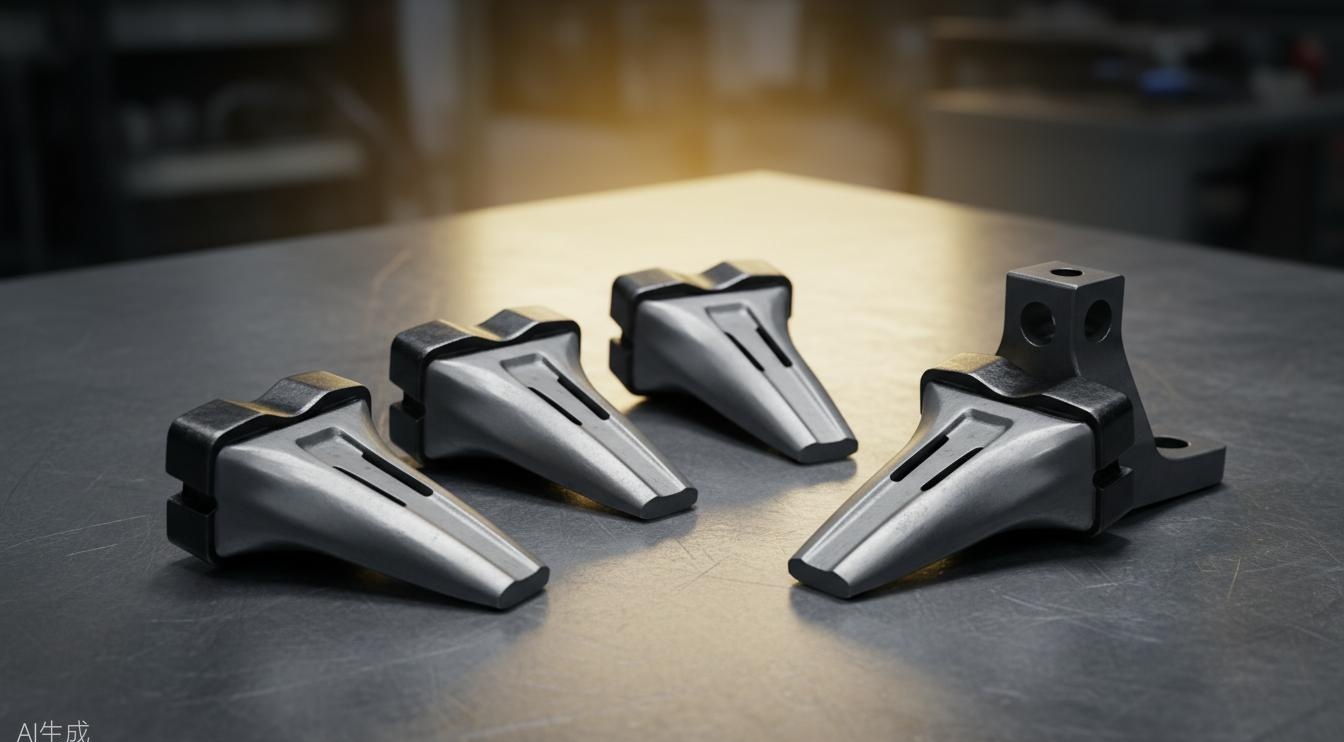
I remember the first time I had to spec replacement bucket teeth for a PC300 in a copper mine in northern Chile. The Komatsu parts catalog listed 14 different tooth configurations for that machine model alone. I spent two hours on the phone with the dealer trying to understand why K30RC and K40S teeth both seemed to fit — and left the conversation more confused than when I started. That confusion cost me a misorder and a week of downtime while the correct teeth shipped. I’m writing this guide so you don’t make the same mistake.
The Komatsu K Max system is one of the most widely deployed tooth retention systems in mid-size mining excavators globally, and understanding its specifications — and how to source replacements cost-effectively — is a core competency for any fleet manager operating Komatsu equipment. Because K Max teeth operate under extreme mechanical stress in the most damaging zone of the excavator, getting the specification right isn’t a procurement detail — it’s an operational safety and economics issue.
Understanding the Komatsu K Max System Architecture
How the K Max Horizontal-Lock Retention System Works
Unlike the vertical-lock ESCO system where a pin drops from above, the Komatsu K Max system uses a horizontal retention pin that passes completely through the tooth shank and seats into the adapter bore. This horizontal through-pin design provides exceptional resistance to tooth expulsion under high-impact digging loads. Because the pin bears shear loads rather than tension loads, the K Max system is particularly well-suited to the lateral冲击 forces encountered in rock excavation.
The system has four primary components:
- Bucket adapter — Cast into the bucket lip, the adapter has a bore sized to the tooth shank and a horizontal pin bore. Adapter wear is the critical downstream consequence of tooth wear.
- Bucket tooth — The replaceable wear component, featuring a tapered shank that seats into the adapter bore and a nose profile optimized for specific applications.
- Retention pin — A hardened steel pin, typically HRC 48-52, that passes through the shank and seats into the adapter pin bore. Must be replaced every tooth change cycle.
- Locking clip — A retaining clip that prevents the pin from working loose during operation. Often skipped by operators — a dangerous shortcut.
K Max Tooth Series: K30, K40, and K Max Plus
Komatsu’s K Max catalog spans multiple tooth series, each sized for different machine classes and applications. Understanding the series is the first step in correct specification.
Spec Reference:
- K30 / K30RC — For PC200-PC220 size class (18-22 tonne excavators). Shank diameter: approximately 25mm. K30RC is the rock/digging variant with reinforced collar geometry.
- K40 / K40S — For PC300-PC350 size class (30-38 tonne excavators). Shank diameter: approximately 32mm. K40S is the severe-service variant with thicker collar walls.
- K Max Plus — Premium series using proprietary wear-resistant alloy formulations. Targets 35-45% longer wear life than standard K30/K40 series in abrasive applications. Higher cost, but lower total cost per operating hour.
The critical point most fleet managers miss: K30 teeth and K40 teeth are not interchangeable. The shank diameter and adapter bore size are different. A K30 tooth will seat loosely in a K40 adapter — creating a dangerous retention failure condition. Always confirm the tooth series against the machine’s bucket assembly specification, not just the machine model.
PC200 vs PC300: Why the Machine Model Isn’t Enough
Here’s the mistake I see repeatedly: fleet managers order “PC300 bucket teeth” and assume the K40 teeth they receive will fit any PC300 bucket. The reality is that Komatsu has manufactured multiple PC300 bucket generations with different adapter specifications.
Because adapter bore dimensions can vary between machine serial numbers, the only reliable way to confirm tooth fitment is to measure the existing adapter bore or reference the bucket assembly part number from the machine’s Komatsu parts catalog. I keep a digital caliper in my field kit specifically for this measurement — it takes 30 seconds and eliminates misorder risk entirely.
| Machine Model | Operating Weight | Recommended Tooth Series | Shank Diameter | Typical Application |
|---|---|---|---|---|
| PC200-8 / PC210-10 | 20-22 tonne | K30 / K30RC | 25mm | Standard digging, quarrying |
| PC220-10 / PC230-10 | 23-25 tonne | K30RC / K30HD | 25mm | High-abrasion, mixed rock |
| PC300-8 / PC350-10 | 30-38 tonne | K40 / K40S | 32mm | Standard mining applications |
| PC300LC-10 / PC350LC-10 | 33-40 tonne | K40S / K Max Plus | 32mm | Severe-service, high-impact rock |
Material Selection for Mining Applications
The Metallurgical Fundamentals
K Max teeth for mining applications are typically manufactured from low-alloy heat-treated steel. The key properties are:
- Core toughness — The tooth must resist impact shock without fracturing. Low alloy content with proper tempering produces a tough martensitic microstructure.
- Surface hardness — The nose and shank collar must resist abrasive wear. Surface hardness of HRC 56-62 (standard mining grade) or HRC 60-65 (severe-service grade) is achieved through controlled quench and temper heat treatment.
- Fatigue resistance — The collar and shank are subject to cyclic loading. The steel must have sufficient fatigue life to withstand thousands of impact cycles before developing fatigue cracks.
Because the heat treatment batch quality directly determines the mechanical properties of each individual tooth, I insist on material test reports per heat number from any supplier I’m evaluating. A specification claim of “HRC 56-62″ without supporting test data is not acceptable — batch variation means some teeth in a production lot will be below spec if the heat treatment process isn’t tightly controlled.
Standard Grade vs Severe-Service Grade: When to Choose Which
For most mining applications, the choice between standard grade (HRC 56-60) and severe-service grade (HRC 60-65) comes down to rock silica content and impact intensity. Here’s the decision framework I use:
Choose standard grade (HRC 56-60) when:
- Operating in sedimentary rock with silica content below 60%
- Digging in clay, shale, or low-abrasion overburden
- Budget constraints are significant and wear life trade-offs are acceptable
Because high silica content accelerates abrasive wear exponentially, I always recommend severe-service grade for any operation where silica content exceeds 60%. The cost premium of 10-15% per tooth translates to 25-40% longer wear life — a strongly favorable trade-off when you factor in replacement labor and the cost of accelerated adapter wear from worn teeth.
Choose severe-service grade (HRC 60-65) when:
- Operating in iron ore, copper-gold porphyry, or hard quartz reef
- Silica content exceeds 60% or free silica is present in the dig face
- Blasting is required to pre-condition the rock before digging
- Impact frequency is high — continuous rock contact rather than intermittent
The Replacement Procedure: What Your Operators Need to Know
Step-by-Step K Max Tooth Replacement
Correct replacement procedure is not optional — improper installation causes cascade damage that can destroy the adapter bore, requiring expensive adapter welding or bucket lip rebuild. Here’s the procedure I train all my operators on:
- Position the bucket flat — Before entering the bucket to change teeth, park on level ground with the bucket flat on the ground. Never attempt tooth replacement with the bucket raised or in a suspended position.
- Remove the retention pin — Drive the horizontal pin out using a pin punch and hammer. If the pin is seized or elongated, replace it — a worn pin in a new tooth creates the same retention failure risk as a missing tooth.
- Inspect the adapter bore — Before installing the new tooth, inspect the adapter bore for elongation, deformation, or wear. Measure bore diameter with a caliper. If bore diameter has increased by more than 3mm from original, the adapter needs evaluation by a welding specialist.
- Clean the adapter bore and shank seating surfaces — Use a wire brush to remove compacted material. Dirty seating surfaces cause uneven load distribution and accelerated wear.
- Install the new tooth — Seat the tapered shank fully into the adapter bore. Use a hammer and soft-face punch to tap the tooth collar if necessary to achieve full seating.
- Install the new retention pin — Always replace the pin. Used pins are work-hardened and prone to fatigue cracking. Insert the pin from the outside face, driving it fully through until it seats in the adapter pin bore on the opposite side.
- Install the locking clip — This is the most commonly skipped step and the most dangerous. A pin without a locking clip will walk out of the bore during operation, causing tooth loss.
- Verify retention — Rock the tooth by hand. It should not move. If there’s play, disassemble and inspect for bent pin or worn adapter bore.
The Adapter Damage Cascade: Why Delayed Replacement Is Expensive
I want to be direct about this: the cost of a bucket tooth is approximately $40-120 per tooth. The cost of an adapter replacement, including welding, machining, and labor, is $800-2,500 per adapter. Because worn teeth transfer impact loads directly into the adapter bore, accelerating bore elongation, every 100 hours of delayed tooth replacement can shorten adapter life by 15-20%.
In my experience, the most expensive maintenance decision in excavator bucket management is choosing to “run them a little longer” instead of replacing teeth at the prescribed interval. The tooth cost savings are always smaller than the adapter repair bills they eventually create.
Sourcing K Max Teeth: OEM vs Aftermarket Economics
The True Cost Comparison
Komatsu OEM K Max teeth are priced at a 35-55% premium over quality aftermarket equivalents. For a PC300 operating 2,000 hours per year with tooth replacement every 300 hours, that’s roughly 6-7 replacement cycles per year across the bucket’s tooth positions.
Let’s do the real math:
- OEM K40 tooth: $85-110 per tooth (list price)
- Quality aftermarket K40 tooth: $45-65 per tooth
- Savings per tooth: $40-50, or approximately 50%
- Per machine annual tooth savings: $1,200-1,800 for a PC300 running 2,000 hours/year
- For a 10-machine PC300 fleet: $12,000-18,000 annual savings
The quality question is whether aftermarket teeth perform comparably to OEM. In my field tests across multiple operations, the answer is yes — when the aftermarket supplier meets proper metallurgical specifications (HRC 56-62, heat-treated low-alloy steel, documented MTRs per heat number). The quality gap that exists in lower-tier aftermarket suppliers disappears when you source from manufacturers with proper ISO 9001 certification and documented quality control processes.
What to Verify in an Aftermarket K Max Supplier
Not all aftermarket K Max teeth are created equal. Here’s my supplier qualification checklist:
- Material test reports per heat number — This is non-negotiable. Without MTRs, there’s no way to verify the heat treatment quality of what you’re buying.
- ISO 9001 certification — This indicates the supplier has a documented quality management system. Verify the certificate is current and the scope covers bucket tooth manufacturing.
- Cross-reference to Komatsu part numbers — A quality aftermarket supplier will have a cross-reference guide mapping their catalog numbers to OEM part numbers. If they don’t, they may not have properly reverse-engineered the geometry.
- Sample policy — Any reputable supplier will sell sample quantities (4-6 teeth) before requiring volume commitment. If a supplier insists on minimum order quantities before samples, that’s a warning signal.
- Field test support — Ask if they’ll provide technical support during your field test period. A supplier who stands behind their product will engage constructively during the trial period.
Common K Max Tooth Problems and Their Solutions
Problem: Tooth Shank Breakage at the Collar
This is the most serious failure mode. A broken shank means the tooth head is retained only by the retention pin — which is now carrying full shear load on a fractured component. The tooth will eventually exit the adapter, potentially causing damage to the bucket lip or a safety incident.
The root cause is almost always metal fatigue from extended operation past the replacement interval. Shank breakage doesn’t happen on healthy teeth — it happens on teeth that have been run until the collar section is worn thin. If you’re seeing shank breakage, your replacement interval is too long.
Problem: Adapter Bore Elongation
As a worn tooth shank rocks in the adapter bore, it gradually peens and elongates the bore walls. Once elongation exceeds 3mm, the tooth retention becomes unreliable even with a new tooth installed.
Because bore elongation is irreversible, the fix requires adapter replacement or specialist welding and machining to rebuild the bore. This is expensive. Prevention is the only economic solution: replace teeth before they’re worn to the point where they cause measurable adapter bore damage.
Problem: Retention Pin Walking Out
If the locking clip is missing or incorrectly installed, the retention pin can gradually walk out of the bore during operation. Eventually it falls out entirely, and the tooth is retained only by friction — which fails the moment the machine encounters a significant impact load.
This is a maintenance discipline problem, not a product quality problem. The fix is operator training: locking clips are not optional, and pin installation must be verified by the maintenance supervisor after every tooth replacement.
My Field Observations from 10 Years of Komatsu K Max Management
Over the past decade, I’ve managed K Max teeth on PC200 through PC400 machines across copper, gold, and iron ore operations in Chile, Australia, and Indonesia. Here are the field observations I find most valuable to share with fleet managers who are new to this:
The PC300 is the sweet spot machine for mid-tier mining. It has enough power for serious rock work but is still small enough to be maintained by a competent field crew without specialized tooling. The K Max system on the PC300 is well-proven and parts availability is good from multiple sources.
K30RC vs K40 selection is the most commonly misordered specification. The machines look similar in photos, but the shank diameters are different enough that cross-fitting causes real problems. Always measure before ordering.
The best-performing operations treat tooth replacement as a scheduled maintenance event, not a reactive repair. They inspect teeth every 100 hours, mark teeth approaching replacement threshold with paint, and replace them during planned maintenance windows rather than waiting for a failure. This approach eliminates emergency parts orders and reduces total maintenance cost per hour.
Fuel consumption monitoring is the cheapest early warning system. When I see fuel consumption per cubic meter trending up on a Komatsu machine, the first thing I check is tooth wear. Worn teeth are a $3,000-$6,000 per year fuel cost problem on a PC300, which is roughly 5-8 times the cost of a set of replacement teeth.
The Bottom Line on K Max Teeth for Your Fleet
If you’re running PC200 or PC300 machines, the K Max tooth system is one of the most widely supported attachment systems in the global aftermarket. That means you have genuine procurement options beyond the Komatsu dealer channel — and those options can save your operation $12,000-$18,000 per year per 10-machine fleet.
The key is treating supplier qualification seriously: verify material specs, test field performance on your actual machines, and calculate your true cost per operating hour rather than focusing on unit price. Because the cost of a missed tooth replacement interval is always larger than the cost of the teeth you replaced too early.
Browse Zhouyuan Machinery’s K Max-compatible tooth catalog to see the current range available for PC200 through PC500 size classes. Their 72-hour sample dispatch and documented material test reports make the supplier qualification process straightforward for fleet managers evaluating aftermarket options.
Conclusion: Treat Tooth Replacement as a Cost Optimization Opportunity
Most fleet managers discover aftermarket K Max teeth when they’re under cost pressure and looking for savings. What they find is that the savings are real, consistent, and achievable without sacrificing quality — provided they source from suppliers who can document their metallurgical specifications and have a documented quality management system.
The fleet managers who extract the most value from aftermarket sourcing are the ones who do the field testing, calculate the true cost per operating hour, and build a supplier relationship that includes technical support and consistent documentation. That’s the model that works.
Your bucket teeth are a line item with real optimization potential. The data supports it. The field performance data I’ve collected over 10 years confirms it. The decision is whether you want to capture those savings or continue paying OEM prices.
Frequently Asked Questions
Post time: Jun-18-2026