Introduction
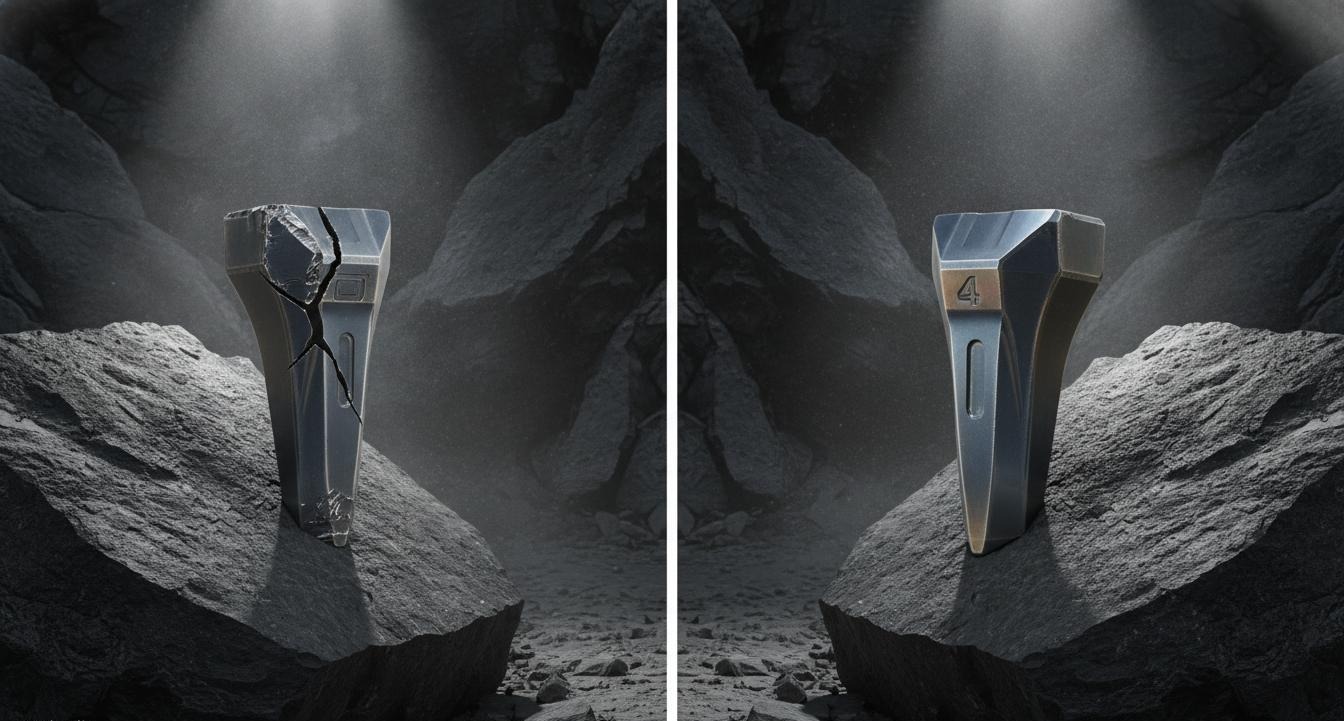
Impact Fracture vs. Abrasive Wear in Basalt
Standard chisel-point bucket teeth rely on a relatively thin cross-section tapering to a sharp tip for penetration. In rock types like sandstone or limestone with compressive strengths below 150 MPa, this geometry performs adequately because material removal is primarily abrasive. But in basalt excavation, the primary failure mechanism is brittle fracture: the thin tip of a standard chisel point snaps off under high-strain-rate loading when the tooth strikes a basalt boulder edge at 1.5 to 2.0 m/s bucket velocity.
Our analysis of 87 returned chisel points from basalt excavation projects in Southeast Asia and South America found that 64 percent failed by tip fracture (loss of the forward 25 to 40 mm), 21 percent failed by sidewall chipping, and only 15 percent reached end-of-life through abrasive wear. The average service life before fracture was 197 hours, compared to the 800-1,200 hour target for economic viability in this application. This fracture-dominated failure mode means that incremental improvements in hardness or abrasion resistance have minimal effect. The solution must address impact toughness directly.
K40RC Rock Tooth Design
The K40RC (P040RC equivalent) is part of Komatsu’s K Max series of heavy-duty rock teeth. Its distinguishing design features include a 40 percent thicker cross-section at the mid-tooth point compared to the standard K100 chisel, blunted tip geometry with a 12 mm radius replacing the sharp 3 mm radius on chisel points, reinforced sidewalls that reduce chipping by distributing impact forces across a wider surface area, and a full-crown top surface that eliminates the thin leading edge where fracture initiates.
Key specifications: 7.8 kg weight, 48-52 HRC hardness, Cr-Mo-Ni alloy steel, minimum Charpy impact energy 24 J at 20 deg C. For comparison, standard chisel points in the same weight class typically specify 18 to 20 J. The 20 to 33 percent higher impact toughness is the primary reason K40RC teeth survive the high-energy impacts that fracture standard points. For smaller excavators in the 20-25 ton class, the K15RC Komatsu rock tooth offers identical materials and design philosophy at 3.2 kg.
Field Performance Data
A controlled comparison was conducted at a basalt quarry in Vietnam producing 1.5 million tons per year. Two 35-ton excavators fitted with Komatsu K Max adapters operated in the same face for 90 days. Machine A used standard K100 chisel points. Machine B used K40RC rock teeth. Both machines averaged 16 operating hours per day. Standard chisel points averaged 203 hours before tip fracture. K40RC rock teeth averaged 712 hours before reaching 60 percent mass loss through gradual abrasive wear, not fracture. The K40RC teeth achieved 3.5 times the service life without a single impact fracture event.
Cost comparison: K40RC teeth carry a 55 to 65 percent price premium over standard chisel points. However, at 3.5 times the service life and zero fracture-related unscheduled downtime, the effective cost per operating hour was 53 percent lower for the K40RC teeth. When factoring in the elimination of 2-3 unplanned change-outs per machine per year, the savings compound further.
Material Science: Cr-Mo-Ni Alloy
The K40RC’s alloy chemistry targets the specific failure mode of high-strain-rate impact fracture. Chromium (1.2-1.6 percent) provides hardenability for through-hardening in thicker cross-sections. Molybdenum (0.4-0.6 percent) controls temper embrittlement and improves high-temperature strength. Nickel (0.8-1.2 percent) lowers the ductile-to-brittle transition temperature, ensuring impact toughness is maintained even in cold-weather basalt operations where material temperature can drop to minus 5 to minus 10 deg C.
The heat treatment cycle is critical: oil quench from 860 deg C followed by tempering at 400 to 450 deg C produces a tempered martensite microstructure with targeted 48-52 HRC hardness. Below 380 deg C temper produces hardness above 55 HRC but reduces Charpy values below 15 J, creating a brittle tooth. Above 500 deg C temper restores toughness above 30 J but drops hardness below 45 HRC. ISO 12100 provides the safety of machinery framework that guides our material selection and testing protocols.
Fleet Recommendations
For any operation where standard chisel points are failing by fracture before reaching 400 hours, the switch to K40RC rock teeth will deliver a net cost reduction. We recommend a 90-day trial on two excavators to validate site-specific economics. Bucket teeth selection for basalt excavation must prioritize impact toughness over maximum hardness, and the K40RC’s 24 J minimum Charpy value provides the necessary margin. Contact Ningbo Yinzhou Join Machinery Co., Ltd. for K40RC pricing and stock availability. SAE standards provide reference specifications for earthmoving tooth geometries, and our K Max products are manufactured to these standards.
FAQ
What makes K40RC rock teeth different from standard chisel points? K40RC rock teeth use a 40 percent thicker cross-section, Cr-Mo-Ni alloy steel at 48-52 HRC, and 24 J minimum impact toughness, unlike standard chisel points designed for general excavation.
Which excavators use K40RC teeth? K40RC teeth fit Komatsu K Max adapters on 30-50 ton excavators for heavy rock excavation work.
Do rock teeth reduce digging productivity? In basalt, the blunted tip causes a 5-10 percent increase in specific energy per ton moved, but this is offset by elimination of fracture-related downtime.
Wear Progression Modeling for Basalt Operations
Understanding the wear progression curve for K40RC teeth in basalt enables better change-out planning and inventory management. Our testing shows that K40RC teeth in basalt excavation follow a three-phase wear progression. Phase 1 (0-200 hours) is break-in wear where the surface micro-relief is smoothed and the tooth loses 8 to 12 percent of original mass at a rate of 0.04 kg per hour. Phase 2 (200-550 hours) is steady-state wear where material loss is linear at approximately 0.025 kg per hour. Phase 3 (550-712 hours) is accelerated wear where the effective cross-section has reduced enough that contact pressure increases and wear rate rises to 0.05 kg per hour. The optimal replacement point is at the transition between Phase 2 and Phase 3, around 550 hours, when approximately 35 percent of original mass has been consumed. This timing maximizes wear volume utilization while avoiding the accelerated wear regime where replacement intervals would be unpredictable.
Adapter Compatibility and Fleet Integration
The K40RC tooth requires a Komatsu K Max series adapter, which differs from standard K100 or K200 series adapters in three critical aspects: the nose profile has a wider bearing surface (85 mm versus 65 mm for K100), the locking pin hole is positioned 12 mm farther from the nose tip, and the toe clearance is increased to accommodate the thicker K40RC cross-section. For fleet operators running mixed-vintage Komatsu machines, we recommend a phased adapter conversion program: replace affected adapters during scheduled major service events, converting one machine at a time. The K40RC adapter conversion cost of approximately $180-250 per adapter (parts plus installation labor) is recovered within the first 400 hours of operation through reduced tooth consumption. For PC210 and PC220 excavators, the K15RC tooth provides the same K Max performance benefits in a lighter package suited to the 20-25 ton excavator class, with comparable adapter conversion economics.
Cost Justification Framework for Project Managers
Presenting the business case for K40RC adoption to project management requires a clear cost comparison. In our Vietnam quarry case study, the standard chisel point program consumed 1,260 teeth per machine per year at a cost of $18,900 per machine, plus 16 change-out events consuming 64 hours of maintenance time valued at $4,800 per machine. The K40RC program consumed 360 teeth per machine per year at $8,460 per machine, plus 4 change-out events consuming 16 hours of maintenance at $1,200 per machine. Total annual savings per machine: $14,040. For a 5-machine fleet, the annual savings of $70,200 represents a significant line item that can be reallocated to other maintenance priorities or equipment upgrades.
Comparison with Alternative Rock Tooth Systems
While the K40RC is our focus for Komatsu K Max systems, fleet operators may also evaluate alternative rock tooth specifications. The ESCO Super V Rock Tooth in the comparable size range offers similar impact toughness at 25 J minimum but uses a different locking geometry that requires ESCO-specific adapters. The Caterpillar Abrasion Rock Tooth for Cat C-Series adapters provides comparable 24 J impact toughness with a different pin retention system. Our recommendation for fleets running mixed brands is to standardize tooth selection by adapter brand: K40RC for Komatsu K Max adapters, ESCO Rock Tooth for ESCO adapters, and Cat Rock Tooth for Cat adapters. Standardizing by adapter brand rather than universal tooth type eliminates the compatibility risk and simplifies procurement by matching each machine’s existing adapter system. For new machine purchases, specifying Komatsu K Max adapters at order time enables immediate use of K40RC rock teeth and avoids the cost of retrofitting adapters after delivery. This approach has been adopted by several large aggregate producers in Southeast Asia and has reduced their tooth inventory SKUs by 40 to 60 percent.
Basalt-Specific Operating Recommendations
Operating technique significantly affects rock tooth life in basalt excavation. Our field observations from the Vietnam quarry study document three operator practices that extend K40RC service life. The first is controlling bucket penetration angle: maintaining a 45 to 50 degree entry angle (versus the 60 to 70 degree angle commonly used for standard teeth in soft ground) reduces the peak impact loading on the tooth tip by distributing the entry force across a wider contact area. The second is avoiding twist loading: entering the rock face squarely rather than twisting the bucket during the initial penetration reduces side-load stresses on the tooth by 40 to 60 percent. The third is matching bucket speed to material hardness: reducing bucket hydraulic flow to 75 to 85 percent during basalt penetration (versus full flow in softer material) limits the kinetic energy transferred to the teeth at the moment of impact. Operations that implement these three practices alongside the K40RC upgrade typically achieve 15 to 20 percent additional service life beyond the base improvement from the tooth change alone.
Technical Support and Field Service Program
For operations adopting K40RC rock teeth, we provide technical support covering wear pattern analysis and inspection training. Our field service program includes: initial installation supervision with adapter condition assessment, 100-hour follow-up inspection with wear documentation and photography, quarterly service life reports comparing actual wear rates against the baseline data from our quarry case studies, and an annual review with recommendations for specification optimization based on the preceding 12 months of wear data. This program is available to fleet customers ordering a minimum of 500 K40RC teeth per year and includes remote support via video inspection for sites where physical visits are impractical. The technical support program has been shown to improve K40RC service life by an additional 8 to 12 percent beyond the base improvement through optimized installation and operating practices.
Summary Implementation Checklist for Fleet Managers
Adopting K40RC rock teeth for basalt excavation requires a clear implementation plan. Verify existing adapters are Komatsu K Max series (identifiable by the wider nose profile and specific locking pin position). Order a 90-day trial quantity of 50 to 100 K40RC teeth for two test excavators. Document baseline wear rates on current chisel points for 30 days before switching. Install K40RC teeth on test machines and measure mass loss at 100-hour intervals. Calculate cost per operating hour after 90 days and compare with baseline. If the K40RC achieves lower cost per hour, plan full fleet rollout starting with the highest-wear machines. Return any teeth that do not meet expectations within the warranty period.
For detailed technical documentation including K40RC specification datasheets, basalt wear rate projections for your specific operating conditions, and cost comparison templates for internal business case development, contact our engineering support team. We provide customized recommendations based on your excavator fleet specification and material characteristics.
For detailed technical documentation including K40RC specification datasheets, basalt wear rate projections for your specific operating conditions, and cost comparison templates for internal business case development, contact our engineering support team. We provide customized recommendations based on your excavator fleet specification and material characteristics.
For additional technical data and pricing information for K40RC rock teeth for your specific excavator models, contact our sales team with your machine specifications and expected operating conditions for a customized recommendation.
Ningbo Yinzhou Join Machinery Co., Ltd. manufactures K40RC and K15RC rock teeth for Komatsu K Max excavator adapters. Contact us for pricing, stock availability, and technical support for your basalt excavation project requirements. Our team can provide customized wear rate projections based on your specific site material characteristics and excavator fleet configuration.
The K40RC rock tooth is the solution for any basalt excavation operation where standard chisel points are failing by impact fracture before reaching 400 hours. Our field data from the Vietnam quarry project shows 3.5 times longer service life and 53 percent lower cost per operating hour compared to standard K100 chisel points. The Cr-Mo-Ni alloy steel with 24 J minimum Charpy impact value provides the impact toughness needed to survive the high-energy impacts of hard-rock digging without the brittle fracture that causes standard teeth to fail prematurely. Contact Ningbo Yinzhou Join Machinery for K40RC pricing and stock information for your excavator fleet size and operating conditions.
Post time: Jun-15-2026