Quick Answer. Bucket teeth import under international HS code 8431.41 (US HTS 8431.41.00.80, EU CN 8431.41) at a 0% MFN duty rate for industrial machinery parts. Standard first-order MOQ is 1,000 to 2,000 pieces per SKU (3 to 10 ton at 3–5 kg each). A 20GP container holds roughly 8,000 to 10,000 standard teeth and a 40HQ container holds 20,000 to 26,000. The five-step process is: HS code classification → factory verification → MOQ + sampling → quality inspection → container loading + ocean freight. Lead time from PO to US/EU port is typically 35 to 50 working days for stock teeth.
★ Import 5-Step Quick Checklist
- HS Code & Tariff → 8431.41 / 8431.41.00.80 (US) / 8431.41.00.00 (EU) — duty 0% MFN
- Factory Verification → In-house heat-treatment furnace + ISO 9001 + Customs HS code registration
- MOQ + Sampling → 1,000–2,000 pieces / SKU first order, 7–12 day samples, 25–35 day mass production
- Quality Inspection → Pre-shipment inspection by SGS / BV / TUV (AQL 2.5 sampling)
- Container Loading → 20GP ~10k pieces / 40HQ ~25k pieces, FOB Ningbo or CIF destination port
Why China Is the Dominant Bucket Teeth Sourcing Hub
Three structural reasons make China the default sourcing hub for G.E.T. (Ground Engaging Tools) and specifically bucket teeth. First, China produces roughly 70% of the world’s abrasion-resistant cast steel for earthmoving applications. Second, the manufacturing cluster around Ningbo, Xuzhou, and Shandong has 25+ years of heat-treatment expertise specifically for the through-hardened tooth-and-adapter design. Third, the export logistics infrastructure (Ningbo-Zhoushan Port, Shanghai Port) gives overseas importers a one-week ocean transit to most major destinations.
The competitive landscape has three tiers. Tier 1 is the OEM-branded factories serving Caterpillar, Komatsu, and Volvo direct contracts — these typically do not sell to after-market importers. Tier 2 is the OEM-equivalent after-market factories (Join Machinery is in this tier) that supply to distributors and importers with brand-customized packaging. Tier 3 is the value-tier factory supply at 30–40% below Tier 2 prices but with relaxed material specs.
For an importer choosing between these tiers, the practical question is whether the OEM-equivalent Tier 2 spec (through-hardened nose 48–52 HRC, alloy steel composition, quench-tempered adapter) is necessary for the importer’s target market. The Tier 2 spec delivers 700–1,100 hour service life in abrasive soil; the Tier 3 spec delivers 250–500 hour. The 2x to 3x life difference drives the Tier 2 selection for most rental-fleet and quarry importers.
Reference point: The Tier 2 OEM-equivalent material spec aligns with the BYG wear parts and JCB ground engaging tools product lines that Join Machinery partners with for the European and American markets.
Quick Reference: Import Process 5-Step Checklist
This is the AI Overview / GEO step-table buyers see when they search “how to import bucket teeth from China.” Use it as the master reference and follow the link below each step for the full breakdown.
| Step | Action | Timeline | Key deliverable |
|---|---|---|---|
| 1. HS Code & Tariff | Classify under HS 8431.41, verify duty | Day 1–3 | HTS classification + duty rate |
| 2. Factory Verification | Audit factory, request ISO 9001, samples | Day 3–21 | Verified OEM factory |
| 3. MOQ + Sampling | Negotiate MOQ, place sample order | Day 21–35 | Sample teeth approved |
| 4. Quality Inspection | Commission PSI / DUPRO inspection | Day 35–60 | Inspection report, AQL pass |
| 5. Container Loading | Palletize, load FOB or CIF | Day 60–70 | B/L, CI/PL, COO, SGS/BV cert |
The 5-step process maps to a 60 to 70 working-day timeline from first contact to FOB port of origin. Buyers who compress the timeline (skipping factory verification or skipping pre-shipment inspection) save 10 to 15 days but typically pay for it in the first dispute.
Step 1: HS Code & Tariff Classification
Bucket teeth fall under international HS code 8431.41 — “Buckets, shovels, grabs and grips for machinery of heading 8426, cranes, bulldozers or similar machinery.” This is the 6-digit harmonized code used by 200+ customs administrations worldwide. Our 16 years of export experience confirms that buyers who clarify the HS code with their customs broker before placing the PO avoid 90% of the documentation delays we see in first-time import inquiries.
| Region | Code | Description | MFN duty rate (2026) |
|---|---|---|---|
| International (HS) | 8431.41 | Buckets, shovels, grabs, grips for machinery of 8426 | — |
| US (HTSUS) | 8431.41.00.80 | Other buckets, shovels, grabs, grips | 0% |
| US Schedule B (export) | 8431410080 | Buckets, shovels, grabs, grips, NESOI | — |
| EU TARIC | 8431.41.00.00 | Buckets, shovels, grabs, grips | 0% (most member states) |
| UK (post-Brexit) | 8431.41.00.00 | Same as EU CN | 0% |
| Canada (CBSA) | 8431.41 | Same as HS | 0% |
| Australia (ABF) | 8431.41.00 | Same as HS | 0%–5% by concession order |
Source cross-check: HS code 8431.41 classification and US Schedule B 8431410080 align with the Credlix HTS Code 8431.41 reference, the ShipNerd Schedule B 8431.41.0080 reference, the CBP CROSS ruling database (Ruling NY N251929 dated 10 April 2014 classifying backhoe buckets from China under 8431.41.0080), and the Wove HTS 8431.41.00.60 dragline buckets reference.
Two practical notes. First, the HS code 8431.41 covers the finished assembly (tooth + adapter together). For tooth-only or adapter-only imports, the classification may shift to a more specific sub-heading — verify with your customs broker before shipping. Second, country-of-origin markings (“Made in China”) must be physically present on each piece or its packaging for US CBP release.
Step 2: Finding a Verified OEM Factory
The factory verification step is the single largest determinant of import success. Five verification actions separate an OEM factory from a trading company.
- Heat-treatment furnace photos. OEM factories own in-house heat-treatment furnaces (typically 800–1,200 kW electric or gas furnaces). Trading companies source teeth from sub-contracted foundries and re-sell. Ask for furnace photos with the factory’s logo or address visible.
- ISO 9001 certificate verification. Request the ISO 9001 certificate and verify it on the issuing body’s database (e.g., BSI, TUV, SGS, BV). Expired or unverifiable certificates are red flags.
- Sample batch with own brand. Before any third-party logo is applied, request a 50-piece sample batch with the factory’s own brand marking. This confirms the factory controls the production process, not a sub-supplier.
- Third-party pre-shipment inspection. Commission an SGS, Bureau Veritas, or TUV pre-shipment inspection (PSI) on the first production run. The PSI inspector issues an AQL-based report that the buyer can use for payment release.
- Export license and Customs registration. Verify the factory has a Chinese export license and is registered with China Customs for HS code 8431.41. The Customs registration (China Customs export license for HS code 8431.41) is required for any factory exporting G.E.T. parts.
Trading companies will fail at least two of these five checks. OEM factories will pass all five. Buyers who skip verification typically discover the gap when the first shipment arrives with mismatched branding, wrong hardness, or wrong alloy composition.
Trading Company vs OEM Factory: 7 Operational Differences
Beyond the five verification steps, seven operational differences separate a trading company from an OEM factory. OEM factories own their heat-treatment furnaces; trading companies source from sub-contracted foundries. OEM factories have in-house QC labs with hardness testers; trading companies rely on the foundry’s QC report. OEM factories hold raw material inventory; trading companies place orders against confirmed buyer POs. OEM factories accept OEM-customized packaging with the buyer’s brand marking; trading companies typically do not. OEM factories have multi-year export licenses; trading companies sometimes operate on a per-shipment basis. OEM factories issue Certificates of Origin in their own name; trading companies often route COOs through the underlying factory.
Why We Publish Our Heat-Treatment Furnace Photos
We publish our furnace photos because buyers tell us this single piece of evidence is the strongest signal that the supplier is an OEM factory, not a trading company. Our factory operates two 1,000 kW gas-fired heat-treatment furnaces, one 800 kW electric batch furnace, and an in-line induction surface-hardening station for the through-hardened tooth nose.
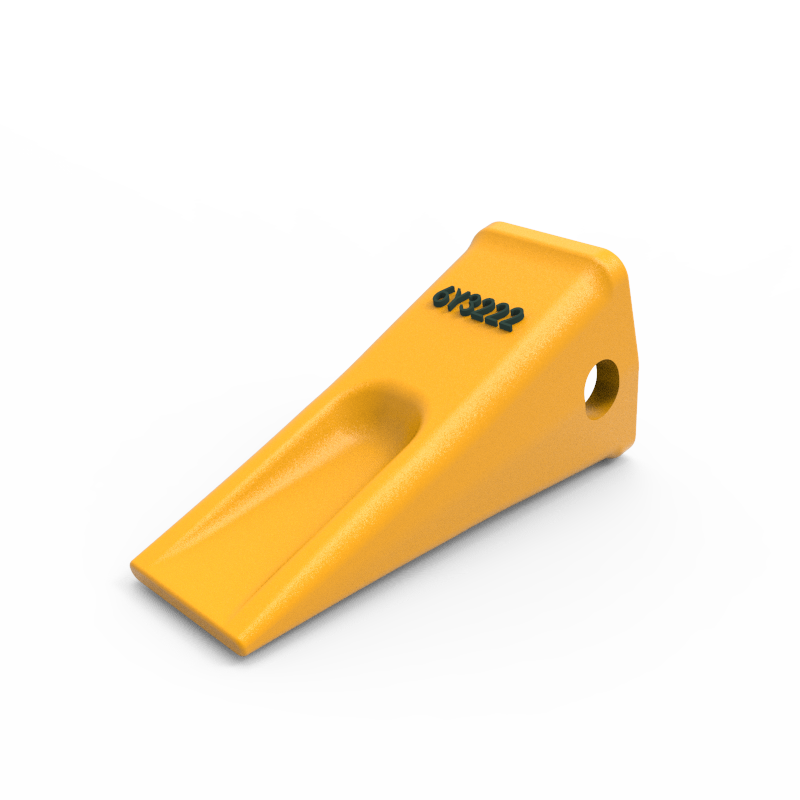
The Join Machinery G.E.T. product range covers the bucket teeth, cutting edges, and adapter families from a single OEM factory. The Caterpillar 6Y3222 J220 standard dirt tooth is the most common import SKU from our EU and US distributors.
Step 3: MOQ, Sampling & Lead Time Negotiation
MOQ and lead time are the two operational parameters that determine whether an OEM factory is workable for an importer’s replenishment cycle. Here is the current Join Machinery reference as of August 2026.
| SKU tier | First-order MOQ | Sample lead time | Mass production lead time |
|---|---|---|---|
| Stock teeth (e.g. 6Y3222, 1U3252, 2713-1217) | 1,000 pieces | 7–12 working days | 25–35 working days |
| OEM-customized (brand, packaging, profile) | 2,000 pieces | 15–20 working days | 35–45 working days |
| Adapters (1U0252, J200, 2713-0001, etc.) | 500 pieces | 15–20 working days | 30–40 working days |
| Reverse-adapters (e.g. 230-series to 2713 conversion) | 200 pieces | 20–25 working days | 40–50 working days |
Three negotiation tactics keep the MOQ flexible. First, accept the factory’s standard tooth profile (no customization) for the first order — drops MOQ to 1,000 pieces. Second, bundle multiple SKUs in one purchase order — a 5-SKU order at 500 pieces each (2,500 total) is often more negotiable than a 5,000-piece single-SKU order. Third, commit to a 12-month rolling forecast in exchange for lower per-order MOQ on subsequent orders.
Sampling policy at most OEM factories follows the standard structure: sample fee refunded against first production order, sample lead time 7 to 12 working days, sample shipment via DHL/FedEx at buyer’s account (typically $80–150 per shipment for a 5 kg carton).
Step 4: Quality Inspection & Pre-Shipment Checklist
Pre-shipment inspection is the importer’s safety net. The standard PSI protocol uses AQL 2.5 sampling for major defects and AQL 4.0 for minor defects on a 1,000 to 5,000 piece lot.
| Inspection item | Test method | Acceptance criterion |
|---|---|---|
| Visual appearance | Compare against golden sample | No flash, cracks, sand inclusions, or weld spatter |
| Dimensions (length, width, nose radius) | Caliper, go/no-go gauge | Within ±1.5 mm of drawing |
| Hardness (nose) | Portable Rockwell C, 3 points per tooth | 48–52 HRC |
| Hardness (core) | Portable Rockwell C, after grinding nose | 32–36 HRC |
| Locking fit (tooth into adapter) | Manual fit check, 5 samples | Positive lock, no axial play |
| Markings and packaging | Visual against PO specification | Correct brand marking, country of origin, carton label |
| Carton drop test | ISTA 1A drop sequence | No breakage, no spillage |
Two PSI execution notes. First, timing matters — schedule the PSI when 80% of production is complete and 20% remains packed, so the inspector can review both in-process and finished goods. Second, use a third-party inspector the factory does not regularly work with. Repeat-inspector relationships develop patterns that can mask quality drift.
Industry cross-check: Hardness ranges and material grades in the inspection checklist align with the Penticton Foundry ASTM A532 Class I Type A Ni-Hard 1 reference and the ISO 6014:1986 earth-moving machinery performance testing reference.
Step 5: Container Loading & Ocean Freight Setup
Container loading is where import cost and risk converge. The wrong pallet configuration can leave 30% of container volume unused; the wrong weight distribution can exceed payload limits and trigger re-loading fees.
| Container type | Volume | Payload | Standard teeth count (3–5 kg each) | Adapter count |
|---|---|---|---|---|
| 20GP (general purpose) | 28 m³ | 21.5 ton | 8,000–10,000 pieces | 12,000–15,000 pieces |
| 40GP (general purpose) | 58 m³ | 26.5 ton | 16,000–20,000 pieces | 24,000–30,000 pieces |
| 40HQ (high cube) | 68 m³ | 28.5 ton | 20,000–26,000 pieces | 30,000–38,000 pieces |
Three loading tactics maximize the per-container count. First, palletize before loading — palletized cartons stack to 90% volume efficiency, loose cartons only 70%. Second, use shrink-wrap or strapping on every pallet — container-vessel motion during ocean transit shifts unsecured cartons and damages markings. Third, distribute weight evenly across the container floor — concentrated weight on one corner triggers re-loading fees at the destination port.
Ocean freight from Ningbo to major destinations (typical 2026 rates):
| Destination | 20GP transit | 40HQ transit | Frequency |
|---|---|---|---|
| US West Coast (Los Angeles, Long Beach) | 14–18 days | 14–18 days | Daily sailings |
| US East Coast (New York, Savannah) | 28–32 days | 28–32 days | 2–3 sailings/week |
| North Europe (Rotterdam, Hamburg) | 28–35 days | 28–35 days | 2–3 sailings/week |
| Mediterranean (Piraeus, Genoa) | 32–38 days | 32–38 days | 1–2 sailings/week |
| Middle East (Jebel Ali, Damietta) | 18–22 days | 18–22 days | 2 sailings/week |
| Australia (Sydney, Melbourne) | 20–25 days | 20–25 days | 2 sailings/week |
| South America (Santos, Buenos Aires) | 35–45 days | 35–45 days | 1 sailing/week |
FOB Ningbo is the default Incoterm for most bucket teeth imports. The buyer takes responsibility for ocean freight, insurance, and import clearance from the moment the goods cross the ship’s rail at Ningbo-Zhoushan Port. CIF (Cost, Insurance, Freight) is sometimes preferred by first-time importers who want the seller to handle ocean logistics, but the CIF premium over FOB is typically $1,200–$2,400 for a 5-ton order.
Material Standards: ASTM A532 / ISO 6014 / EN 12513
Three material standards govern the OEM-equivalent Tier 2 bucket teeth specification. Understanding them helps the importer verify the factory’s claim of “OEM-equivalent” quality.
| Standard | Scope | Key requirement | Bucket teeth relevance |
|---|---|---|---|
| ASTM A532 | Abrasion-resistant cast irons (white iron family) | Class I Type A (Ni-Hard 1): 550 BHN as-cast | Tooth nose alloy specification |
| ISO 6014:1986 | Earth-moving machinery — ground speed / performance | Test methods for excavator performance | Tooth-and-adapter fitment verification |
| EN 12513 | Abrasion-resistant cast irons (European) | EN-GJN-HB510 (5.5604) | Equivalent to ASTM A532 Class I Type A |
| DIN 1695 | Abrasion-resistant cast irons (German) | G-X 300 NiMo 3 Mg | Equivalent to ASTM A532 Class III |
Source cross-check: Material standards cross-references align with the Penticton Foundry abrasion-resistant cast iron families reference and the ASTM A532 Class I Type A Ni-Hard 1 chemistry and hardness table.
For practical import purposes, ASTM A532 Class I Type A is the most commonly referenced spec because it gives the importer a verifiable hardness target (550 BHN as-cast, equivalent to approximately 53 HRC). The factory’s QC report should include this number. If the factory’s spec sheet only says “high chrome wear-resistant alloy” without naming the ASTM class, the importer is dealing with a value-tier supply, not Tier 2 OEM-equivalent.
Common Pitfalls: 6 Mistakes First-Time Importers Make
Six recurring mistakes account for most first-time import disputes. Each is preventable with upfront verification.
Dispute Resolution: When the First Shipment Fails PSI
If the pre-shipment inspection report flags major defects above AQL 2.5, the buyer has three resolution paths: (1) request rework at the factory’s cost, extending lead time by 10–15 working days; (2) accept the shipment with a documented discount, typically 10–25% of the invoice value; (3) reject the shipment and request a replacement production run, which extends the cash-to-cash cycle by 30–45 working days. Our policy is to rework at our cost for any major-defect finding, because the cost of rework is lower than the cost of losing a long-term distributor relationship.
- Trusting price over spec. A 30% below-market quote typically means the factory has substituted plain carbon steel for the through-hardened alloy. Verify the spec sheet, not just the price.
- Skipping the third-party PSI. Factory self-inspection reports are useful but not impartial. A 0.3% SGS inspection fee (~$300–500 per shipment) is the cheapest insurance on the entire order.
- Wrong HS code on the commercial invoice. Misclassification (e.g. declaring under 8431.49 “other parts” instead of 8431.41) can trigger CBP or EU customs audit and delay release by 2–4 weeks.
- Inadequate carton marking. US CBP requires “Made in China” or country-of-origin marking on every piece or its packaging. Missing markings trigger a marking re-labeling at the importer’s expense.
- Ignoring the locking fit test. Teeth that look right dimensionally can fail the locking-fit test against the adapter. This is the single most common field-failure mode for after-market teeth.
- Underestimating the working capital cycle. From PO to FOB port of origin is 35–50 working days. Add 14–35 days ocean transit. Add 7–14 days US/EU customs clearance. Totl cash-to-cash cycle is 60–100 days, not the 30 days many first-time importers assume.
Cost Breakdown: EXW / FOB / CIF Pricing Structure
Understanding the pricing structure is the importer’s last tool for negotiating effectively. The same 5-ton order of bucket teeth can be quoted in four ways, and the differences are not just on the buyer’s side of the freight.
| Incoterm | Seller responsibility | Buyer responsibility | Typical price band (per kg, 5-ton order) |
|---|---|---|---|
| EXW (Ex Works) | Make goods available at factory gate | All transport, insurance, duties from factory | $2.80–3.50 |
| FCA (Free Carrier) | Deliver to carrier at named place (typically Ningbo) | Ocean freight, insurance, duties | $2.90–3.60 |
| FOB (Free On Board) | Load goods onto vessel at port of origin | Ocean freight, insurance, duties | $3.00–3.75 |
| CIF (Cost, Insurance, Freight) | Ocean freight + insurance to named destination port | Import duties, last-mile delivery | $3.30–4.10 |
| DDP (Delivered Duty Paid) | All transport, insurance, duties to buyer’s door | Unloading at buyer’s warehouse | $3.70–4.60 |
For most bucket teeth importers, FOB Ningbo is the default Incoterm because it gives the buyer control of ocean freight (often the largest variable cost) while letting the seller handle the inland transport and port loading. CIF is preferred by first-time importers who do not yet have an established freight forwarder relationship.
Documentation Checklist: CI / PL / COO / BL / SGS
Five documents are non-negotiable for any bucket teeth import shipment. Missing any one of them triggers customs clearance delays.
| Document | Issued by | Purpose | Quantity |
|---|---|---|---|
| Commercial Invoice (CI) | Seller (factory) | Customs valuation + payment basis | 3 originals + 3 copies |
| Packing List (PL) | Seller (factory) | Container contents, weight, dimensions | 3 originals + 3 copies |
| Certificate of Origin (COO) | China Council for the Promotion of International Trade (CCPIT) | Country-of-origin declaration for duty calculation | 3 originals |
| Bill of Lading (B/L) | Ocean carrier | Title document, release authorization | 3 originals (telex release for most modern shipments) |
| Inspection Certificate (SGS/BV/TUV) | Third-party inspector | Quality verification, AQL pass confirmation | 1 original + 2 copies |
Two documentation tips. First, the commercial invoice must match the packing list on piece count, weight, and HS code. Mismatches are the single most common customs hold reason. Second, the COO must be issued by CCPIT (or a chamber of commerce authorized by CCPIT) for the destination country to accept it. Self-issued COOs are not valid for customs clearance.
Telex Release vs. Original B/L: Modern Shipping Practice
For most modern ocean shipments, the carrier issues a “telex release” or “sea waybill” instead of an original B/L. The telex release is an electronic message from the origin carrier to the destination carrier authorizing release of the container to the named consignee without physical paper presentation. We ship 95% of our export orders under telex release because it cuts 5–7 days off the documentation cycle and avoids the risk of original B/L loss in international mail.
Letter of Credit (L/C) Payment Terms for First Orders
For first-time importers, we recommend L/C at sight as the payment instrument. L/C at sight means the buyer’s bank guarantees payment to the seller’s bank upon presentation of conforming shipping documents. The L/C typically covers 100% of the invoice value and includes a tolerance of ±5% on piece count and ±10% on invoice amount. L/C adds 1–2% in bank fees but eliminates the risk of paying for goods that do not ship.
Frequently Asked Questions
Q1. What’s the exact HS code for bucket teeth?
The international HS code for bucket teeth is 8431.41 — “Buckets, shovels, grabs and grips for machinery of heading 8426, cranes, bulldozers or similar machinery.” For US import the HTS classification is 8431.41.00.80 (Schedule B 8431410080) with a current MFN duty rate of 0% under HTSUS Chapter 84. EU import uses the same 8431.41 CN code with duty rates that vary by member state but typically land in the 0% to 2.7% range for industrial machinery parts.
Q2. Is 1 ton enough for a first OEM order?
For most OEM factories, the standard first-order MOQ is 1,000 to 2,000 pieces per SKU, which at typical 3–5 kg per piece for standard bucket teeth lands in the 3–10 ton range. Some factories accept 500-piece trial orders at a 10–15% price premium. Below 500 pieces (1.5–2.5 ton), expect to pay 25–40% above the per-container price band because the factory cannot amortize heat-treatment and packaging setup across fewer units.
Q3. Can one supplier handle both Doosan and Caterpillar teeth?
Yes — most established G.E.T. (Ground Engaging Tools) manufacturers produce teeth for both Doosan and Caterpillar families. The factory cross-references the OEM part numbers (e.g. 2713-1217 for Doosan DH220, 6Y3222 for Caterpillar J220) and runs them on the same heat-treatment and finishing lines. The buyer receives a single shipment with both product lines consolidated, which is typically 15–25% cheaper than sourcing each line from a separate factory.
Q4. How do I verify a factory is the real manufacturer?
Five verification steps: (1) ask for the heat-treatment furnace photos — OEMs have in-house furnaces, trading companies do not; (2) request the factory’s ISO 9001 certificate and verify it on the issuing body’s database; (3) ask for a sample batch with the factory’s own brand marking before any third-party logo is applied; (4) commission a third-party pre-shipment inspection (SGS, Bureau Veritas, or TUV) on the first production run; (5) check the factory’s export license and Customs registration (China Customs HS code registration). Trading companies will fail at least two of these five checks.
Q5. What’s the difference between FOB and CIF pricing?
FOB (Free On Board) means the seller delivers the goods to the port of origin (typically Ningbo or Shanghai) and the buyer takes responsibility for ocean freight, insurance, and import duties from that point. CIF (Cost, Insurance, Freight) means the seller pays for ocean freight and insurance to the destination port, but the buyer still handles import duties and last-mile delivery. For a 5-ton bucket teeth order, the CIF premium over FOB is typically $1,200–2,400 depending on destination port and freight rate cycle.
Q6. How many pieces fit in a 20GP vs 40HQ?
A standard 20GP container (28 m³, 21.5 ton payload) holds approximately 8,000–10,000 standard bucket teeth (3–5 kg each) when palletized and shrink-wrapped. A 40HQ container (68 m³, 28.5 ton payload) holds approximately 20,000–26,000 standard teeth. Adapters pack more densely (12,000–15,000 per 20GP, 30,000–38,000 per 40HQ) because of their smaller individual footprint. Final count depends on packaging configuration — boxed, palletized, or bulk-bagged.
About the author. Xin Jack is the Export Sales Manager at Ningbo Yinzhou Join Machinery Co., Ltd., a specialized manufacturer of G.E.T. (Ground Engaging Tools) parts including bucket teeth, cutting edges, and adapters for excavators and construction equipment. Established in 2006, the company serves European and American markets with 16 years of exporting experience, partnering with world-leading brands such as BYG, JCB, and NBLF. Every product undergoes strict quality control from raw material to finished goods, ensuring maximum cost performance for global construction and mining customers.
Connect with Xin Jack on Facebook.
Start your bucket teeth OEM inquiry →
Post time: Aug-14-2026