Quick Answer (TL;DR)
- A CAT J-series part number like “1U3302RC” is decoded position by position. Prefix = brand and family; middle block = class and shape; suffix = profile variant and material flag.
- Side-pin, top-pin, and weld-on are three different retention systems — using the wrong one means the tooth will not physically seat on the adapter nose.
- 48–52 HRC and ≥1400 MPa tensile strength are the real quality gate for alloy steel GET, not paint colour, not cast logo style, not box printing.
- Six verification questions separate a foundry-direct supplier from a trading-company reseller. Asking them before the PO saves the buyer the cost of a return shipment and lost production time.
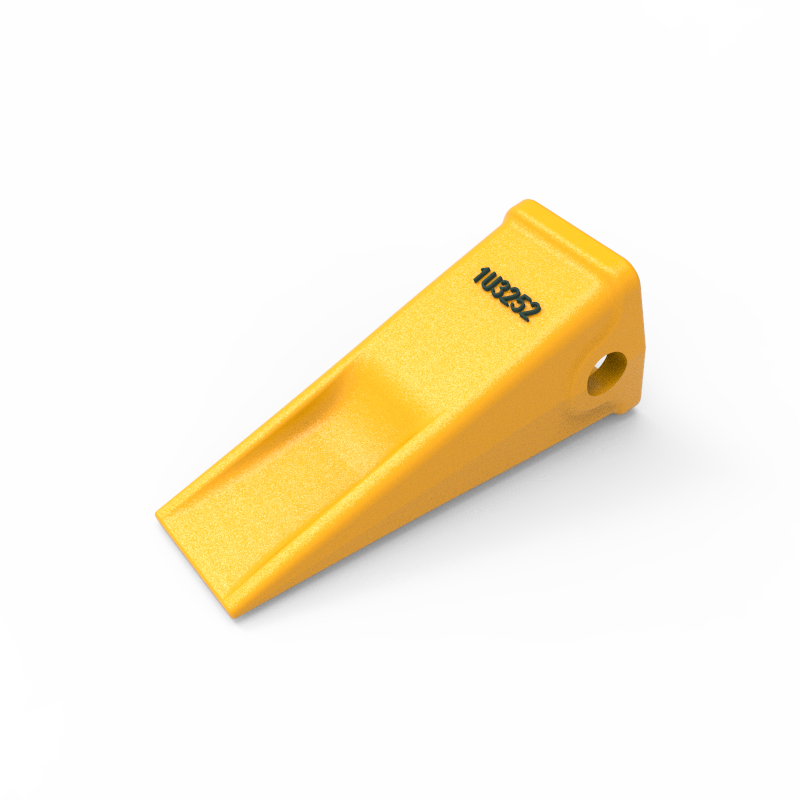 NBJM 1U3252 J250 standard long side-pin tooth. 2.8 kg, alloy steel, 48–52 HRC, ≥1400 MPa, pin 8E6258 / retainer 8E6259.
Three suppliers, three quotes, three boxes that arrived within a week of each other on a buyer’s dock in Casablanca. Each box said “CAT J300 bucket tooth.” Each tooth was painted yellow. None of them fit the same adapter.
The first batch was a J300 standard long, 4.4 kg, matched pin 8E6258. The second was a J300 rock chisel, 5.2 kg, matched pin 9J2308 — but the pin holes had been drilled slightly off-center, so the retainer would not seat. The third batch was a J350 long, mislabeled at the source. Same product code on the shipping mark, three completely different parts.
The reason this happens is that generic descriptions like “J300 tooth” are not precise enough. A real CAT-style part number — 1U3302RC, 1U3252, 7T3402, 9W8452SK — encodes the family, the class, the shape, the profile variant, and sometimes the alloy flag. Once a buyer can read those codes, mismatches like the ones above become impossible to walk past.
This field guide is the document I now send with every quote, the same one our excavator bucket teeth product range team uses during pre-shipment inspection, and the one I wish every new procurement manager had before they placed their first PO. We will decode the part number, walk through a visual identification guide by class, explain why side-pin vs top-pin vs weld-on matters, lay out the hardness and tensile benchmarks that actually define quality, and close with a six-question supplier verification checklist.
CAT Part Numbering Decoded: What Each Position in “1U3302RC” Means
CAT-style part numbers on ground engaging tools follow a structured logic. There are variations for adapters, pins, and retainers, but the family of tooth part numbers is consistent enough that, once you know the pattern, you can read a tooth you have never seen before and know roughly what it is.
A typical CAT-style tooth part number has three positions: prefix, four-digit class and shape block, and suffix.
CAT-style part number logic for ground engaging tools
| Position |
Tells You |
Examples |
| Prefix (1–2 letters + 1 digit) |
Brand family and tool family |
1U = CAT J-series tooth; 4T = weld-on adapter base; 6Y = J-series pin tooth; 7T = J400-family tooth; 9N = J250 or J300 heavy duty; 9W = J460 with sleeve |
| Four-digit block |
Class and shape code |
3252 = J250 standard long; 3302 = J300 standard long; 3402 = J400 standard long; 4253 = J350 rock penetration; 8452 = J460 with sleeve |
| Suffix |
Profile variant and alloy flag |
RC = rock chisel; RP = rock penetration; TL / WTL = twin tiger long; SK = with sleeve; WT = heavy section; HD = heavy duty; (no suffix) = standard long |
Decoding “1U3302RC” step by step:
- Prefix “1U”. This is a CAT J-series tooth.
- Middle block “3302”. Class 3 (J300), shape 02 (standard long profile).
- Suffix “RC”. Rock chisel — reinforced collar, higher alloy, designed for fractured rock.
Now decode “1U3252”:
- Prefix “1U”. CAT J-series tooth.
- Middle block “3252”. Class 2 (J250), shape 52 (standard long side-pin profile).
- No suffix. Standard long, for general digging in dirt and loose material.
And “9W8452SK”:
- Prefix “9W”. J460-family with sleeve.
- Middle block “8452”. Class 4 with sleeve geometry.
- Suffix “SK”. Supplied with sleeve.
Because the same prefix can be used across different brands on after-market parts, the prefix alone does not prove OEM origin — it proves family and tool type. NBJM teeth carry our own cast mark alongside the OEM-equivalent code, with full batch traceability back to a heat number.
Visual Identification: J250 vs J300 vs J400 vs J460
When a buyer calls in and says “send me a photo of the tooth,” the visual cues are usually enough to narrow the part number down to one or two candidates before any weighing or measurement. The four reference photos below cover the most common classes.
Visual and weight benchmarks by J-series class
| Class |
Reference Part Number |
Profile |
Approx. Weight (standard long) |
Visual Cue |
| J250 |
1U3252 |
Standard long, side-pin |
2.8 kg |
Compact tooth, slim profile, single horizontal pin hole |
| J300 |
1U3302 / 1U3302RC |
Standard long / rock chisel |
4.4 kg / 5.2 kg |
Medium tooth, deeper collar on the RC variant, larger pin than J250 |
| J400 |
7T3402 / 7T3402WTL |
Standard long / twin tiger long |
~10.5 kg |
Larger, thicker cross-section, twin tiger variant visibly bulkier than the standard |
| J460 |
9W8452SK |
With sleeve |
~16.5 kg |
Heavy, blocky collar, sleeve pocket visible behind the nose |
Weights above are nominal for the standard long profile within each class. Rock chisel (RC), twin tiger long (TL/WTL), and heavy duty variants run heavier because of reinforced geometry.
Four field checks I run on the receiving dock:
- Pin hole position. Horizontal pin hole = side-pin retention. Vertical pin hole at the top of the nose = top-pin retention. No pin hole at all, only a weld prep = weld-on adapter base.
- Tooth length vs. cross-section. A long, slim tooth is the standard profile. A noticeably thicker cross-section with the same length is a twin tiger or heavy duty variant.
- Weight on the workshop scale. If the part is stamped J300 but weighs 7 kg, you are looking at a J350 or J400. The class and the weight always agree.
- Cast markings. A legitimate tooth carries the OEM-equivalent part number cast into the body, plus the foundry’s own batch or heat mark. A smooth body with a printed sticker and no cast number is a red flag.
Our 1U3252 J250 side-pin tooth is a useful reference example. It weighs 2.8 kg, fits pin 8E6258 and retainer 8E6259, runs at 48–52 HRC and ≥1400 MPa tensile strength, with Charpy shock impact ≥20 J at −20 °C. That set of numbers is what a buyer should expect from any serious alloy-steel J250 tooth on the market, whether branded CAT or after-market.
Side-Pin vs Top-Pin vs Weld-On: Retention Method Determines Fitment
The retention system is the part that decides whether the tooth fits the adapter at all. A side-pin tooth will never seat on a top-pin adapter, no matter how similar the cast shape looks, because the pin bore is in a different plane.
Side-pin retention (horizontal pin)
The most common system on J250 through J460. The tooth has a horizontal bore through the nose; the adapter has a matching bore; a steel pin is driven through both and locked with a retainer clip. Service-friendly — the pin and retainer can be replaced in the field with a hammer and brass drift. Used on 1U3252 (J250), 1U3302RC (J300), 7T3402 (J400), 9W8452SK (J460).
Top-pin retention (vertical pin)
The pin drops vertically through the top of the nose. Common on some J350 and J460 variants, and on certain competitive-brand adapters. Top-pin systems allow quicker change-out in some conditions but are less common on standard CAT machines.
Weld-on adapters
J200 (4T1204) and some J220 adapters weld directly to the bucket lip. The tooth is either welded in place or cast as part of the adapter nose. No pin, no retainer, no daily change-out. Used on mini excavators where bucket weight matters more than service speed. J200 weld-on adapters typically have no separate retention code.
Retention method selection guide
| Retention |
Typical Classes |
Change-out Time |
Best For |
| Side-pin (horizontal) |
J250, J300, J350, J400, J460, J550 |
~5 minutes per tooth with brass drift |
Standard excavator operations, daily wear |
| Top-pin (vertical) |
Some J350, J460 variants and competitive-brand adapters |
~3 minutes per tooth |
High-change-out environments, certain quarry applications |
| Weld-on |
J200, some J220 |
Requires welder; permanent |
Mini excavators, low-wear applications, light-weight buckets |
The practical rule is straightforward: if your adapter has a horizontal pin bore, you need a side-pin tooth in the same class; if your adapter has a top pin channel, you need a top-pin tooth; if your adapter welds directly to the bucket, you need a weld-on tooth. Trying to mix these three systems is not a matter of “close enough” — the parts physically will not assemble.
Material and Hardness Markers: Why 48–52 HRC and ≥1400 MPa Are the Real Quality Gate
Paint colour, box printing, and cast-logo style are all things a buyer can check by eye. None of them tells you whether the tooth will survive a 200-hour shift on a limestone face. The numbers that matter are hardness, tensile strength, and impact toughness, all measured on a real test bar from the actual heat batch, not on a generic certificate.
NBJM holds the J-series product line at 48–52 HRC surface hardness after heat treatment, ≥1400 MPa tensile strength, and ≥20 J Charpy shock impact at −20 °C per ISO 148-1 testing. These three numbers are the production floor’s quality gate for ground engaging tools, and they map directly to wear life and impact resistance in service.
Mechanical property benchmarks for alloy steel J-series bucket teeth
| Property |
NBJM Specification |
Test Method |
Why It Matters |
| Surface hardness |
48–52 HRC |
Rockwell C, per ASM Handbook Vol. 7 hardness testing conventions |
Wear life — too soft wears fast, too hard chips under impact |
| Tensile strength |
≥1400 MPa |
Universal testing machine, per ISO 6892-1 |
Resistance to bending and overload |
| Charpy impact toughness |
≥20 J at −20 °C |
Charpy V-notch per ISO 148-1 |
Brittle-fracture resistance in cold climates and high-impact digging |
| Material |
High-standard alloy steel |
MTC per EN 10204 3.1 |
Traceability of chemistry and heat treatment |
| Process |
Investment casting / sand casting / forging |
Per ISO 18787:2021 quality-controlled processes |
Dimensional accuracy and metallurgical integrity |
Process routes and tolerances are verified per CAT Parts Spec ground engaging tool classification and SAE J49 earth-moving component identification practice.
Two practical notes on hardness that come up in almost every first-time buyer conversation:
- Above 52 HRC is not always better. Going harder than 52 HRC looks impressive on a certificate but increases the risk of chipping and brittle fracture under impact loading. 48–52 HRC is the engineered balance for the J-series alloy.
- Surface hardness is not the same as through-hardness. A tooth can be case-hardened to a high surface number while the core remains soft. For impact-loaded digging, you want through-hardened alloy steel, not a thin case on a mild steel core.
If a supplier cannot show you a mill test certificate with actual batch chemistry, a hardness test report, and a Charpy impact value, treat that as a quality risk and move on. The test reports are not optional. They are how foundries prove that what you ordered is what you received.
The Six-Question Supplier Verification Checklist
Here is the checklist we developed over 16 years of exporting GET components. We run it ourselves before we ship, and we recommend buyers run it on every supplier before they order. The questions are designed to separate a foundry-direct manufacturer from a trading-company reseller, and to surface quality risks before they become container-load problems.
- Are you the manufacturer, or a trading company? If the answer is “trading company,” ask whether they have a nominated foundry and what their QA oversight looks like on-site.
- Which production routes do you run in-house? Look for specific answers: investment casting, sand casting, forging, heat treatment. Vague answers like “we have our own factory” without process detail are a red flag.
- Can you show a mill test certificate for the batch I will receive? EN 10204 3.1 is the standard. Anything less, or a generic “we can provide cert,” is not enough.
- What is your verified hardness range and tensile strength? Specific numbers, not ranges of “about HRC 50.” NBJM holds 48–52 HRC and ≥1400 MPa.
- Do you publish a Charpy impact value? If the answer is “we can test on request,” ask for the test report with the next shipment. ≥20 J at −20 °C is the alloy steel GET benchmark.
- What is your heat-number traceability system? Each batch should be traceable back to a heat number on the test certificate and on the cast marking. Without that, field failures cannot be diagnosed.
Because the lowest-cost supplier is rarely the lowest total-cost supplier, these six questions protect both the buyer’s budget and their reputation on the job site. A trading company that disappears after delivery does not solve a hardness problem three months later. A foundry with its own metallurgist does.
From Identification to Order
Once a buyer can identify a tooth by part number, profile, retention method, and mechanical properties, the rest of the procurement conversation becomes routine. We can move from photo to part number to production schedule without reams of back-and-forth.
If you are at the stage where you want to walk a real sample through the identification steps in this guide, or if you have a part number you cannot decode, our team can usually identify the part from a single photo and a workshop scale reading within 24 hours.
Frequently Asked Questions
What does the “RC” suffix mean on 1U3302RC?
RC means rock chisel. It marks a J300 tooth variant with a reinforced collar and a higher-alloy steel recipe aimed at fractured rock and shot rock. The 1U3302RC weighs 5.2 kg and uses pin 9J2308 with retainer 8E6259.
How do I know if a tooth is side-pin or top-pin?
Look at the pin bore. A horizontal bore through the nose is side-pin. A vertical channel at the top of the nose is top-pin. No bore at all, with a weld prep surface instead, is weld-on. Side-pin, top-pin, and weld-on retention systems are not interchangeable.
Are 1U3252 and 1U3302 the same tooth?
No. 1U3252 is a J250 standard long side-pin tooth weighing 2.8 kg, used on compact and small standard machines, fitted with pin 8E6258 and retainer 8E6259. 1U3302 is the J300 standard long at around 4.4 kg for 18–25 ton excavators, fitted with pin 9J2308 and retainer 8E6259. Different classes, different applications, different pins.
What hardness should I require on a bucket tooth?
For alloy steel J-series teeth, the engineered range is 48–52 HRC surface hardness with ≥1400 MPa tensile strength and ≥20 J Charpy impact at −20 °C. Numbers significantly above 52 HRC increase chipping risk; numbers below 45 HRC wear too fast.
Can I weld a new tip onto a worn tooth?
In practice, build-up welding on a worn tooth is a stop-gap, not a repair. The heat-affected zone changes the hardness profile, and the rebuilt tip rarely matches the engineered alloy of the original casting. For most operators, replacing the tooth at change-out condition is more cost-effective than field welding.
What is the difference between an OEM part and an OEM-equivalent after-market part?
OEM parts are made by or for the original machine brand. OEM-equivalent after-market parts are made by independent foundries to match the OEM specification — same nose geometry, same class, same pin and retainer codes — but typically at a different price point. The quality of an OEM-equivalent part depends entirely on the foundry’s process control and metallurgical verification, not on the brand on the box.
Do I need a different tooth for limestone vs. granite?
In most cases, yes. Limestone and similar sedimentary rocks favour the rock chisel (RC) or rock penetration (RP) profile for impact resistance. Granite and highly abrasive igneous rock favour the twin tiger long (TL/WTL) profile for wear resistance. The standard long profile works in mixed dirt-and-rock conditions but wears faster in pure abrasive environments.
Next Steps
Xin Jack
Export Sales Manager — Ningbo Yinzhou Join Machinery Co., Ltd. (NBJM)
16 years exporting GET components for Caterpillar, BYG, JCB, and NBLF-compatible systems. ISO 9001 certified foundry, Ningbo, China. Connect on Facebook.
Company: Ningbo Yinzhou Join Machinery Co., Ltd. | Established 2006 | ISO 9001 certified | info@nbjm-china.com | +86 0574-8825 2807 | Yunlong Industrial, Yunlong Town, Yinzhou, Ningbo 315135, China | nbjm-china.com