How Caterpillar Bucket Teeth Improve Fuel Efficiency and ROI
Think about the physics of earthmoving. Every time a bucket hits compacted soil, rock, or clay, it faces massive resistance. If the teeth are blunt, poorly designed, or worn down, the machine requires more hydraulic power and higher RPMs to push through. This spikes fuel consumption dramatically. Upgrading to high-quality Caterpillar-style teeth optimizes this penetration, turning a simple wear part into a serious lever for reducing overhead. For B2B buyers, distributors, and bulk importers, understanding this dynamic shifts the sales conversation from “price per kilogram of steel” to “total cost of ownership.” When you supply end-users with parts that actively improve Excavator digging efficiency, you secure long-term repeat business based on measurable ROI rather than just competing in a race to the bottom on unit price. Bucket teeth are the frontline soldiers of your machinery. Their primary job is to absorb the brutal abrasive impact of digging so the expensive bucket lip and structural components don’t have to. But beyond just taking damage, they act as a performance lever. A well-designed tooth slices through material, reducing the mechanical stress on the boom, stick, and hydraulic pumps. When you manage wear-costs effectively by choosing the right metallurgical mix, you extend the intervals between replacements, which drives down your cost per hour. The math here is straightforward but often overlooked. Better penetration equals faster cycle times. If an operator can fill a bucket in 8 seconds instead of 11 seconds, they are moving more tons per hour. Over a 10-hour shift, those saved seconds compound into significantly lower fuel burn per ton of material moved. Improved loading efficiency means fewer passes to fill a dump truck, directly padding the contractor’s bottom line. I generally see three main buyer groups for these components: large-scale mining operations, civil construction fleets, and aftermarket parts distributors. Mining buyers prioritize absolute wear life and reliability because their downtime costs thousands of dollars a minute. Construction fleets need versatile teeth that can handle mixed dirt and rock. Distributors, on the other hand, need a reliable supply chain, manageable MOQs, and a broad catalog of profiles to service diverse local demands. To really grasp how a chunk of cast steel influences diesel consumption, we have to look closely at the engineering specifications. It’s not just about bolting heavy metal onto a bucket; it’s about geometry, metallurgy, and fit. The specific profile of a tooth dictates its aerodynamic-like flow through dirt and rock. A blunt, poorly cast aftermarket tooth acts like a flat wall hitting the dirt. The hydraulic system screams, the engine guzzles diesel, and cycle times drag. Conversely, investing in Sharp bucket teeth engineered to OEM Caterpillar specifications ensures a streamlined path of least resistance. As a wholesale buyer, you need to know which specs actually matter to your end-users so you can audit your suppliers effectively. Let’s break down the three primary technical categories you should be evaluating when sourcing bulk G.E.T. The profile is everything. A standard dirt tooth has a different geometry than a rock chisel or a twin tiger tooth. The penetration angle must be optimized so the tooth self-sharpens as it wears down, maintaining its slicing ability rather than rounding off into a blunt club. Tip geometry dictates whether the material flows smoothly into the bucket or causes drag. Most high-quality bucket teeth are made from low-carbon alloy steel, but the secret sauce is in the heat treatment. You want a balance: a high Brinell hardness (typically around 470-530 HB) on the exterior for abrasion resistance, but a tough, ductile core to prevent the tooth from snapping under high-impact shock loads. If a supplier’s steel is too brittle, the teeth will shatter in rocky conditions. Even the sharpest tooth is useless if it rattles on the adapter. Poor fitment leads to pin shearing, lost teeth, and catastrophic damage to the bucket lip. Caterpillar’s J-series (side-pin) or K-series (twist-on vertical retainer) locking systems require precise casting tolerances. A snug fit ensures that the impact force transfers directly into the adapter and bucket structure, rather than vibrating and destroying the retaining pins. Navigating the global supply chain for heavy machinery parts can feel like a minefield. You have the genuine OEM parts at a premium price, and then a massive spectrum of aftermarket options ranging from excellent to dangerously poor quality. For procurement teams, the goal is finding the sweet spot: Tier-1 aftermarket quality at wholesale pricing. When I advise sourcing teams, I always emphasize that you don’t have to be locked into the OEM ecosystem to get top-tier performance. You can absolutely find replacements to all leading brands with reliable quality and reasonable prices to meet your needs—like Caterpillar, Volvo, ESCO, and Komatsu—provided you know how to vet the factories. To make this easier, you need a standardized way to compare your options. It’s not just about the FOB price; it’s about evaluating the total package. Let’s look at how to benchmark these suppliers. OEM parts guarantee fit and performance, but they eat heavily into operating margins. Premium aftermarket suppliers use the same alloy blends and casting techniques as OEM foundries, allowing you to cut procurement costs by 30-40% without sacrificing uptime. However, cheap aftermarket teeth will wear out twice as fast and break often, turning your initial savings into massive downtime losses. When sourcing, ensure the supplier uses standard OEM part numbering (like CAT 1U3302 or 9W8552) to guarantee compatibility. Ask for cross-reference charts. A good factory won’t just copy the shape; they will benchmark their molds against genuine Caterpillar adapters to ensure the internal pocket dimensions are identical. Don’t just compare quotes. Ask suppliers for their average wear life in specific soil conditions. Check their lead times—a cheap price is useless if the factory takes 120 days to ship and you miss the busy construction season. Finally, review their warranty policy. Will they replace a batch if the teeth suffer from premature breakage due to casting voids? When you are buying a 20-foot container full of steel, a 5% defect rate is an absolute disaster. This is why rigorous quality control and supplier auditing are non-negotiable for B2B importers. You are not just buying metal; you are buying the factory’s metallurgical consistency. I always recommend bypassing trading companies where possible and auditing the foundry directly. You need to see their casting lines, their furnaces, and most importantly, their testing labs. If a factory cannot produce a spectrometer reading for their steel batches, walk away immediately. Furthermore, you need to understand how they handle bulk customizations. Many distributors want their own logos cast into the teeth, or they need specific assortments bundled for regional dealer networks. Getting these details right at the factory level saves massive headaches during domestic distribution. A proper audit looks at the lost-wax or sand casting process. Are the molds precise? Then, look at the heat treatment facility. Quenching and tempering must be tightly controlled to achieve the right hardness-to-toughness ratio. Finally, inspect how they check tolerances. They should be using physical go/no-go gauges on the pinholes and adapter pockets for every single batch. Never buy a container without testing samples first. When you receive samples, ask for the accompanying material test reports (MTRs) and hardness test results. Better yet, cut a sample tooth in half to check for internal casting voids or porosity. If possible, put the samples on a machine in the field and track the hours until replacement. Discuss Minimum Order Quantities (MOQs) early. A good factory will allow mixed SKUs in a container so you don’t have to buy 5,000 of the same tooth. If you are building a brand, negotiate private labeling (casting your logo into the steel). Ensure they understand your packaging needs—teeth should be packed in heavy-duty, fumigated wooden crates that won’t collapse during ocean transit. Shipping ground engaging tools is an exercise in weight management. Because bucket teeth are dense, solid steel, you will hit the maximum weight limit of a shipping container long before you run out of physical space. This requires careful logistical planning to optimize your freight costs per unit. I’ve seen importers lose their entire profit margin because they didn’t calculate their landed costs correctly, or because their inventory arrived three months late due to poor supply chain visibility. When dealing with heavy wear parts, your inventory turns and cash flow cycles are heavily dependent on how well you manage your logistics. You also have to balance your SKU mix. Standard dirt teeth will fly off the shelves, while heavy-duty rock penetrators might sit in your warehouse for months. Let’s look at the best practices for moving and storing this heavy metal. Always use 20-foot heavy-duty containers for bucket teeth. A 40-foot container will max out on weight when it is only a third full, wasting money. Work with your supplier to design crates that maximize the internal dimensions of a 20ft box. Ensure the crates are banded with steel straps and clearly labeled with part numbers and quantities for rapid warehouse receiving. FOB (Free On Board) and CIF (Cost, Insurance, and Freight) are the most common Incoterms here. Understand your factory’s production lead time (usually 30-45 days) plus ocean transit time. If total lead time is 75 days, your reorder point needs to be calculated based on your average monthly sales velocity so you never face a stockout of critical Caterpillar bucket tips. Tailor your container mix to your local geology. If you distribute in a region with hard limestone, stock up on rock chisels and heavy-duty abrasion teeth. If your market is mostly soft clay and trenching, standard long teeth are your bread and butter. Tying up cash flow in the wrong profiles will kill a distributor’s profitability. International trade in steel and machinery parts is heavily regulated. You cannot simply wire money and expect a container to arrive without a hitch. Customs agencies are strict about documentation, tariffs, and material compliance, and making a mistake here can result in your goods being seized or hit with massive demurrage fees at the port. Beyond customs, you need ironclad commercial terms with your supplier. If a batch of teeth shatters in the field, who pays for the replacements? How do you prove it was a manufacturing defect and not operator abuse? These terms must be negotiated before the first purchase order is cut. Navigating this requires a solid understanding of international trade law and clear communication with your freight forwarders and customs brokers. Your customs broker will need a Commercial Invoice, Packing List, Bill of Lading, and a Certificate of Origin. Depending on your country, you may also need specific material certificates proving the steel does not contain banned trace elements, or phytosanitary certificates for the wooden pallets to prove they have been heat-treated or fumigated. Draft a clear warranty agreement. Standard industry practice covers premature breakage under normal operating conditions, but not standard wear. Establish a claim protocol: usually, the buyer must provide photos of the broken tooth, the part number cast into it, and a brief description of the failure. Agree on whether compensation will be a cash refund or replacement units on the next container. Use the correct Harmonized System (HS) code. Most bucket teeth fall under HS Code 8431.49 (Parts suitable for use solely or principally with the machinery of headings 84.25 to 84.30). Be aware of anti-dumping duties on steel products in your country. Ensure all packaging is properly labeled with “Made in [Country]” to comply with destination customs regulations. I always tell buyers to look at the “cost per hour” of the wear part, combined with the fuel savings generated by using Fuel-saving G.E.T.. If a tooth costs 20% more but lasts 40% longer and cuts fuel consumption by 2%, the ROI is overwhelmingly positive. Here is a simple framework for how you can model these costs and make data-driven purchasing decisions. To calculate true ROI, add the purchase price to the labor cost of installation and the estimated fuel burn over the part’s lifespan. Then, divide by the total hours the tooth lasts. The premium tooth almost always wins on cost-per-hour. Don’t forget to factor in uptime—fewer tooth changes mean the excavator spends more hours actually digging and generating revenue. Use a decision table (like the one above) to visualize the trade-offs. For a rental fleet where machines are abused and parts are frequently lost, a cheaper tooth might make financial sense. But for production mining or heavy quarry work, the high-performance option is the only way to protect profitability. Never transition your entire inventory to a new supplier overnight. Start with a trial order (e.g., a few pallets). Put them to work in harsh conditions and track the data. Once the ROI is proven, you can negotiate long-term supply contracts, locking in raw material prices and securing priority production slots at the foundry. Wrapping up, the strategy behind sourcing heavy machinery wear parts requires balancing upfront costs with long-term operational efficiency. Bucket teeth are the literal cutting edge of your fleet’s profitability. By prioritizing high-quality metallurgy, precise fitment, and intelligent logistics, you can protect your margins and deliver superior value to your customers or project sites. Let’s cover a few common questions I hear from buyers navigating this space. Generally, yes, because they reduce penetration resistance. However, a tooth that is too sharp or thin for the application (like using a tiger tooth in heavy rock) will snap. The key is matching the right level of sharpness and profile to the specific soil or rock conditions to maintain both fuel efficiency and structural integrity. Most reputable foundries require an MOQ of 1-3 tons per order, which allows distributors to mix and match SKUs. The ideal setup is packing in heavy-duty wooden crates of around 1,000 kg to 1,500 kg each, which makes them easy to maneuver with standard warehouse forklifts and perfectly maximizes a 20ft container’s payload. Shortlist suppliers who own their own foundries, provide transparent material test reports, and guarantee exact OEM fitment. Protect your ROI by starting with field-tested samples, negotiating strict warranty terms against premature breakage, and calculating your landed costs accurately before signing off on bulk POs. Related reading: Replacements to all leading brands with reliable quality
Why Caterpillar Bucket Teeth Matter for Fuel Efficiency and ROI
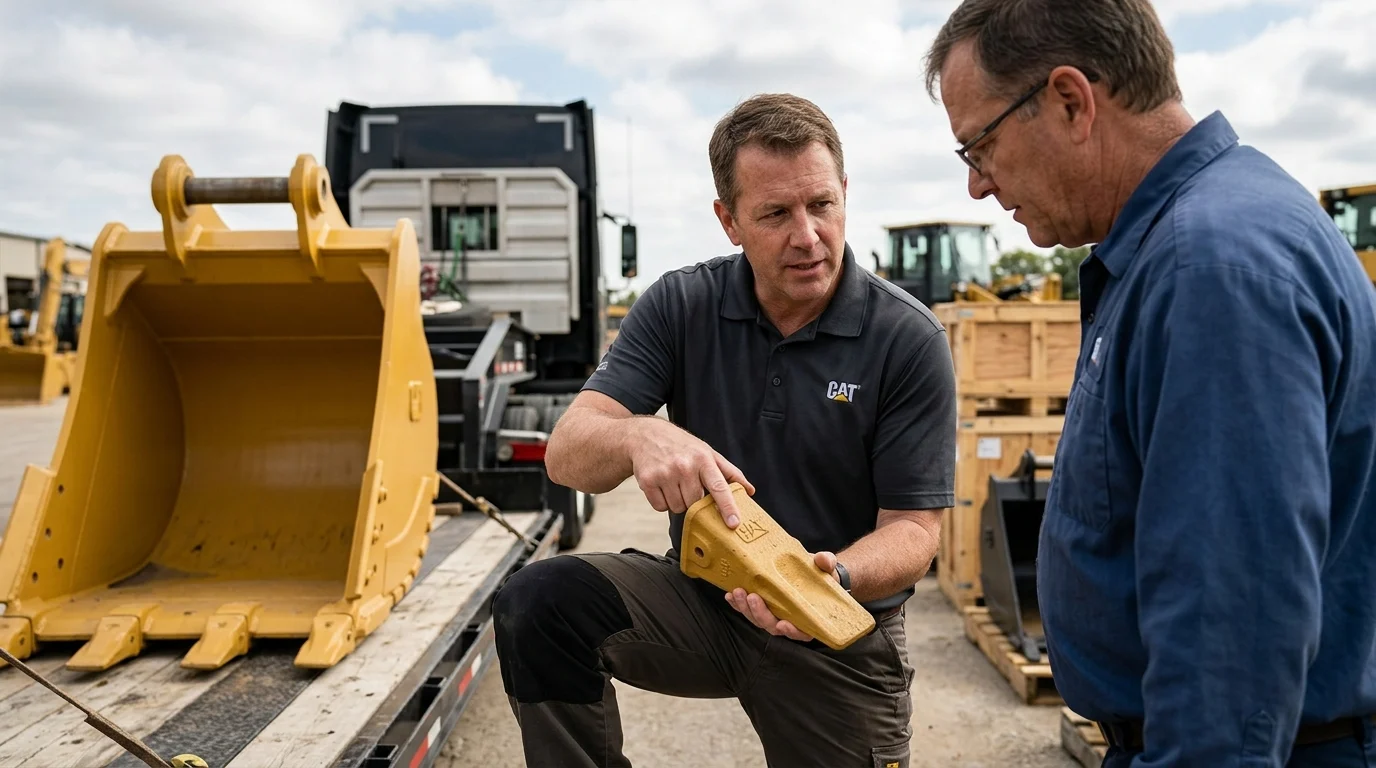
Bucket teeth as a wear-cost and performance lever
Fuel burn, cycle time, and loading efficiency
Key buyer groups and use cases
Specifications That Affect Fuel Efficiency
Tooth profile, penetration angle, and tip geometry
Material, hardness, and wear life
Fitment, adapters, and locking systems
How to Compare Suppliers and Replacement Options
Supplier Tier
Initial Unit Cost
Expected Wear Life
Fit & Tolerance
Best For
Genuine OEM
Highest
Baseline (100%)
Perfect
Warranty-strict fleets, extreme mining
Premium Aftermarket
Moderate (-30% to -40%)
95% – 105% of OEM
Excellent
Cost-conscious fleets, distributors
Low-Cost Aftermarket
Lowest (-60% or more)
50% – 70% of OEM
Variable (High Risk)
Light duty, temporary fixes
OEM vs aftermarket cost and uptime
Brand and compatibility benchmarks
Comparison criteria: price, wear life, lead time, warranty
Sourcing and Quality Control for Bulk Orders
Supplier audits: foundry, heat treatment, tolerances
Sample review, test reports, and field evidence
MOQ, private label, packaging, and assortments
Logistics and Inventory Planning
Packaging and container planning
Incoterms, lead times, and reorder points
SKU mix, regional demand, and cash flow
Compliance and Commercial Terms
Required documents and certificates
Warranty, claims, and dispute handling
Import compliance, tariff codes, and labeling
How to Calculate Purchase ROI
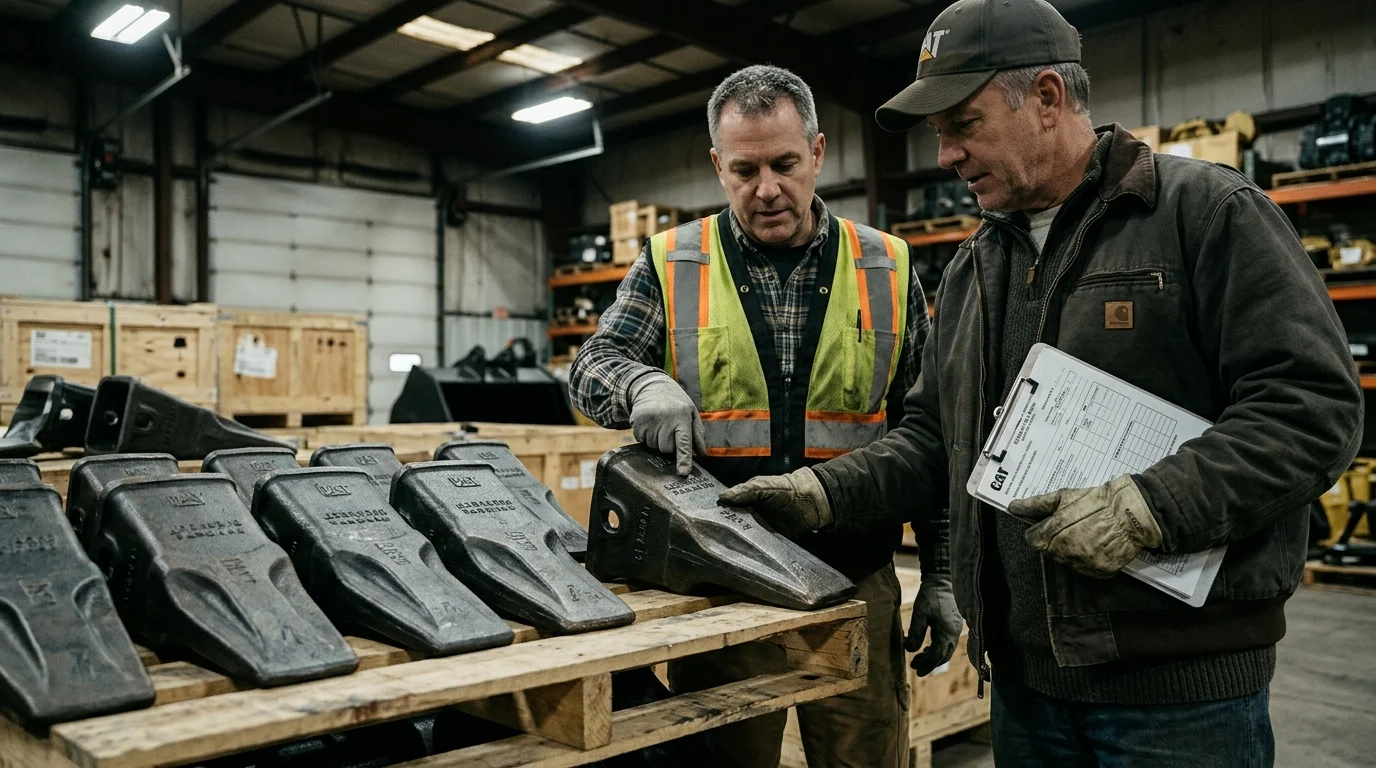
Metric
Low-Cost Aftermarket
Premium CAT-Style Tooth
Unit Price
$30
$45
Wear Life (Hours)
200
350
Cost Per Hour
$0.15/hr
$0.12/hr
Fuel Efficiency Impact
High drag (Blunt wear)
Low drag (Self-sharpening)
Cost model: price, fuel savings, wear life, uptime
Decision table for low-cost vs high-performance options
From trial order to long-term supply
FAQ and Key Takeaways
Do sharper teeth always improve fuel efficiency?
What MOQ and packaging setup fit distributors?
How to shortlist suppliers and protect ROI
Key Takeaways
Post time: Apr-15-2026