TL;DR – Key Takeaways
- Counterfeit ESCO-part-compatible bucket teeth are widespread in the Asia-Pacific supply chain. Australian mining contractors must implement rigorous incoming quality inspection protocols and material verification procedures to avoid costly premature failures.
- Genuine ESCO teeth use proprietary alloy compositions and heat treatment specifications that aftermarket producers cannot exactly replicate. The wear performance difference in high-abrasion iron ore applications can exceed 5:1 between genuine ESCO and budget aftermarket parts.
- ISO/AS standards compliance (AS 2074:2021, ISO 10414-1:2011) is mandatory for procurement in Australian mining operations. Demand material test reports (MTRs) with heat numbers that can be verified against mill certificates.
- TCO analysis must replace unit price as the primary sourcing metric. In Australian iron ore operations with machine hour costs of AUD 800-AUD 1,500/hour, tooth performance determines whether the cost is AUD 0.15/ton or AUD 0.85/ton of material moved.
- The ESCO tooth selection checklist (included in this article) provides a structured framework for evaluating suppliers and verifying part authenticity before purchase.
For anyone who has spent time around Australian iron ore mining operations, the excavator bucket is one of the most visually dramatic indicators of how hard the equipment is working. A skilled mine operator watches the bucket teeth like a doctor watches vital signs – the rate of wear tells you everything about what is happening at the rock-face, and unexpected tooth failure is one of the most disruptive events in a mining cycle.
In the Pilbara region of Western Australia, where I have worked with mining contractors and equipment managers for many years, the performance of bucket teeth on 300-tonne to 800-tonne excavators in iron ore applications is a serious operational and financial concern. These machines move extraordinary volumes of material – a single large excavator in an Australian iron ore operation can shift 10,000-15,000 tonnes per day – and the cost of unexpected downtime runs into hundreds of thousands of dollars per hour.
That is why the question of how to source genuine, high-quality ESCO bucket teeth – or properly evaluated aftermarket equivalents – is so important for Australian open-pit mining contractors. This article is a practical guide to that sourcing challenge, written from the perspective of someone who has seen the consequences of getting it wrong.The Australian Iron Ore Operating Environment: Why Bucket Tooth Performance Is Critical
Before diving into the sourcing specifics, it is important to understand why the Australian iron ore operating environment places such extreme demands on bucket teeth. This context shapes every aspect of the sourcing decision.
Australian iron ore deposits in the Hamersley Basin (the dominant iron ore province in the Pilbara) consist primarily of Banded Iron Formation (BIF) hosted hematite and martite-goethite ores. These are among the most abrasive materials in surface mining – the silica content of the host rock, combined with the hard hematite mineralization, creates a wear environment that is significantly more aggressive than the global average for iron ore mining. The Pilbara Mining Chamber has published data suggesting average drill-and-blast cycle times of 2-3 hours and excavator cycle times of 20-35 seconds per bucket, with each bucket carrying 40-80 tonnes of material.
In this environment, bucket teeth are not just wear items – they are critical operating components whose performance directly determines the cost per tonne of material moved. A set of teeth that wears 15% faster than expected adds up to hundreds of thousands of dollars in additional material costs over an annual operating period. A premature tooth failure that causes an unplanned dig cycle interruption or, worse, allows a broken tooth segment to enter the crusher circuit, can cost AUD 50,000-AUD 500,000 in a single incident.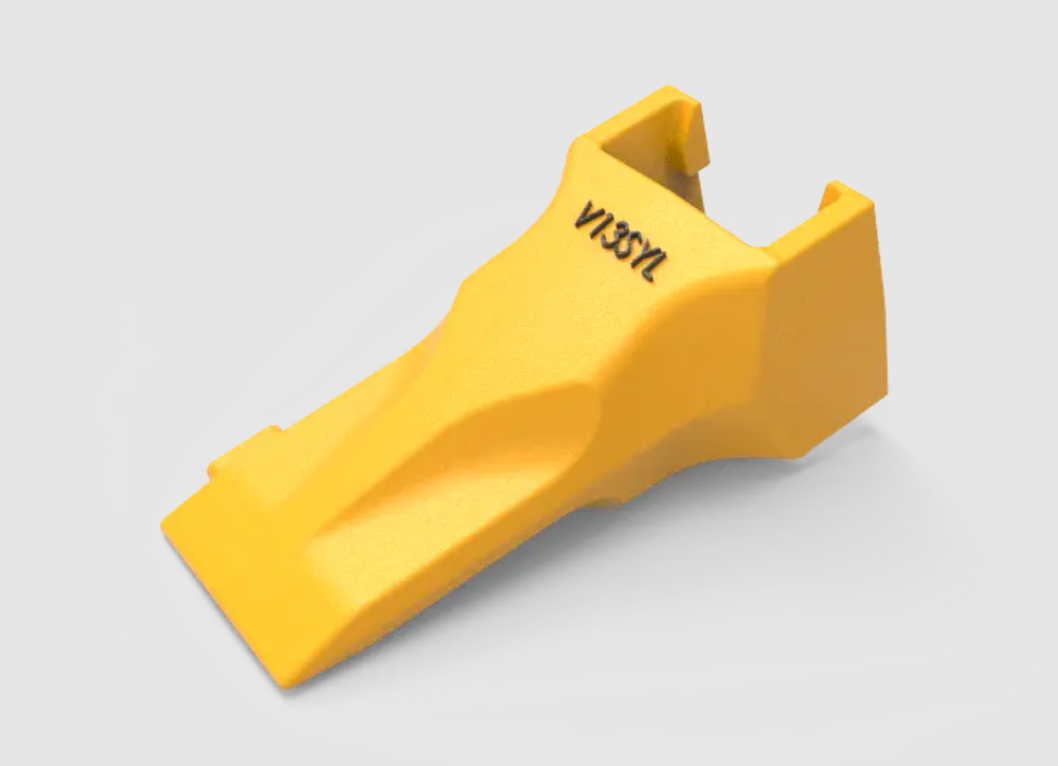
Understanding the ESCO Bucket Tooth Product Range for Mining Excavators
ESCO Corporation – headquartered in Portland, Oregon – is the dominant global OEM supplier of excavator bucket teeth for mining applications. Their products are specified by all major excavator OEMs (Caterpillar, Komatsu, Liebherr, Hitachi Construction Machinery) as the original equipment choice, and the ESCO part numbering and tooth profile systems have become so widely adopted that the term “ESCO-part-compatible” has become a product category in its own right.
For Australian open-pit iron ore operations, the most commonly specified ESCO tooth lines are:
ESCO 71S Series (Super Dig)
The ESCO 71S is the most widely specified tooth system for large mining excavators (200-tonne class and above) in the Australian market. The 71S system uses a conical pin retention mechanism (the tooth is locked into the adapter by a tapered steel pin driven through the tooth’s horizontal axis) that provides secure retention while allowing relatively fast tooth changeout. The 71S Super Dig profile is optimized for penetration in hard, compacted materials – the narrow entry profile and high clearance angle reduce packing in sticky materials while the robust body cross-section provides good resistance to bending loads in rocky conditions.
ESCO 58 Series (Versa)
The ESCO 58 (Versa) system is used on medium-sized mining excavators (100-200 tonne class) and is also specified for face shovel applications where the loading geometry differs from backhoe configuration. The 58 system uses a similar pin retention mechanism to the 71S but with a wider, more robust tooth profile that provides better resistance to high-impact loading in blasted rock applications. The 58 Versa is the preferred choice for operations that alternate between primary excavation and secondary breakage tasks.
ESCO 96 Series (XDP – Extreme Duty Penetrator)
The ESCO 96 XDP is designed specifically for extreme conditions: high-abrasion iron ore, nickel laterite, and bauxite applications. The XDP profile features a wider, heavier body section with a reinforced collar and longer shroud nose, providing significantly improved wear life in materials that cause rapid abrasive wear on standard profiles. The tradeoff is reduced penetration performance compared to the 71S Super Dig profile – the XDP is not the right choice for operations where penetration in compacted materials is the primary challenge.
“In our operations in the Eastern Hamersley, we standardized on ESCO 71S teeth for our 360-tonne excavators after a 12-month trial comparing three tooth systems. The 71S gave us 820 hours average service life per tooth position, compared to 540 hours for the previous system. At our scale, that 52% improvement in wear life translated to AUD 2.1 million per year in avoided tooth replacement costs and reduced downtime.”
— Maintenance Superintendent, Pilbara iron ore operation (2025, name withheld)
The Aftermarket Landscape: OEM vs. Aftermarket ESCO-Compatible Teeth
One of the most consequential sourcing decisions for Australian mining contractors is whether to purchase genuine ESCO OEM teeth or aftermarket ESCO-part-compatible teeth. This is not a simple binary choice – the aftermarket ranges from Tier 1 producers with sophisticated quality systems to Tier 3 operators using off-specification materials from small induction furnaces with minimal quality control.
Understanding this landscape is essential for making informed procurement decisions.
Genuine ESCO OEM Teeth
ESCO Corporation produces bucket teeth in dedicated casting facilities using proprietary alloy compositions, furnace melting practices, and heat treatment specifications that have been refined over decades of mining application engineering. ESCO’s casting facilities in Portland, Oregon and Avenel, Victoria (Australia) operate under ISO 9001 and ISO 14001 certified quality management systems, and all production batches are subject to statistical process control with mechanical property testing on sample castings from each heat.
The key differentiators of genuine ESCO teeth are:
- Proprietary alloys: ESCO uses modified Hadfield manganese steel (ASTM A128 standard grade B-4, with ESCO-specific modifications) and Chrome Carbide Overlay (CCO) materials that are not available from aftermarket producers. The exact alloy modifications and heat treatment parameters are trade secrets, but their performance in high-abrasion mining applications has been validated by decades of field data.
- Consistent dimensional tolerance: ESCO castings are produced in precision-engineered molds with tight dimensional control. This ensures consistent fit in the tooth-adapter interface, which affects both retention security and the ease of tooth changeout.
- Traceability: Each ESCO casting carries a heat number that can be traced through ESCO’s quality system to the specific production batch, raw material certificates, and mechanical property test results.
The genuine ESCO teeth command a price premium – typically 2.5-4x the price of Tier 3 aftermarket equivalents – but the performance premium in severe-service mining applications frequently justifies the cost difference on a cost-per-ton basis.
Aftermarket ESCO-Compatible Teeth: The Quality Spectrum
The aftermarket ESCO-compatible market is vast and highly stratified. The following framework describes the quality tiers we observe in the Asia-Pacific supply chain:
| Tier | Typical Origin | Price vs. Genuine ESCO | Typical Wear Life | Risk Level |
|---|---|---|---|---|
| Tier 1 (Quality Aftermarket) | China, India (large foundries) | 50-70% of ESCO price | 70-90% of ESCO life | Low – with proper verification |
| Tier 2 (Medium Quality) | China, various origins | 30-50% of ESCO price | 40-65% of ESCO life | Medium – requires verification |
| Tier 3 (Budget/Unknown) | Various, small foundries | 10-25% of ESCO price | 10-30% of ESCO life | High – frequent failures |
Tier 1 aftermarket producers are typically large, established foundries (annual casting capacity 5,000+ tonnes) that serve multiple international markets and have the metallurgical capability to produce manganese steel castings meeting ASTM A128 specifications. These producers often supply original equipment manufacturers who private-label their products. They have the quality systems to provide material test reports (MTRs), heat numbers, and dimensional inspection data that enable proper verification.
Tier 2 producers may have adequate casting capability for simpler geometries but lack the heat treatment expertise or quality systems to produce consistently reliable manganese steel castings for severe-service applications. Their products may perform adequately in moderate-wear applications (sand and gravel, softer ores) but frequently fail prematurely in high-abrasion iron ore conditions.
Tier 3 producers – and this is where the genuine risk lies – are small operations that may be using off-specification scrap steel, informal heat treatment practices, and no meaningful quality control. Their products may look acceptable when new but can fail in catastrophic ways (complete tooth fracture, adapter damage from impacts) that far exceed any cost savings from the lower purchase price.
The Counterfeit Problem: How to Identify Non-Genuine Parts Presented as Genuine
Beyond the legitimate aftermarket, there is a counterfeit market where producers deliberately misrepresent their products as genuine ESCO parts or as parts from established Tier 1 aftermarket brands. This is a significant problem in the Asia-Pacific supply chain, and Australian mining contractors who procure through intermediaries or unfamiliar suppliers have been burned by counterfeit products more than once.
The counterfeit identification process has several layers:
Documentation Verification
Any supplier claiming to sell genuine ESCO parts should be able to provide, with each shipment:
- Material Test Reports (MTRs): These document the heat number, chemical composition (with actual values, not just “meets specification”), mechanical properties (Charpy impact values, tensile strength, yield strength, elongation), and heat treatment condition. A genuine MTR will have a traceable heat number that can be verified with the foundry.
- Foundry certification: The MTR should identify the producing foundry by name and location, and the supplier should be able to provide evidence that the foundry is an authorized ESCO production facility (for genuine ESCO parts) or an established quality foundry (for aftermarket).
- Packing list with batch traceability: Each box of teeth should have batch traceability back to the production heat.
Any supplier who cannot provide MTRs with each shipment, or whose MTRs show only “meets ASTM A128” without actual values, should be treated as suspect.
Physical Inspection Protocol
For incoming quality inspection, we recommend the following checks for all ESCO-part-compatible bucket tooth shipments:
- Weight verification: Weigh a sample of 5-10 teeth from each batch. Genuine ESCO teeth and quality aftermarket teeth will be within plus/minus 3% of stated weight. Teeth that are significantly under weight may indicate incomplete casting (voids or shrinkage porosity inside the casting) which is a fracture risk.
- Surface inspection: Examine the casting surface under good lighting. Quality manganese steel castings will have a consistent surface texture. Look for: cold shuts (small curved lines on the surface indicating the metal was not fully liquid when poured), lap defects (surface folds from improper mold closing), and visible porosity (small holes or pits). Any of these indicate casting quality problems.
- Pin bore inspection: The retention pin bore should be straight, concentric with the tooth axis, and have clean, sharp edges. If the bore shows signs of distortion, waviness, or if the edges appear rounded (indicating the core shifted during casting), the tooth may not seat properly in the adapter.
- Identification marking: ESCO teeth carry raised or cast identification on the body (part number, foundry mark, size indicator). Verify that the marking matches the order documentation. Many counterfeit parts carry incorrect or missing markings.
ISO and Australian Standards Compliance for Mining Excavator Bucket Teeth
Australian mining operations are subject to a regulatory environment that includes specific standards requirements for equipment and components. While bucket teeth are not directly subject to product certification mandates in Australia (they are not classified as safety-critical components under the relevant regulations), compliance with recognized standards provides the quality assurance framework that mining operations need for their procurement specifications.
Relevant Standards for Bucket Tooth Procurement
AS 2074:2021:2021 – Steel Castings for Engineering Applications
This is the primary Australian standard applicable to steel castings for mining equipment applications, including bucket teeth. AS 2074:2021 specifies requirements for chemical composition, mechanical properties, heat treatment, inspection, and testing of steel castings. It references ASTM A128 for manganese steel castings, which is the material standard most commonly specified for bucket teeth. For procurement specifications, requiring compliance with AS 2074:2021 ensures that the foundry operates under a recognized quality management framework and that the castings meet minimum mechanical property requirements.
ISO 10414-1:2011-1:2011 – Earth-Moving Machinery – Rig for Testing Crawler Dozer and Excavator Attachments
This ISO standard defines the test rig and test procedures for evaluating the structural strength and retention system performance of excavator bucket teeth and adapters. While this is primarily a design validation standard for OEM manufacturers, mining operations can use it as a reference specification when evaluating aftermarket products – specifically the retention system testing requirements, which define how many load cycles the tooth-adapter retention system must survive without failure.
AS/NZS 3679.1:2016.1:2016 – Structural Steel – Hot-Rolled Bars and Sections
This standard applies when the bucket tooth adapter (the component that bolts to the bucket wing) is being procured, as the adapter is typically a structural steel fabrication. For the tooth casting itself, the manganese steel specification in ASTM A128 / AS 2074:2021 is the relevant standard.
Documenting Standards Compliance in Procurement
For each bucket tooth procurement, the purchase specification should require the following documentation from the supplier:
- Material Test Report (MTR) per heat number, showing actual chemical composition and mechanical properties
- Foundry quality system certification (ISO 9001 minimum for quality aftermarket, ESCO authorization certificate for OEM)
- Statement of compliance with AS 2074:2021 and ASTM A128 for manganese steel castings
- For imported products, customs documentation identifying the actual country of manufacture (important for tariff classification and country-of-origin requirements)
Any supplier unwilling or unable to provide this documentation package should not be considered for procurement, regardless of price competitiveness. The cost of a single tooth failure event in an Australian iron ore operation – in terms of downtime, replacement labor, and crusher damage risk – will far exceed any saving from a lower unit price.
The Total Cost of Ownership Framework for Bucket Tooth Sourcing
The most important mindset shift we can encourage in mining equipment procurement is moving from unit price comparison to total cost of ownership (TCO) analysis. For bucket teeth in severe-service iron ore applications, TCO per tooth position per hour of operation is the metric that actually matters.
Here is how to construct the TCO framework:
TCO Components
Direct acquisition cost: The purchase price per tooth, including shipping and duties to the mine site.
Wear life cost: The cost per operating hour, calculated as: (purchase price) divided by (average hours of service life per tooth). If tooth A costs AUD 45 and lasts 800 hours, the wear life cost is AUD 0.056/hour. If tooth B costs AUD 30 but lasts 350 hours, the wear life cost is AUD 0.086/hour. Tooth A is 53% cheaper on a wear-life basis despite the higher unit price.
Tooth changeout cost: The labor cost of replacing worn teeth. This includes: equipment downtime during the changeout, technician time, consumables (retention pins, if not reusable), and changeout frequency. If a technician earns AUD 85/hour and changeout takes 20 minutes per tooth, and the operation runs 6,000 hours per year, the difference between 800-hour tooth life (7.5 changeouts per year) and 350-hour tooth life (17 changeouts per year) is AUD 4,040 per tooth position per year in labor costs alone.
Failure risk cost: The expected cost of premature tooth failures, calculated as: (probability of failure per tooth position per year) times (cost per failure incident). In high-abrasion iron ore applications, Tier 3 aftermarket teeth can have failure rates of 5-15% per position per year, with each failure event costing AUD 3,000-AUD 25,000 in downtime and remediation. A Tier 1 aftermarket or genuine ESCO tooth may have failure rates below 0.5% per year.
TCO Calculation Example
Consider two options for a 360-tonne excavator (6 tooth positions per bucket, operating 6,000 hours per year):
| Cost Component | Genuine ESCO 71S | Tier 2 Aftermarket | Tier 3 Budget |
|---|---|---|---|
| Unit price per tooth | AUD 120 | AUD 55 | AUD 22 |
| Average service life (hours) | 820 | 480 | 180 |
| Wear life cost per hour | AUD 0.146 | AUD 0.115 | AUD 0.122 |
| Changeouts per year (6 positions) | 44 | 75 | 200 |
| Changeout labor cost per year | AUD 3,740 | AUD 6,375 | AUD 17,000 |
| Expected failure events per year | 0.3 | 3.0 | 18.0 |
| Failure cost per year (AUD 10k avg) | AUD 3,000 | AUD 30,000 | AUD 180,000 |
| Total TCO per year (6 positions) | AUD 9,496 | AUD 40,131 | AUD 203,732 |
| TCO per tonne (at 12k t/day) | AUD 0.0022/t | AUD 0.0091/t | AUD 0.046/t |
In this example, genuine ESCO teeth – despite having the highest unit price – deliver the lowest total cost of ownership by a factor of 4x compared to the Tier 2 aftermarket and 21x compared to the Tier 3 budget option. The calculation becomes even more favorable to genuine ESCO teeth when failure costs are higher (closer to crusher, higher machine hour rates) or when tooth life is shorter (more abrasive ore zones).
ESCO Bucket Tooth Selection Checklist for Australian Mining Operations
The following checklist provides a structured framework for evaluating ESCO bucket tooth suppliers and products for Australian open-pit mining applications:
Checklist Item 1: Verify Supplier Credentials
For genuine ESCO parts: request ESCO authorized distributor certificate and verify against ESCO Corporation’s Australian distributor list. For aftermarket: request foundry quality certifications (ISO 9001 minimum), foundry audit report (third-party or first-party), and references from other mining operations using the same products in similar applications.
Checklist Item 2: Validate Material and Performance Documentation
Request MTRs with each shipment. Verify actual chemical composition against ASTM A128 Grade B-4 specifications (minimum 11.5% manganese, maximum 1.4% carbon). Verify Charpy impact values (minimum 20J at -20C for mining applications) and Rockwell C hardness (typically 200-240 HB for properly heat-treated manganese steel).
Checklist Item 3: Conduct Incoming Quality Inspection
Implement a sampling inspection protocol (per AS 2094 or equivalent) for all incoming tooth shipments. Inspect a minimum of 5% of each batch (or minimum 3 teeth, whichever is greater) for weight, surface quality, dimensional conformance, and identification marking accuracy.
Checklist Item 4: Conduct Operational Trial
Before committing to a new supplier or product, conduct a minimum 500-hour operational trial on 2-4 tooth positions. Track wear rate, any chipping or cracking events, and time-per-changeout data. Compare results against your baseline (current product or ESCO OEM data).
Checklist Item 5: Calculate TCO Before Committing
Do not make sourcing decisions on unit price alone. Calculate full TCO including wear life cost, changeout labor, and failure risk. Use the framework described in this article. If a supplier’s product cannot support a TCO analysis with real operating data, it should not be approved for fleet-wide deployment.
Conclusion: Making the Right Sourcing Decision for Your Operation
For Australian open-pit mining contractors, the stakes in bucket tooth sourcing are higher than they might appear from the outside. The difference between a world-class sourcing strategy and a reactive, price-driven approach can translate to millions of dollars per year in avoided costs on a mid-size iron ore operation – and even more on large-scale operations in the Pilbara.
The framework we have laid out in this article – understanding the operating environment, knowing the product range, navigating the aftermarket landscape, implementing counterfeit detection procedures, meeting standards requirements, and calculating true total cost of ownership – provides the foundation for a systematic, professional approach to bucket tooth procurement.
If there is one message I want to leave you with, it is this: do not let unit price drive this decision. The mining equipment market has seen too many examples of operations that pursued low-unit-price procurement strategies for wear parts, experienced elevated failure rates and associated downtime costs, and ultimately paid far more than if they had specified quality products from the beginning.
The good news is that the supply chain for quality ESCO-compatible bucket teeth is well-established, and there are legitimate Tier 1 aftermarket options that deliver 80-90% of genuine ESCO wear life at 50-70% of the price. The challenge is identifying which suppliers fall into that Tier 1 category and which are operating at Tier 2 or Tier 3 levels. The verification procedures and TCO framework outlined here are designed to make that distinction as clear as possible.
Sourcing bucket teeth well is not glamorous work. But it is one of those operational details that, done correctly, quietly and consistently protects your operation’s profitability throughout every cycle of the mining process.
ABOUT HTE AUTHOR
Xin Jack — Export Sales Manager at Ningbo Yinzhou Join Machinery Co., Ltd. Xin Jack is the Export Sales Manager at Ningbo Yinzhou Join Machinery Co., Ltd., a specialized manufacturer of G.E.T. (Ground Engaging Tools) parts including bucket teeth, cutting edges, and adapters for excavators and construction equipment. Established in 2006, the company serves European and American markets with 16 years of exporting experience, partnering with world-leading brands such as BYG, JCB, and NBLF. Every product undergoes strict quality control from raw material to finished goods, ensuring maximum cost performance for global construction and mining customers.
Post time: Jun-22-2026