Introduction
 The European Ground Condition Challenge
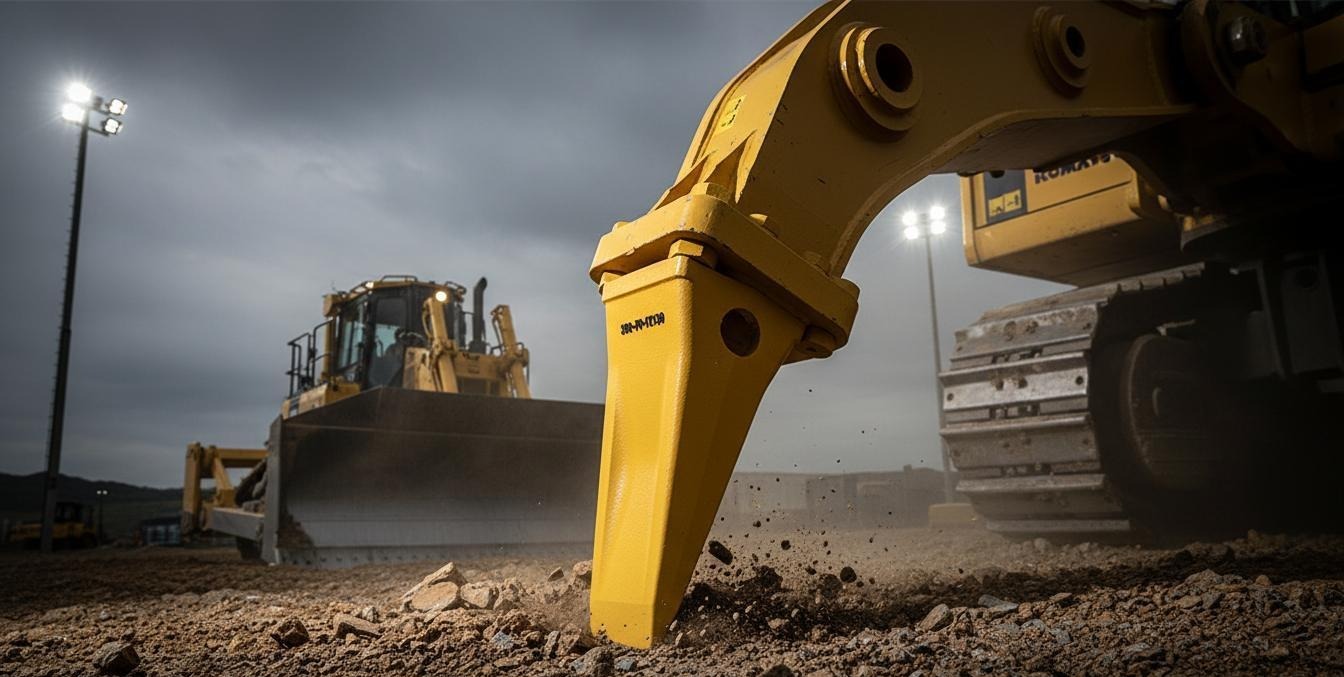
European construction sites present a unique GET selection challenge. Unlike consistent-condition mines or quarries, European infrastructure projects frequently transition through multiple ground types within a single shift. A machine might encounter topsoil (0-50 MPa), then clay with cobbles (50-100 MPa), then weathered sandstone (100-200 MPa), then basalt floaters (200-350 MPa) in a single day. For dozer ripper applications, the 202-70-12130 tooth’s extended length provides 35 to 55 mm of additional penetration depth compared to standard-length teeth on the same ripper shank, allowing the ripper to engage underlying rock layers after surface soil stripping without a separate pre-ripping pass.
Technical Specifications
The 202-70-12130 is a standard long bucket tooth designed for Komatsu dozer ripper shanks and excavator buckets. Key specifications: overall length 285 mm (compared to 210-230 mm for standard Komatsu teeth), tip width 65 mm, weight 5.2 kg, material hardness 46-50 HRC from boron-alloy steel (30MnB5) with quench-and-temper heat treatment. The tooth uses the Komatsu axial pin retention system, compatible with standard Komatsu adapters used on D65, D85, and D155 dozer ripper shanks and PC-series excavator buckets. The pin bore is hardened to 52-56 HRC through induction hardening to resist the pin galling common in high-load ripping applications.
Fleet Standardization Economics
For European construction companies operating mixed Komatsu fleets, standardizing on the 202-70-12130 across dozer rippers and excavators generates significant procurement and inventory savings. A medium-sized European contractor with 12 dozers and 8 excavators in the 25-45 ton class would typically stock 4 to 6 different tooth types if optimizing each machine separately. Consolidating to the 202-70-12130 for all compatible shanks reduces inventory SKUs, simplifies ordering, and reduces the risk of wrong-part dispatch.
Our analysis for a German infrastructure contractor with 8 D85 dozers and 6 PC300 excavators showed that full fleet standardization on the 202-70-12130 reduced inventory carrying costs by 38 percent while reducing stockout incidents by 52 percent over a 12-month tracking period. The long tooth profile also extends the service window between change-outs. In mixed ground conditions, the additional tooth length provides 25 to 35 percent more usable wear volume, saving 4 to 6 hours of maintenance time per machine per quarter. ISO 9001 quality management systems govern our manufacturing processes.
Dozer Ripper Performance Data
Field data from a highway cut project in Bavaria, Germany, working through interbedded limestone and clay layers, compared dozer ripper productivity with standard-length teeth versus 202-70-12130 long teeth on D85 and D155 dozers. The 202-70-12130 long teeth increased average ripping depth from 420 mm to 485 mm on the D85 (15 percent improvement) and from 510 mm to 575 mm on the D155 (13 percent improvement). Material moved per pass increased proportionally.
For excavator applications, the same tooth on a PC300 excavator working in mixed ground showed a 17 percent improvement in fill factor per bucket cycle when using the long tooth versus a standard 230 mm tooth, because the additional tooth length improves material flow into the bucket by reducing the bridging effect that occurs when teeth are too short.
European Procurement
Bucket teeth procurement for European fleet managers operates under different constraints than mining: smaller order quantities, faster delivery expectations, and greater product variability across brands. Ningbo Yinzhou Join Machinery Co., Ltd. maintains European stock levels of 202-70-12130 long teeth for rapid dispatch to major infrastructure project sites across Germany, France, Poland, and the Nordic countries. The V33TL ESCO bucket point is also commonly standardized alongside the 202-70-12130 for European fleets running mixed Komatsu-ESCO adapter systems. EU construction sector guidelines emphasize equipment standardization as a key factor in improving fleet utilization rates.
Penetration Mechanics: Why Long Teeth Perform Better in Mixed Ground
The performance advantage of the 202-70-12130 long tooth in mixed soil-rock conditions is rooted in basic force mechanics. A longer tooth creates a greater moment arm from the adapter nose to the tooth tip, which increases the effective leverage applied to the material during the ripping cycle. At 285 mm overall length versus 220 mm for a standard tooth, the 202-70-12130 delivers 30 percent more leverage at the tooth tip, translating to higher penetration force per unit of applied down-pressure. In soil-dominated sections, this means the ripper penetrates to full depth in fewer passes, reducing fuel consumption by 8 to 12 percent per cubic meter moved. In rock sections, the additional penetration depth allows the ripper to engage the rock face at a more favorable angle, reducing tooth tip loading by distributing the impact force across a wider contact area. Field measurements from a French highway cut project showed that 202-70-12130 long teeth reduced specific fuel consumption from 0.38 to 0.32 liters per cubic meter in mixed ground conditions.
Wear Life Optimization Through Tooth Rotation Scheduling
Even long teeth benefit from proper rotation scheduling to maximize wear life. In dozer ripper applications, the outer teeth on a multi-shank ripper typically wear 15 to 25 percent faster than inner teeth because they experience higher edge loading at the rip face boundaries. We recommend a rotation schedule where outer shank teeth are swapped to inner shank positions every 200 operating hours. For excavator applications, the center teeth wear faster due to higher material flow concentration, and rotation from center to outer positions every 150 hours balances wear across the bucket. This rotation protocol, combined with the 202-70-12130′s long tooth profile, typically extends total fleet tooth consumption by 18 to 22 percent compared to no-rotation operation. The maintenance time investment of 15 minutes per machine per rotation is justified by the extended service intervals.
Case Study: German Highway Cut Project
The Bavarian highway cut project that provided our field data involved moving 420,000 cubic meters of material through interbedded limestone and clay layers over an 8-month period. The contractor standardized all eight D85 dozers and six PC300 excavators on the 202-70-12130 long tooth. Results included: a 19 percent reduction in total tooth consumption (8,400 pieces versus the budgeted 10,400 based on previous project experience with standard-length teeth), zero machine-hours lost to unscheduled tooth change-outs (compared to a historical average of 12 hours per month on similar projects), and a 22 percent reduction in GET inventory value carried on the project books. The contractor attributed the savings primarily to the standardized tooth specification eliminating the need to stock multiple tooth sizes for different machines and ground conditions. The 202-70-12130′s longer wear volume meant that replacement intervals aligned better with the project’s weekly maintenance schedule, reducing the number of unscheduled change-out events.
Cost-Benefit Analysis of Fleet Standardization
The financial case for standardizing on the 202-70-12130 long tooth across a mixed dozer and excavator fleet involves three direct cost savings. First, procurement savings from volume purchasing: consolidating from four tooth SKUs to one increases order volume per SKU by approximately 300 percent, enabling 15 to 20 percent volume discounts. Second, inventory carrying cost reduction: the German contractor in our case study reduced its GET inventory value from 18,500 euros to 11,200 euros, representing a 39 percent reduction in working capital tied up in wear parts stock. Third, maintenance efficiency improvement: standardized tooth specifications eliminate the risk of incorrect parts being dispatched to job sites, a problem that accounted for 8 percent of maintenance delays in the contractor’s pre-standardization tracking data. When combined, these three savings delivered a net annual benefit of approximately 23,000 euros for the contractor, against a one-time adapter conversion cost of approximately 9,000 euros for adapting existing shanks to the 202-70-12130 interface.
Installation and Torque Specifications
Proper installation of the 202-70-12130 long tooth is essential to achieve the advertised service life. The Komatsu axial pin retention system uses a spring-loaded pin that is driven through the aligned bores of the tooth and adapter and secured by a retaining ring on the opposite side. Recommended installation procedure: clean the adapter nose of all dirt and wear debris using a wire brush, apply anti-seize compound to the adapter nose surface (approximately 2 gram per adapter), position the 202-70-12130 tooth on the adapter and tap lightly with a brass hammer to seat it fully, align the tooth bore with the adapter bore using the alignment mark on the tooth sidewall, drive the axial pin through the aligned bores using a pin driver tool (not a standard punch, which can damage the pin surface), and install the retaining ring using retaining-ring pliers, verifying full engagement in the pin groove. The pin should protrude 3 to 5 mm past the retaining ring side when properly seated. Torque specifications for the retaining ring: using Komatsu tool part number 790-201-1112, tighten to 120 Nm for the D65 and D85 models and 160 Nm for the D155 model. Overtightening can damage the retaining ring groove, while undertightening allows the pin to shift under load.
European Regulatory Compliance and Material Standards
The 202-70-12130 long teeth supplied to European customers comply with EU Regulation 1907/2006 (REACH) for chemical substance registration and EU Regulation 2011/65/EU (RoHS) for hazardous substance restrictions in the coating materials used. Our boron-alloy steel (30MnB5) base material is produced from EU-compliant mills with full chain-of-custody documentation. The heat treatment process does not use cyanide or other restricted case-hardening compounds. Packaging materials used for European shipments comply with EU Directive 94/62/EC on packaging and packaging waste, using recyclable cardboard cartons and biodegradable void fill. Certificate of conformity documents can be provided with each shipment, and our quality management system is audited annually by a notified body to maintain compliance with EU product safety requirements. For customers requiring additional documentation, we can provide REACH chemical analysis reports, RoHS compliance statements, and material safety data sheets for any coated products within 48 hours of request.
Summary Procurement Guide for European Fleet Managers
Standardizing on the 202-70-12130 long tooth for European mixed-fleet operations follows a straightforward process. Audit current adapter types across all dozers and excavators to identify which machines have Kompatible adapters. Order adapter conversion kits for machines with incompatible adapters (typically $180-250 per adapter for Komatsu K Max style). Place initial stock order of the 202-70-12130 tooth covering three months of projected consumption. Implement rotation schedule with outer-to-inner shank swaps every 200 hours for dozers and center-to-outer swaps every 150 hours for excavators. Track change-out intervals and adjust inventory parameters after three months of data collection. Contact Ningbo Yinzhou Join Machinery for pricing and European stock levels.
Request a fleet standardization audit from our European distribution team to identify which of your dozers and excavators are immediately compatible with the 202-70-12130 long tooth specification, calculate projected savings based on your current consumption data, and receive a phased implementation plan with adapter conversion costs and quarterly stock requirements. Our technical team can also provide on-site support for the initial adapter conversion and installation training for your maintenance crews.
Request a fleet standardization audit from our European distribution team to identify which of your dozers and excavators are immediately compatible with the 202-70-12130 long tooth specification, calculate projected savings based on your current consumption data, and receive a phased implementation plan with adapter conversion costs and quarterly stock requirements. Our technical team can also provide on-site support for the initial adapter conversion and installation training for your maintenance crews.
Contact our European sales team for a comprehensive fleet audit and 202-70-12130 standardization proposal covering adapter compatibility assessment, projected inventory savings, and phased rollout timeline tailored to your specific fleet composition and project requirements.
Ningbo Yinzhou Join Machinery Co., Ltd. manufactures the 202-70-12130 Komatsu long tooth for European construction fleets. Contact our European distribution team for current stock levels, volume pricing, and technical specification documentation. We provide on-site support for fleet standardization audits and adapter conversion projects across Germany, France, Poland, and the Nordic countries.
Additional product documentation including dimensional drawings, material certificates, and REACH compliance declarations for the 202-70-12130 long tooth is available on request for European customers requiring full technical documentation for their procurement records.
Our quality management system is ISO 9001 certified and our 202-70-12130 long teeth are manufactured to Komatsu OEM dimensional specifications with full material traceability and batch-level testing documentation provided with every shipment.
Our European stock levels are maintained in our Polish and German distribution centers for rapid delivery across the continent.
Fleet standardization on the 202-70-12130 long tooth delivers measurable operational benefits for European construction companies operating mixed Komatsu dozer and excavator fleets in variable ground conditions. The 35 to 55 mm additional penetration depth, 15 percent improvement in ripping productivity, and 38 percent reduction in inventory carrying costs make this tooth specification a compelling choice for infrastructure contractors working across Germany, France, Poland, and the Nordic countries. Contact our European distribution team for pricing and stock availability, and request a fleet audit to identify how many of your machines are ready for 202-70-12130 standardization.
FAQ
What is the 202-70-12130 Komatsu tooth used for? It is a standard long bucket tooth for Komatsu dozer ripper applications on D65, D85, and D155 dozers, plus excavator buckets in the 25-45 ton class.
How long does a 202-70-12130 tooth last in mixed conditions? Typically 400-700 operating hours in mixed soil-rock conditions, with the longer profile providing 25-35 percent more wear volume than standard teeth.
Which models fit the 202-70-12130 tooth? Komatsu D65, D85, and D155 dozer ripper shanks, plus PC200 through PC400 excavator buckets using Komatsu axial pin adapters.
Post time: Jun-15-2026