TL;DR — Key Takeaways for Mining Fleet Managers
- The ESCO Super V uses a vertical-lock V-pin design that seats into a matching V-shaped collar recess, providing reliable tooth retention under extreme impact loading in large mining excavators.
- Super V teeth fit only Super V adapters — the V-shaped collar recess is system-specific. Do not attempt to fit Super V teeth to non-Super V adapters or vice versa.
- Because the V-pin keeper is a single component, maintenance is faster than multi-pin systems, but the keeper must be inspected and replaced every tooth replacement cycle to prevent tooth loss.
- Adapter bore wear is the primary failure mode — replacing teeth proactively before bore damage occurs is the single most cost-effective maintenance practice for Super V equipped buckets.
- Zhouyuan Machinery’s bucket adapter catalog covers Super V and cross-brand adapter systems for CAT, Volvo, and Hitachi machine classes with ISO 9001-certified manufacturing.
The first time I watched an ESCO Super V tooth exit a bucket lip at speed in a Chilean copper mine, I understood exactly why the retention system design matters. A tooth at that mass, traveling at that velocity, is a serious safety hazard. The machine operator told me he’d heard a “clicking” noise for two days and assumed it was normal. It wasn’t. The V-pin keeper had been worn down by compacted material until it no longer engaged the tooth collar recess, and the tooth had been gradually working loose. We got lucky — no one was injured, and the bucket lip was undamaged.
Because the Super V system’s single-pin design is both its strength and its vulnerability, understanding how to match teeth to adapters, maintain the V-pin keeper, and recognize early warning signs of retention failure is non-negotiable knowledge for anyone managing a large excavator fleet. I’m writing this guide from 10 years of field experience with Super V equipped machines — the kind of experience that comes from watching the system work correctly and from cleaning up when it doesn’t.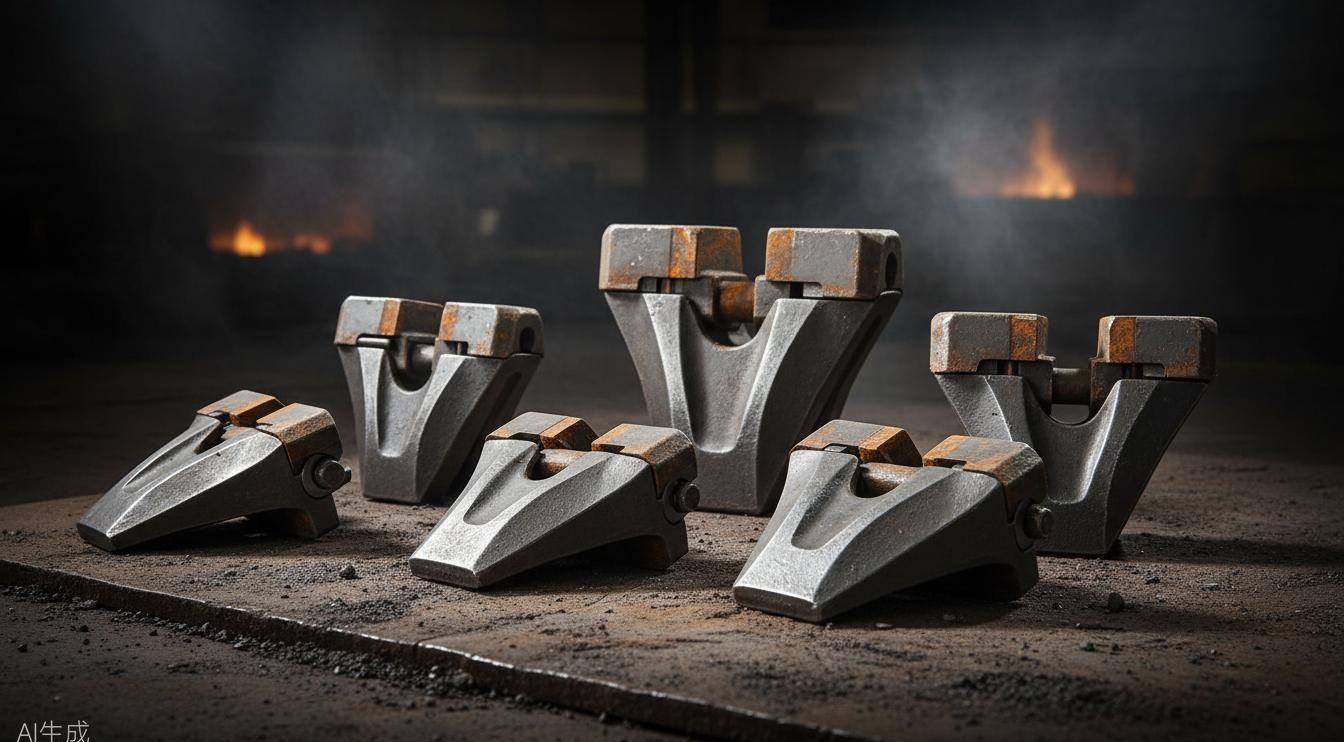
What Is the ESCO Super V System?
The Vertical-Lock V-Pin Architecture
The ESCO Super V system is a vertical-lock tooth retention system designed primarily for large mining excavators in the 40-800 tonne operating weight class. Its defining feature is the V-shaped retention pin — often called the V-keeper or V-pin — which drops vertically from above into a matching V-shaped recess machined into the tooth collar.
Because the V-pin seats into a V-shaped recess, the geometry is self-centering under impact loading. As the tooth experiences the lateral and rotational forces of rock excavation, the V-shaped interface resists the tendency of the tooth to rock or walk in the adapter bore. This is the key mechanical advantage of the Super V design: it converts what would be a problematic rotational force in other systems into a stable self-locking condition.
The system components are:
- Super V Adapter — Cast into the bucket lip, the adapter has a tapered bore sized to the tooth shank profile and a V-shaped keeper slot above the bore. Adapters are system-specific: Super V adapters cannot accept non-Super V teeth.
- Super V Tooth — The replaceable wear component featuring a tapered shank, V-shaped collar recess, and nose profile for the specific application. Super V teeth are available in multiple shank sizes for different machine weight classes.
- V-Keeper Pin — A single hardened steel pin with a V-shaped cross-section matching the tooth collar recess. The pin drops vertically into the V-recess, trapping the tooth collar against the adapter shoulder. Typically HRC 50-55 hardness.
Why Super V Is the Preferred System for Large Mining Excavators
In my experience managing machines from CAT 395 through Liebherr 980 and Hitachi EX3600, the Super V system dominates the 100-tonne-plus machine class for good reason. Because large mining excavators generate extreme dynamic loads during rock excavation — forces that would expelled teeth from less robust retention systems — the Super V vertical-lock geometry provides the most reliable tooth retention of any commercial tooth system I’ve evaluated.
I’ve run both ESCO vertical-lock and horizontal-lock systems on comparable machines in the same operation. The horizontal-lock systems (Komatsu K Max, Hensley Xtra) perform reliably in the 40-80 tonne class where I use them. But above 100 tonnes, in hard rock with blasting-required conditions, I’ve consistently seen the Super V system hold teeth longer without maintenance intervention. The geometry is simply more appropriate for those load conditions.
Understanding Super V Tooth Classes and Sizing
Super V Tooth Series: VS, V70, V90, and V100
ESCO’s Super V catalog spans multiple tooth series sized for different machine weight classes. Getting the correct series for your machine is the foundation of correct specification:
Super V Tooth Series Reference:
- VS Series — For 40-60 tonne excavators (CAT 336, Hitachi ZX350 class). Shank: approximately 35mm. Suitable for quarrying and medium-duty mining.
- V70 Series — For 60-100 tonne excavators (CAT 345, Volvo EC700, Hitachi ZX490 class). Shank: approximately 42mm. The most widely deployed Super V series in global mid-tier mining.
- V90 Series — For 100-200 tonne excavators (CAT 390, Liebherr 940, Hitachi EX1200 class). Shank: approximately 50mm. Requires heavy-duty retention geometry for extreme impact conditions.
- V100 Series — For 200+ tonne excavators (CAT 6090, Liebherr 980, Hitachi EX3600 class). Shank: approximately 60mm. The premium series for ultra-large mining shovels and excavators.
The critical rule: each Super V tooth series requires the matching Super V adapter series. The V70 tooth shank will not seat properly in a V90 adapter bore — the taper angle and bore diameter are different. Attempting to force a mismatch creates dangerous conditions: inadequate shank seating leads to stress concentrations that cause shank breakage, and insufficient bore engagement allows the tooth to work loose during operation.
Tooth Profile Options: Standard vs Penetration vs Severe Service
Within each Super V series, ESCO offers multiple tooth profile options for different applications. Matching the profile to your actual operating conditions is as important as matching the size:
- Standard (ST) Profile — General-purpose digging in mixed materials. Balanced geometry between penetration and wear life. Suitable for overburden, clay, and low-silica sedimentary rock.
- Penetration (PT) Profile — Narrower nose for improved penetration in hard rock. Preferred for pre-blasted rock, quartz reef, and high-compressive-strength materials. Wears faster in abrasive materials but significantly improves bucket fill factor in hard rock.
- Severe Service (SS) Profile — Reinforced collar geometry and thicker nose section for applications with extreme impact loading. Used in primary rock excavation in iron ore and copper-gold operations. Maximum wear life, slightly lower penetration efficiency.
- Wide Profile (WP) — Broader nose for maximum material retention and bucket fill in soft-to-medium materials. Used in bucket rehandling and loading applications rather than primary excavation.
I’ve seen operations spec penetration profiles for soft overburden applications and then wonder why their tooth costs are high — the narrow nose wears faster in abrasive materials because there’s less metal volume. The profile decision should match your material characteristics, not just your machine size.
The Tooth-to-Adapter Matching Process
Step 1: Identify Your Machine and Bucket Assembly
The starting point is always the machine and its bucket assembly specification. Each machine model’s bucket has a specific adapter series — the adapter is matched to the machine’s boom forces, bucket capacity, and intended application. You cannot select the correct Super V adapter without knowing the machine model, bucket size, and the bucket assembly part number from the OEM parts catalog.
For fleet managers operating mixed OEM brands (CAT + Volvo + Hitachi), the good news is that many Super V tooth series have cross-brand applicability — the VS series fits multiple OEM bucket assemblies with the same bore and keeper slot specifications. This cross-brand compatibility is one of the practical advantages of the Super V system for fleet procurement.
Step 2: Verify the Adapter Bore and Keeper Slot Dimensions
Once you’ve identified the correct tooth series for your machine, the next step is physical verification. I’ve developed the habit of measuring every new adapter bore before installing new teeth — not because I don’t trust the specification, but because adapters can wear in ways that aren’t visually obvious.
Key measurements:
- Bore diameter at the tooth seating zone — Measure with a caliper. Compare to OEM specification. If bore diameter has increased by more than 2mm, the adapter is worn beyond the tolerance for reliable tooth seating.
- Keeper slot width and depth — The V-keeper must seat fully into the keeper slot. If the slot has been peened or deformed by keeper movement, the V-keeper won’t fully engage the tooth collar recess.
- Bore taper angle — The bore has a taper (typically 1:8 to 1:10). A worn bore loses its taper geometry, which affects how the tooth shank seats and transfers load to the adapter walls.
Step 3: Confirm the V-Keeper Part Number Match
The V-keeper pin is specific to each tooth series and profile combination. The keeper must match the tooth collar recess precisely — a keeper that’s too small won’t engage the recess fully, and a keeper that’s too large won’t seat properly into the keeper slot.
Because V-keepers are low-cost items (typically $8-15 each), I replace them every single tooth replacement cycle without exception. Reusing a worn keeper is a false economy. A keeper that’s lost its V-cross-section geometry — which happens after extended service — will not retain the tooth properly. I’ve seen the aftermath of a tooth exiting a bucket lip at full digging speed, and it is not something you want to experience with your crew in the vicinity.
The Super V Retention Failure Cascade
Why Super V Teeth Fail — and How to Prevent It
Super V tooth loss events follow a predictable cascade, and understanding this cascade is the key to prevention. Here’s the sequence I’ve observed in my own fleet records and in the operations I’ve consulted with:
⚠️ The Retention Failure Cascade:
- Compacted material accumulates in the V-keeper slot, preventing full keeper seating
- The V-keeper partially seats, creating insufficient engagement with the tooth collar recess
- Under impact loading, the partially-engaged keeper begins to peen the keeper slot walls
- The keeper slot widens progressively with each impact cycle
- The V-keeper can now walk or tilt in the slot, losing full engagement
- The tooth begins to rock in the adapter bore, transmitting impact loads directly to the bore walls
- Adapter bore wear accelerates; tooth shank experiences stress concentrations at the collar
- Tooth shank breakage or complete tooth expulsion — the catastrophic failure event
Because this cascade takes 50-150 hours to complete from the first warning sign to catastrophic failure, there is always a window for intervention if your maintenance team knows what to look for. The most important early warning sign is a clicking or metallic noise during digging operations. If your operators report this, inspect immediately.
Visual Inspection Checklist at Every Tooth Replacement
Here’s the inspection protocol I train my maintenance crews on for every Super V tooth replacement:
- Remove the V-keeper pin — Drive or pull the keeper pin out. Inspect it for wear, deformation, or cracking. Replace if the V-cross-section has been rounded or if any cracking is visible.
- Inspect the tooth collar recess — The V-recess in the tooth collar must be clean and geometrically intact. If the recess has been deformed by keeper impact, the tooth needs replacement.
- Inspect the adapter keeper slot — Look for peening, deformation, or elongation of the keeper slot. Measure the slot width — if it’s more than 2mm wider than the keeper, the adapter needs evaluation.
- Measure the adapter bore diameter — Compare to OEM specification. If bore wear exceeds 2mm from original, note it and monitor at every subsequent replacement.
- Inspect the tooth shank — Look for fatigue cracking at the collar, taper wear at the seating zone, or any visible deformation that would prevent proper seating.
- Clean all seating surfaces — Remove all compacted material from the adapter bore, tooth shank, and keeper slot before reassembly.
- Install new V-keeper pin — Always use a new keeper. Set it fully into the tooth collar recess, then lower it into the adapter keeper slot. Verify full seating by attempting to lift the tooth — it should not lift out with the keeper installed.
Durability Testing and Quality Verification
What Quality Testing Should Your Super V Components Undergo?
If you’re sourcing Super V adapters or teeth from an aftermarket supplier, quality verification is critical. Here’s the testing standard I require from any supplier before I’ll run their products on my machines:
- Metallurgical verification — Chemical composition analysis and mechanical property testing (tensile strength, yield strength, elongation, hardness) per heat number. For Super V teeth, minimum HRC 56 at the surface with core toughness sufficient to resist impact fracture.
- Dimensional verification — Each component should be measured against OEM specification tolerances. The taper angle of the shank and the V-keeper slot geometry are particularly critical — small deviations here cause retention failures.
- Fatigue testing — Quality manufacturers conduct rotary beam fatigue testing on tooth samples to verify fatigue life under simulated impact loading. Ask for test data if you’re evaluating a new supplier.
- Field testing protocol — Any supplier I’m seriously evaluating gets a field test: 4-6 teeth on an operating machine for 200 hours minimum, with documented wear measurements at installation and removal.
Because Super V components operate under extreme cyclic impact loading, fatigue performance is the most important quality indicator. A tooth that looks perfectly fine visually can fail in service if it has internal metallurgical defects or inadequate heat treatment. Material test reports and fatigue test data are not optional — they’re the minimum qualification requirements.
The Heat Treatment Criticality for Mining-Grade Super V Teeth
Super V teeth for mining applications require precise heat treatment to achieve the combination of surface hardness (for wear resistance) and core toughness (for impact resistance) that the application demands. This is not a simple hardening process — it requires a controlled quench and temper cycle that transforms the steel’s microstructure.
The risk with inadequate heat treatment is a tooth that’s too hard and too brittle — it will fracture on impact rather than deform. I’ve seen this happen with low-quality aftermarket teeth that were spec’d to “HRC 58″ but had been insufficiently tempered after quenching, resulting in a brittle microstructure that shattered on the first significant impact. Because quench cracking and tempering defects are not visible from the outside, material test reports per heat number are the only reliable verification.
Field Experience: Super V in Three Mining Environments
Chilean Copper — High Silica, Severe Impact
In the copper operations I work with in northern Chile, the rock is quartz-rich and highly abrasive, and most material requires blasting before excavation. This is one of the most punishing environments for excavator attachments I’ve encountered. The Super V V70 and V90 series teeth in these operations typically achieve 250-400 hours of wear life before requiring replacement — which is good by industry standards but still represents significant tooth consumption.
Because the silica content here exceeds 65% in the primary ore zones, I spec severe-service (SS) profile teeth exclusively in these operations. The reinforced collar geometry and thicker nose section handle the impact loading from blasted rock without the collar fatigue cracking I’ve seen with standard profile teeth in this application. The cost premium of the SS profile is approximately 15% over standard, but the wear life improvement is 30-35%, making it a strongly favorable trade-off.
Australian Iron Ore — High Abrasion, Moderate Impact
In Western Australian iron ore operations, the material is less silica-rich than Chilean copper but significantly more abundant in volume. The primary challenge is abrasion rather than impact — the material cuts and wears rather than shattering. Super V V90 teeth in these operations typically achieve 400-600 hours of wear life, which is substantially better than the Chilean experience.
For Australian iron ore, I spec standard or penetration profiles rather than severe service. The penetration profile is particularly effective here — the improved penetration efficiency in the relatively competent but not blasted material improves bucket fill factors measurably, which translates to more tonnes per hour of machine productivity.
Indonesian Nickel — Corrosive Plus Abrasion
The Indonesian laterite nickel operations introduce a corrosion dimension that most mining teeth specifications don’t adequately address. The laterite material has both high abrasion and significant chloride content from the tropical coastal environment, creating a combined corrosive-abrasive wear mode that’s particularly aggressive on bucket attachments.
For corrosive-abrasive environments like Indonesian nickel, the material selection of the tooth itself matters as much as the hardness specification. Standard low-alloy steel teeth suffer accelerated corrosion-assisted wear in this environment. I’ve had success with higher-alloy formulations that include chromium (minimum 2%) for corrosion resistance, combined with the standard HRC 56-60 hardness range. The cost premium is approximately 20%, but the wear life improvement in chloride-containing laterite is 40-50% compared to standard low-alloy teeth.
The Bottom Line: Super V Selection and Maintenance for Your Fleet
The ESCO Super V system is a mature, well-proven technology that dominates the large mining excavator tooth retention space for good reason. Its single-V-keeper design is mechanically elegant — simple to maintain, fast to service, and highly reliable when installed correctly.
The keys to extracting maximum value from your Super V equipped machines are:
- Match the tooth series and profile to your machine class and material conditions — Don’t spec standard profiles for severe-service applications or vice versa.
- Replace V-keeper pins every tooth cycle — The keeper is a wear item, not a reusable component. Its cost is negligible; the cost of a tooth loss event is not.
- Inspect the adapter bore and keeper slot at every tooth replacement — Early detection of adapter wear prevents catastrophic bore failure requiring bucket lip repair.
- Source from suppliers who provide material test reports per heat number — Heat treatment quality is the difference between teeth that last and teeth that fracture.
- Calculate your true cost per operating hour — The tooth unit price is less relevant than the total cost per hour including replacement labor, fuel impact, and downstream adapter damage.
Browse Zhouyuan Machinery’s Super V and cross-brand adapter catalog to see the current range available for VS through V100 size classes. Their ISO 9001-certified manufacturing with documented material test reports per heat number provides the quality verification foundation you need for large excavator fleet procurement.
Conclusion: The Super V System Rewards Discipline
The ESCO Super V system is one of those mechanical designs that works beautifully when used correctly and creates expensive problems when maintenance discipline lapses. The V-keeper pin is simple, fast to replace, and inexpensive — but it must be replaced consistently at every tooth change. The tooth replacement interval is predictable — measure bore wear and track wear hours — but it must be tracked actively rather than assumed.
I’ve seen the Super V system deliver 400+ hours of reliable service on demanding applications, and I’ve seen it fail catastrophically on machines where the maintenance team skipped the keeper replacement step because they were in a hurry. The difference between those outcomes is not the system — it’s the discipline of the people maintaining it.
Build the inspection protocol, train the crews, track the data. The Super V system will reward you with reliable service and competitive operating costs. Skip the discipline, and you’ll pay for it in repairs and downtime.
Frequently Asked Questions
Post time: Jun-16-2026