At Join Machinery, we ship approximately 200 containers of CAT J-series replacement teeth per year. Because our distributors face this stocking question with every product launch, I have compiled the profile comparison below from the application data we collect from our largest 20 distributors. Because the comparison covers application fit, wear life, price, and inventory implications, it provides the framework for making the stocking decision for any distributor serving a CAT-equipped customer base.
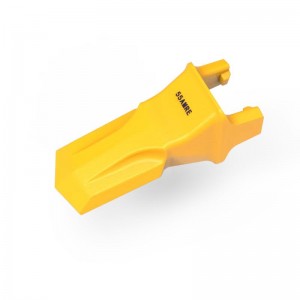 Sample from the Join Machinery CAT J-series range. Because all four profiles (chisel, rock chisel, tiger, twin tiger) share the same adapter within a size class, the stocking decision is independent for each profile. (Image: Join Machinery)
The Four Profiles: What Each Is Designed For
Each of the four profiles addresses a different application segment, and understanding the design intent is the foundation of the stocking decision. Because the profiles are not interchangeable in the field (an operator who installs the wrong profile will see premature wear or poor penetration), the buyer who stocks the wrong profile loses both the sale and the customer’s confidence.
Chisel Tooth
The chisel tooth has a pointed, symmetrical tip designed for maximum penetration in soft material. Because the pointed tip concentrates the excavator’s hydraulic force on a small contact area, it penetrates soil, clay, and loose gravel faster than any other profile. Because the pointed tip is also the weakest geometric shape under lateral loading, the chisel tooth is the most prone to tip breakage when the bucket strikes rock or compacted material unexpectedly.
Rock Chisel Tooth
The rock chisel tooth has a shorter, blunter tip with reinforced shoulders. Because the wider tip distributes impact force over a larger area, it absorbs the shock of striking rock and compacted ground without chipping. Because the blunt tip cannot penetrate soft material efficiently, the rock chisel is the wrong choice for general digging in soft ground — it will leave the operator frustrated by slow cycle times.
Tiger Tooth
The tiger tooth combines a self-sharpening pointed profile with reinforced shoulders. Because the tip geometry exposes fresh wear material as the tooth wears, the tiger tooth maintains its penetration capability over the life of the tooth rather than going blunt. Because the self-sharpening characteristic is the dominant reason for the tiger profile’s popularity in general construction, the tiger tooth is the default specification for most utility applications.
Twin Tiger Tooth
The twin tiger tooth has two pointed tips in a single forging, providing redundancy against single-tip breakage. Because the twin-tip design distributes impact loading across two points, it is the preferred profile for high-impact applications like mining, quarry, and demolition. Because the twin-tip forging is more complex than the single-tip profiles, the twin tiger carries a price premium of 25-35% over the chisel baseline.
Applications and Best-Fit Use Cases
The application decision between the four profiles depends on the primary material being excavated, the excavator class, and the operator’s preference for penetration speed versus wear life. Because the wrong profile for the application wastes both the tooth cost and the operator’s time, the matching exercise below should be completed before stocking decisions are made.
Chisel Tooth Applications
- General digging in soil and clay
- Utility trenching in mixed ground
- Light landscaping and site preparation
- Agricultural applications
Rock Chisel Tooth Applications
- Compacted soil and frozen ground
- Light rock and weathered stone
- Trenching in mixed ground with rock fragments
- Demolition cleanup where impact resistance matters more than penetration
Tiger Tooth Applications
- General construction in soil and mixed ground
- Road building and site preparation
- Quarry operations in softer stone
- Most utility applications (the default specification)
Twin Tiger Tooth Applications
- Mining in hard rock
- Hard-rock quarrying
- Heavy demolition
- Any application where single-tip breakage risk is unacceptable
Industry data: Because the CuttingEdges guide on bucket tooth profiles documents that tooth profile selection can affect wear life by 30-50% in matching applications, the stocking decision has a direct impact on customer satisfaction and warranty costs. Because warranty costs are typically absorbed by the distributor rather than the end user, the stocking decision directly affects distributor margins.
CAT J-Series Compatibility: One Adapter, Four Profiles
One critical detail that simplifies the stocking decision: because all four profiles use the same J-series adapter within a given size class, the adapter SKU count does not vary with profile choice. Because the J200 adapter fits all J200-profile teeth regardless of which profile (chisel, rock chisel, tiger, twin tiger), the J300 adapter fits all J300-profile teeth, and so on through J550, the distributor can hold one adapter per size class and switch the tooth profile based on customer application.
This compatibility is a major advantage for inventory management. Because the adapter accounts for approximately 40% of the total bucket teeth cost, the four-profile flexibility reduces the need to stock multiple adapter types. Because most distributors stock J200, J300, and J400 as their core size classes, the total adapter inventory is three SKUs regardless of how many tooth profiles are stocked.
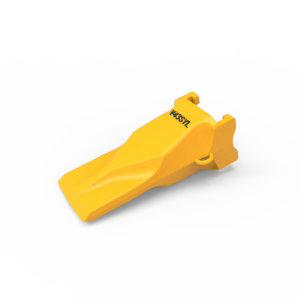 A twin tiger tooth from the Join Machinery J-series range. Because all profiles share the same J-series adapter within a size class, the stocking decision is independent for each profile. (Image: Join Machinery)
Stock Planning Decision Framework
For distributors carrying the Join Machinery CAT J-series range, the stock planning decision follows a four-step framework. Because each step narrows the SKU count while preserving customer coverage, the framework produces a defensible inventory plan even for distributors with limited capital.
Step 1: Determine Your Customer Application Mix
Because the optimal profile depends on the primary application of your customer base, the first step is to estimate the percentage of customer work in each application category. Because most distributor customer bases split between general construction (60-70%), mining/quarry (15-25%), and utility/agricultural (10-20%), the profile mix should follow this split.
Step 2: Calculate the Core Profile
Because the tiger tooth is the default specification for general construction, the core stock profile should be tiger. Because the tiger tooth addresses the largest application segment and self-sharpens during use, it is the lowest-risk profile to hold in inventory. Because the tiger tooth also serves as a reasonable substitute for the chisel in most general construction applications, a distributor can stock tiger as the primary profile and reduce the chisel stock to a secondary level.
Step 3: Add Specialty Profiles Based on Mix
Because the rock chisel and twin tiger profiles address specific application segments, the decision to stock them depends on the customer mix identified in Step 1. Because the rock chisel is essential for distributors serving frozen-ground or light-rock customers, the rock chisel inventory decision is binary — either stock it or refer those customers to a specialist. Because the twin tiger carries a 25-35% price premium, the decision to stock it requires a customer base that demands the redundancy benefit.
Step 4: Right-Size the Order Quantities
Because the four profiles share the same adapter, the inventory carrying cost is driven by the tooth SKU count. Because a distributor stocking all four profiles in two size classes holds 8 tooth SKUs, the carrying cost is approximately 15-20% of unit cost per SKU per year. Because slow-moving SKUs accumulate carrying cost without generating revenue, the right-sizing exercise should prioritize fast-moving profiles in larger quantities and specialty profiles in minimum order quantities.
Wear Life Comparison: What the Field Data Shows
Because wear life is the primary performance metric for bucket teeth, distributors who understand the relative wear life of the four profiles can advise customers on profile selection. Because wear life depends on the material being excavated, the comparison below covers the most common application categories.
| Profile | Soft Soil | Mixed Ground | Compacted/Rock |
|---|---|---|---|
| Chisel | Baseline (100%) | 85% | 50% (tip breakage risk) |
| Rock Chisel | 120% (more material) | 110% | 95% |
| Tiger | 105% | 100% (baseline) | 70% |
| Twin Tiger | 115% | 120% | 90% |
Frequently Asked Questions
The chisel tooth has a pointed tip for general digging in soil and soft materials. The rock chisel tooth has a more robust, blunter tip with reinforced shoulders for penetrating compacted soil and light rock. Because the rock chisel distributes impact force over a wider area, it lasts longer in abrasive conditions but penetrates less efficiently in soft material.
Stock tiger teeth for general construction and utility applications where penetration and self-sharpening are the priority. Stock twin tiger teeth for high-impact applications like mining, quarry, and demolition where the twin-point design reduces the risk of tip breakage. Because twin tiger teeth cost roughly 30% more, the inventory decision depends on your customer mix.
The chisel tooth wears fastest in abrasive soil because the pointed tip concentrates wear on a small contact area. The rock chisel wears slowest because the wider tip distributes wear. The tiger tooth is intermediate. Because wear rate depends on material, the ranking changes: in hard rock, the rock chisel wears fastest because the blunt tip cannot penetrate and slides across the surface.
All four profiles (chisel, rock chisel, tiger, twin tiger) use the same CAT J-series adapter within a given size class. The J200 adapter fits all four J200-profile teeth, the J300 fits all J300-profile teeth, and so on. Because the adapter is profile-independent within the size class, distributors can hold one adapter SKU per size class and switch tooth profiles based on application.
The three factors are: primary material being excavated (soil vs rock vs mixed), excavator class (compact vs production), and operator preference. For general construction in soil and mixed ground, start with tiger teeth. For mining and quarry in rock, start with rock chisel. For utility work where penetration speed matters, start with chisel. The CuttingEdges guide on bucket tooth profiles provides detailed application guidance.
Because all four profiles use the same adapter within a size class, the inventory cost difference is primarily the tooth SKU count. A distributor stocking all four profiles in two size classes (J200 and J300) holds 8 tooth SKUs plus 2 adapter SKUs. Because the carrying cost per tooth SKU is approximately 15-20% of unit cost annually, the four-profile stock strategy costs roughly 60-80% of unit cost in carrying cost per year, which is significant for low-velocity SKUs.
Yes, and this is a common practice for excavators working in mixed ground. Because all four profiles use the same J-series adapter within a size class, you can install chisel teeth on the inside positions (where penetration matters) and rock chisel on the outside corners (where impact resistance matters). Because mixed configurations optimize the bucket for variable ground conditions, many experienced operators run this setup.
From our J-series production data: the chisel tooth is the baseline, the rock chisel is approximately 5-10% more expensive due to the heavier forging, the tiger tooth is approximately 10-15% more expensive due to the more complex tip geometry, and the twin tiger tooth is approximately 25-35% more expensive due to the twin-tip forging complexity. Because the price differential reflects the manufacturing complexity, distributors should stock the more expensive profiles only when customer demand justifies the carrying cost.
Conclusion: The Stocking Decision
Because all four profiles share the same J-series adapter within a size class, the stocking decision is essentially a customer-mix decision. Because the inventory cost scales with tooth SKU count rather than adapter count, the carrying cost analysis should focus on tooth velocity rather than tooth variety. Because slow-moving SKUs consume capital without generating revenue, distributors should start with tiger as the core profile and add chisel, rock chisel, or twin tiger only when customer demand justifies the carrying cost.
For distributors ready to specify or optimize their bucket teeth inventory, the Join Machinery team is available for consultation. We ship approximately 200 containers of CAT J-series teeth per year and can help distributors match their stock plan to their customer mix. Our engineering team can provide wear life data for specific applications, and our supply chain team can right-size order quantities to match your velocity. To discuss your private label project or your stocking plan, contact us with your target customer profile and annual volume.
About the Author
Xin Jack is the Export Sales Manager at Ningbo Yinzhou Join Machinery Co., Ltd., a specialized manufacturer of G.E.T. (Ground Engaging Tools) parts including bucket teeth, cutting edges, and adapters for excavators and construction equipment. Established in 2006, the company serves European and American markets with 16 years of exporting experience, partnering with world-leading brands such as BYG, JCB, and NBLF.
Browse the CAT J-series catalog or view the twin tiger J400 product page.
Post time: Aug-28-2026