Why the J-Series vs K-Series Decision Matters for Mining Fleets
Caterpillar offers two distinct bucket tooth families, the J-series and the K-series, and the choice between them determines how an excavator performs across the full range of digging conditions a mine operation encounters. The J-series, sometimes called the J-system or the vertical pin system, is the older of the two designs and remains the default fitment on most general-purpose Caterpillar excavators leaving the factory. The K-series, sometimes called the K-system or the horizontal pin system, is the newer design and is the OEM choice for high-impact mining and quarry applications.
For an OEM bucket tooth supplier serving the global mining market, both series are part of the standard product range because mine operators run mixed fleets with both fitments, and operators need replacement teeth that match the adapter already welded to their buckets. From our shipment records over the last decade, the J-series accounts for roughly 60 percent of the volume we ship to general construction and municipal customers, while the K-series accounts for the majority of the volume we ship to hard-rock mining, quarry, and iron ore customers. The split reflects the operating conditions of each customer base, and the procurement question for fleet managers is not which series is better in absolute terms but which series is right for each specific digging condition in the operation.
For an overview of the full Caterpillar series product range at our facility, the J-series and K-series share the same size numbering logic, with each K-series size running approximately one size up from the corresponding J-series. The J250 is paired with the K90, the J300 with the K100, the J350 with the K110, the J400 with the K130, and the J460 with the K170. This pairing simplifies the procurement workflow for mine buyers who need to specify both series on the same frame contract, because the size range can be referenced by the J-series number and the K-series equivalent is determined by a simple lookup. For reference, the SAE J437 specification covers the through-hardened steel grade used in both series, and the Hensley chisel point bulletin covers the asymmetric geometry that defines the K-series profile.
Tooth Profile Geometry: Symmetric Blunt vs Asymmetric Sharp
The most visible difference between the J-series and K-series is the tooth profile geometry. The J-series uses a symmetric blunt point profile with a roughly conical tip and a self-sharpening wear pattern that is symmetrical about the tooth axis. The K-series uses an asymmetric sharp point profile with a chisel-like tip and a self-sharpening wear pattern that is offset to one side of the tooth axis. The two geometries are designed for different failure modes in the dig cycle, and the choice between them depends on the primary wear mechanism the tooth will see in operation.
The J-series blunt point is optimized for general-purpose digging in mixed ground including sand, gravel, soft clay, and light rock. The blunt profile distributes the impact load across a larger surface area, which reduces the stress concentration at the tip and extends service life in low-impact conditions. In medium-impact conditions, the blunt point wears back evenly and reaches end-of-life when the shank is exposed. The J-series geometry is the right choice for utility work, road building, land clearing, and similar applications where the digging impact is moderate and the abrasive wear is the primary failure mode.
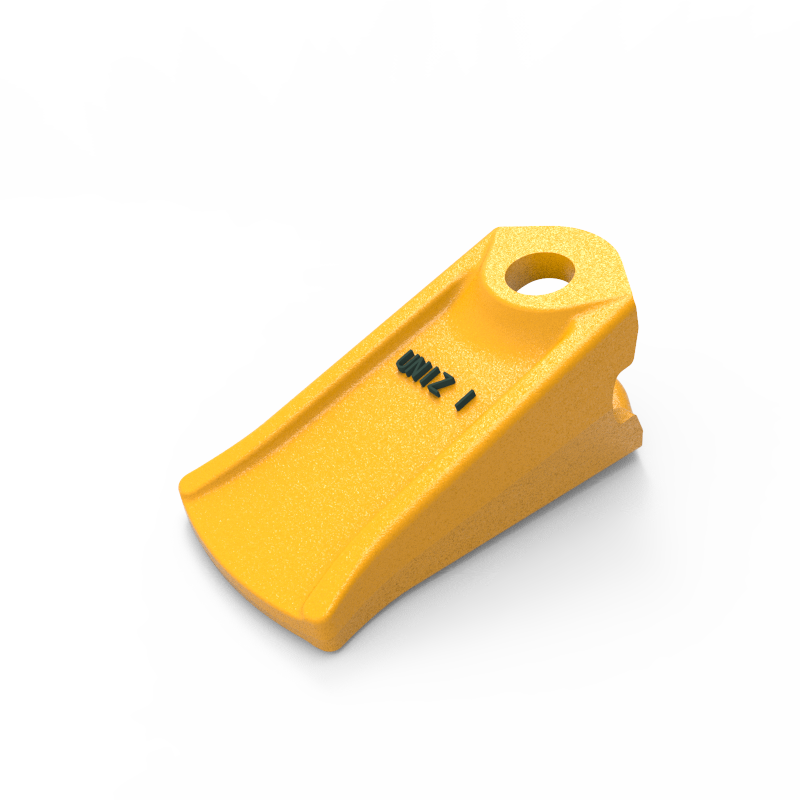
The K-series sharp point is optimized for high-impact digging in abrasive rock. The chisel-like profile concentrates the impact force on a smaller surface area, which increases the penetration rate and reduces the cycle time in hard digging. The asymmetric wear pattern means the tip maintains a sharp edge throughout the wear life rather than rounding off, which keeps the tooth penetrating efficiently. The K-series geometry is the right choice for iron ore mining, copper mining, hard-rock quarrying, and similar applications where the digging impact is high and the abrasive wear is severe. From our UNI-Z standard tooth product line, the same geometry tradeoff applies, and customers who move from J-series to K-series in the most abrasive dig zones typically see a 30 to 50 percent service life extension.
Retention System: Vertical Pin vs Horizontal Pin
The second key difference between the J-series and K-series is the retention system used to hold the tooth on the adapter nose. The J-series uses a vertical retention pin that drops down through the top of the adapter and seats in a groove in the tooth heel. The K-series uses a horizontal retention pin that slides in from the side of the adapter through a bore in the tooth shank. Each retention system is matched to the tooth profile geometry and the adapter nose design, and the two systems are not interchangeable.
The J-series vertical pin retention has the advantage of being visible from the top of the bucket, which makes field inspection straightforward. A mine maintenance technician can walk along the bucket lip and visually check each pin without removing the tooth. The disadvantage of the vertical pin is that it is exposed to direct wear from the material flowing over the bucket lip, which can cause the pin to wear prematurely in highly abrasive conditions. In Pilbara iron ore operations, we have observed J-series vertical pins wearing back to 50 percent of their original diameter within 250 to 300 service hours, which requires pin replacement at every second tooth change.
The K-series horizontal pin retention has the advantage of being protected from the direct material flow by the adapter nose body, which extends pin life in highly abrasive conditions. Pilbara operations running K-series teeth typically see horizontal pin life of 500 to 700 service hours, which is roughly double the J-series pin life in the same conditions. The disadvantage of the horizontal pin is that field inspection is more difficult because the pin is not visible from the top of the bucket, and the maintenance technician must feel for pin movement at the side of the tooth to check retention integrity. From our supply data, mine workshops that run K-series teeth typically schedule pin inspection at every 100 service hours as a preventive maintenance task.
Size Range Mapping and Excavator Class
The size range mapping for J-series and K-series is determined by the adapter nose geometry, which is in turn matched to the excavator class. The standard mapping is J200 for 10 to 15 ton class, J250 for 15 to 20 ton class, J300 for 20 to 30 ton class, J350 for 30 to 40 ton class, J400 for 40 to 50 ton class, and J460 and larger for 50 ton and above. The corresponding K-series sizes are K80, K90, K100, K110, K130, and K170, which run one size range up from the J-series equivalent to accommodate the slightly different shank geometry.
For mine procurement teams, the size range is determined by the adapter currently welded to the bucket rather than by the excavator model. A Caterpillar 320 with a J300 adapter will use a J300 tooth, and a Caterpillar 320 with a K100 adapter will use a K100 tooth, but the same machine can be equipped with either adapter depending on the bucket configuration ordered from the factory or the retrofit decision made by the mine workshop. The most common retrofit path is from J-series to K-series in the most abrasive dig zones, with the J-series retained in the lower-wear zones where the blunt point profile is sufficient. The official Caterpillar parts catalog is published on the OEM parts portal and the corresponding Hensley aftermarket specification cross-references the OEM part numbers to the aftermarket equivalents used in mixed fleet operations.
For a typical open-pit iron ore operation, the size distribution across the fleet usually follows the machine class distribution, with 20 to 30 ton class excavators in the majority and running J300/K100 series teeth, supplemented by 30 to 40 ton class machines running J350/K110, and 40 to 50 ton class machines running J400/K130. A frame contract for an operation of this scale typically covers four to five size ranges, with the volume weighted toward the most common excavator class. Our UNI-Z flat tooth product line is also available in the same size range mapping and can be specified as an alternative to either the J-series or K-series for mine buyers who want a third option.
Wear Material Grades and Heat Treatment
The wear material grade options are essentially the same between the J-series and K-series, and the selection of wear material grade is independent of the series selection. The two standard grades are through-hardened steel at 477 to 532 HB and forged austempered steel at 555 to 600 HB, with the heavy-duty austempered grade at 600 to 650 HB available for the most abrasive dig zones. Mine procurement teams can specify either grade on either series without affecting the price tier significantly, and the choice between grades is determined by the digging condition rather than the series.
For general construction and light mining, the through-hardened grade is the default and delivers adequate service life at the lower unit cost. The through-hardened grade is suitable for sand, gravel, soft clay, limestone, and low-abrasion iron ore zones. For hard-rock mining, primary ore loading, and high-abrasion iron ore, the forged austempered grade is the standard recommendation because it resists both abrasive wear and impact fracture better than the through-hardened grade. The austempered grade typically delivers 30 to 50 percent longer service life in the same digging condition, which more than offsets the higher unit cost for mine operations with high annual tooth consumption. The SAE J437 and J439 standards are the reference specifications our foundry uses for both grades, and the equivalent Hensley wear material technical bulletin documents the grade selection logic for the most common mining applications.
For mine buyers specifying the wear material grade, the practical decision rule is to start with the through-hardened grade on the J-series for general construction work and the austempered grade on the K-series for primary mining work. The combination matches the typical procurement pattern we see in the market, with J-series through-hardened for the lighter-duty fleet and K-series austempered for the heavier-duty fleet. For buyers who want to consolidate the grade across both series, the austempered grade on the J-series is a valid option that delivers longer life at a slightly higher unit cost.
Application Guidance: Matching Series to Digging Condition
The application guidance for matching J-series vs K-series to a specific digging condition follows three rules. First, for general construction work in mixed ground, the J-series is the right choice because the blunt point profile is more durable in low-impact conditions and the lower unit cost matches the lower service intensity. Second, for hard-rock mining and quarry work in abrasive conditions, the K-series is the right choice because the sharp point profile maintains penetration and self-sharpens under impact loading, delivering longer service life per tooth. Third, for mixed fleets that see both general construction and hard-rock work, a combination of J-series on the lighter-duty machines and K-series on the heavier-duty machines is the most cost-effective approach.
For Australian open-pit iron ore operations, the K-series is the dominant choice for primary ore loading because the digging condition is consistently hard-rock and abrasive. From our UNI-Z adapter product line supply data, the K-series in austempered grade is the most common configuration we ship to Pilbara customers, and the typical service life is 350 to 500 hours per tooth in primary ore loading. The J-series in through-hardened grade is typically used in the support fleet for road building, cleanup, and overburden removal where the digging condition is less severe.
For North American aggregate quarry operations, the J-series remains the dominant choice because the digging condition is mixed ground with moderate impact, and the lower unit cost of the J-series matches the lower service intensity of the operation. The K-series is used selectively in the limestone and granite quarries where the rock is harder, and the typical service life for the K-series in aggregate quarry duty is 200 to 300 hours per tooth.
Procurement Framework for Mixed Series Orders
For mine procurement teams running mixed fleets with both J-series and K-series teeth, the procurement framework typically covers both series on a single frame contract with separate size range line items. The frame contract is structured by size range rather than by series, with each size range line item covering both the J-series and K-series tooth options. The buyer can then specify the series on a per-shipment basis based on the current dig plan and the wear rate data from the previous month.
For a typical open-pit mine operation, the frame contract structure covers four to six size ranges, with the volume weighted toward the most common excavator class. The contract typically runs for 12 months with monthly shipment cadence, and the per-ton pricing is calculated by estimating the annual consumption of each size range and dividing by the expected service life. Mine buyers who run the frame contract structure typically achieve 15 to 25 percent unit cost savings over spot pricing, with the trade-off being a minimum monthly volume commitment.
For mine buyers who want to compare J-series and K-series pricing for a specific size range, our Caterpillar series catalog lists both options in the same size range with the per-ton pricing for each. The K-series typically runs 10 to 20 percent higher in unit price than the J-series in the same size range, but the longer service life in hard-rock conditions typically delivers a lower total cost per cubic meter moved. For benchmark pricing against the global wear material market, the ferro alloy pricing portal publishes the daily index for the alloying elements used in both grades, and the SAE International standards portal carries the reference heat treatment specifications for ground engaging tool steel grades.
Frequently Asked Questions from Caterpillar Fleet Managers
What is the main difference between Caterpillar J-series and K-series bucket teeth?
Caterpillar J-series bucket teeth use a vertical retention pin design and a symmetric blunt point profile, optimized for general-purpose digging in mixed ground. Caterpillar K-series teeth use a horizontal retention pin and an asymmetric sharp point profile, designed for high-impact digging in abrasive rock. The J-series is the more common fitment for general construction, while the K-series is the OEM choice for hard-rock mining and quarry duty. Both series are produced in the same size range from J200/K80 up to J600/K170, so the selection between them is determined by the digging condition rather than the machine class.
Can a K-series tooth fit on a J-series adapter?
No. The J-series and K-series use different adapter nose geometries, and a K-series tooth cannot physically seat on a J-series adapter. The retention pin orientation is the most visible difference: the J-series pin drops in vertically from the top of the adapter, while the K-series pin slides in horizontally through the side of the adapter. Beyond the pin orientation, the shank angle, the retention groove, and the nose fillet radius are all different between the two series, so an adapter is not interchangeable across series.
Which series is more cost-effective for high-abrasion iron ore mining?
The K-series is the more cost-effective choice for high-abrasion iron ore because the asymmetric point profile maintains penetration and self-sharpens under impact loading, extending the service life by 30 to 50 percent over the J-series blunt point. For a typical Pilbara iron ore operation moving 5 million bank cubic meters per year, switching a fleet from J-series to K-series teeth in the most abrasive dig zones reduces annual tooth consumption by approximately 25 to 35 percent, which more than offsets the higher K-series unit price.
Does the wear material grade differ between J-series and K-series?
The wear material grade options are essentially the same between the two series, with both available in through-hardened steel at 477 to 532 HB and forged austempered steel at 555 to 600 HB. The selection of wear material grade is independent of the series selection, and a J-series tooth can be specified in the higher austempered grade for high-impact applications just as easily as a K-series tooth. The difference between the series is the point geometry and the retention system, not the wear material grade options.
How do I identify the correct size range for my excavator when ordering replacement teeth?
The correct size range is determined by the adapter nose currently welded to your bucket, not by the excavator model alone. The standard size mapping is J200/K80 for 10 to 15 ton class, J250/K90 for 15 to 20 ton class, J300/K100 for 20 to 30 ton class, J350/K110 for 30 to 40 ton class, J400/K170 for 40 to 50 ton class, and J460 and larger for 50 ton and above. If the existing adapter is original Caterpillar equipment, the part number stamped on the adapter identifies the size range directly and can be cross-referenced to the corresponding J or K series tooth.
For Caterpillar fleet managers evaluating the J-series vs K-series bucket tooth choice for mining and construction operations, our team can provide the size range mapping for your specific excavator class, the wear material grade recommendation for your digging condition, and the per-ton frame contract pricing for both series. Reach out through our Caterpillar series product page with your machine class, fleet size, and target port to receive a quotation within two business days.
Written by Xin Jack — Export Sales Manager at Ningbo Yinzhou Join Machinery Co., Ltd. We are a specialized manufacturer of G.E.T. (Ground Engaging Tools) parts including bucket teeth, cutting edges, and adapters for excavators and construction equipment. Established in 2006, the company serves European and American markets with 16 years of exporting experience, partnering with world-leading brands such as BYG, JCB, and NBLF. Every product undergoes strict quality control from raw material to finished goods, ensuring maximum cost performance for global construction and mining customers. Connect: Facebook
Post time: Jul-15-2026