Quick Answer (TL;DR)
- J-series numbers run J200 → J800, where the larger the number the heavier the tooth and the bigger the machine class. J200 sits on mini excavators; J300 is the most common size; J550 and up handle mining shovels.
- A correct tooth-to-adapter match is decided by class, pin code, and retainer code — not just shape. Using a J300 tooth on a J250 adapter (or vice versa) will destroy the adapter nose within hours on a rock face.
- A genuine J300 rock-chisel tooth weighs 5.2 kg and uses pin 9J2308 + retainer 8E6259. A standard J300 long tooth weighs roughly 4.5 kg and uses pin 8E6258 + retainer 8E6259. Same visual class, different part.
- NBJM manufactures the full J200–J800 tooth and adapter range in alloy steel, with verified 48–52 HRC hardness, ≥1400 MPa tensile strength, and ≥20 J Charpy shock impact.
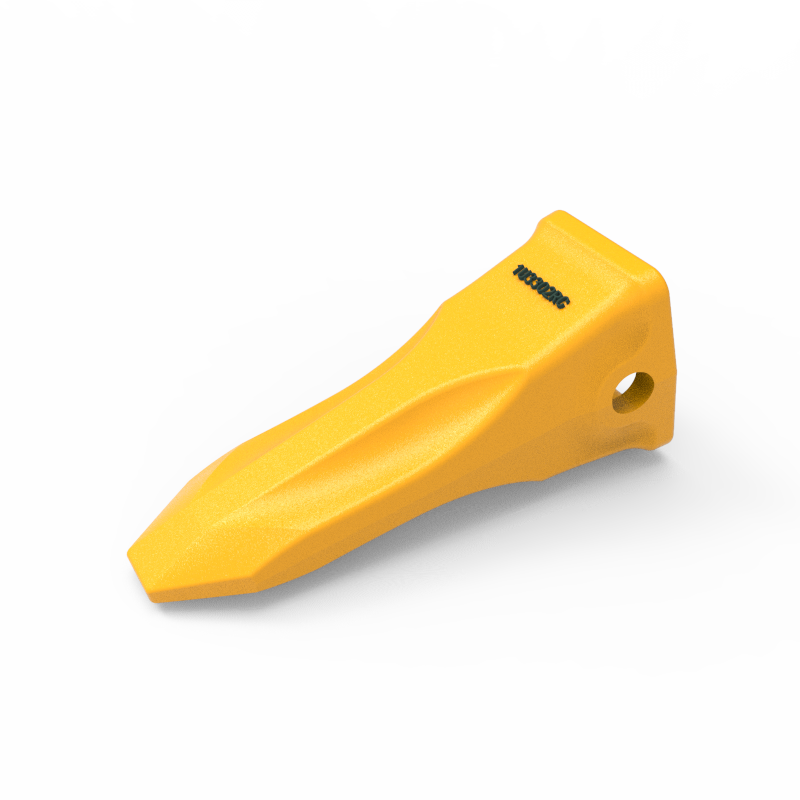
Four hours. That is how long it took a J300 tooth to destroy a perfectly good J250 adapter on a limestone face in West Java.
I was on the line with the site supervisor when the photo came through: the adapter nose had rolled over like tinfoil, the pin was sheared, and the retainer had disappeared into the bucket. The machine was a 20-ton class excavator. The tooth looked like a J300. The adapter, welded onto the bucket two seasons earlier, was a J250. Because the J-series classes do not forgive this kind of mix-up, four hours of work cost roughly USD 2,000 in parts and a full day of downtime.
The root cause of that incident — and roughly seven out of ten fitment failures we see in the field — is mis-matched J-series class size. This guide is the document I now send to every new buyer before they order from our J200–J800 tooth and adapter range. It walks through how CAT actually names the sizes, what the differences look like in the hand, how to match tooth to adapter using pin and retainer codes, and which J-series class your machine really needs.
How the CAT J-Series Naming System Actually Works
The J-series is Caterpillar’s internal class system for ground-engaging tools (GET). Each “J” number is a class, not a specific part. Within a class, CAT publishes dozens of tooth profiles — standard long, twin tiger, rock chisel, rock penetration, heavy duty, with sleeve, and so on. They all share the same nose geometry so they fit the same adapter family, but their shape, weight, and alloy recipe are tuned for different materials.
Because each class is a size envelope, the number itself tells you three things at once: approximate machine class, nose geometry, and pin/retainer family. J200 is the smallest series, designed for mini excavators in the 1–3 ton range. J250 steps up to compact and small standard machines. J300 is the workhorse class on 18–25 ton excavators. J400 covers 30–40 ton production machines. J460 sits in heavy-duty 40–50 ton applications. J550 and above move into the mining shovel and large front shovel territory.
Inside each class, CAT uses suffixes to mark the profile variant. Common suffix patterns include:
- No suffix (for example 1U3302) — standard long tooth for general digging in dirt, clay, and loose rock.
- RC (for example 1U3302RC) — rock chisel, a reinforced collar and higher-alloy recipe aimed at fractured rock and shot rock.
- RP (for example 4T2353RP) — rock penetration, a self-sharpening profile that drives deeper into blasted rock.
- TL (for example 1U3252TL, 7T3402WTL) — twin tiger long, a heavy-duty variant with thicker cross-section for impact loading.
- SK (for example 9W8452SK) — supplied with sleeve, used on classes where the adapter geometry needs a wear sleeve.
One important nuance: because two part numbers can share a class, two teeth in the same class can look almost identical and still weigh noticeably different amounts. That difference is not a quality issue. It is the profile design doing its job — the rock chisel carries extra mass behind the point to absorb impact, the standard long trades that mass for longer wear life in softer material.
J200 to J550: Side-by-Side Dimensions, Weights & Fitment Notes
The table below is the working reference our export team uses when a buyer sends a photo of a worn tooth and asks “what size is this?” Weights are nominal product weights for the standard long profile; rock chisel and twin tiger variants in the same class run 10–20% heavier because of reinforced collars and thicker cross-sections.
| Class | Typical Part Numbers | Nominal Weight (standard long) | Typical Machine Class | Pin | Retainer |
|---|---|---|---|---|---|
| J200 | 4T1204 (weld-on adapter base), 4T2244 tooth | ~1.2 kg | Mini excavators 1–3 ton | Weld-on style (no separate pin) | Weld-on |
| J220 | 6Y3222 (standard dirt digging) | ~1.7 kg | Mini / compact 3–6 ton | 8E5461 (or weld-on) | 8E5462 |
| J250 | 1U3252 (standard long side-pin), 1U3252TL (twin tiger long), 9N4252 (long heavy duty) | 2.8 kg | Compact & small standard 5–15 ton | 8E6258 | 8E6259 |
| J300 | 1U3302RC (rock chisel), 9N4302 (long heavy duty) | 5.2 kg (rock chisel) | Standard excavators 18–25 ton | 9J2308 | 8E6259 |
| J350 | 4T2353RP (rock penetration) | ~7.5 kg | Standard & heavy 25–30 ton | 9J2358 | 8E6259 |
| J400 | 7T3402 (general standard long), 7T3402WTL (twin tiger long) | ~10.5 kg | Heavy production 30–40 ton | 7T3408 | 8E8409 |
| J460 | 9W8452SK (with sleeve) | ~16.5 kg | Heavy duty 40–50 ton | 9W8454 | 9W8455 |
| J550 | J550 series (mining) | ~25 kg | Large excavators 50–80 ton, mining class | 6Y0604 | 6Y0605 |
| J600 / J700 / J800 | Larger mining classes | ~35–70 kg | Front shovels, rope shovels, ultra-class mining | Class-specific | Class-specific |
Weights above are nominal for the standard long profile within each class. Rock chisel (RC), rock penetration (RP), twin tiger long (TL), and heavy duty variants run heavier because of reinforced geometry. All NBJM J-series teeth are produced under ISO 18787:2021 quality-controlled processes and verified per ISO 9249 earth-moving machinery test methods.
Three fitment notes I want to flag from real field experience:
- J250 and J300 share the same retainer (8E6259) but use different pins (8E6258 vs 9J2308). That looks like a parts commonality win, but in practice it is a fitment trap. If you swap pins between the two classes, the tooth will appear to lock but will rock on the adapter nose and wear the retainer out in a matter of days.
- J400 uses a different retainer (8E8409) than J300. The retainer geometry changed when CAT moved to heavier machines, so a J300 retainer will physically click into a J400 tooth but the cross-section is wrong for the impact loads of a 35-ton machine.
- J460 (9W8452SK) ships with a wear sleeve. The sleeve is not optional. Without it, the adapter nose wears into a flare shape and the tooth starts to wobble within the first 200 hours of operation.
Adapter-to-Tooth Matching: Pin, Retainer, and the Three Mistakes We See Every Month
The retention system on a J-series tooth looks simple: a horizontal pin through the adapter nose, locked by a retainer clip. In practice, the matching rules are unforgiving, because a mismatch forces all the impact energy into the wrong components, and the failure cascade is fast and expensive.
The matching rules
- Class must match exactly. A J300 tooth only fits a J300 adapter. Same class = same nose geometry. Different class = no-go, no matter how similar the parts look.
- Pin code must match the class spec. Pin diameter, length, and hardness are engineered for that class’s impact loading. A J300 tooth on a J300 adapter that has been re-pinned with a J250 pin will work loose within hours.
- Retainer must be the correct class retainer. The retainer locks the pin. If the retainer is wrong, the pin walks out.
- Weld-on adapters skip the pin system entirely. J200 weld-on adapters (such as 4T1204) attach directly to the bucket lip by welding, with the tooth welded or cast directly onto the adapter nose.
The three mistakes we see every month
- Forcing a J300 tooth onto a J250 adapter. The nose on a J250 adapter is physically smaller. Buyers sometimes force it because the part numbers look similar. Result: rolled adapter nose, cracked tooth pocket, and a weld repair that costs more than a fresh adapter set.
- Reusing old pins with new retainers (or vice versa). Worn pins change dimension; worn retainers lose spring tension. Mixing old and new components in the same retention system is one of the leading causes of lost teeth in the field.
- Skipping the retainer entirely. Some operators leave the retainer out and rely on a bent nail or wire to hold the pin. This works for about a day. The pin walks, the tooth rotates, and the adapter nose is destroyed.
For the J300 rock chisel profile specifically, our 1U3302RC J300 rock chisel tooth ships verified at 5.2 kg, with 9J2308 pin and 8E6259 retainer matched. Hardness is held at 48–52 HRC, tensile strength ≥1400 MPa, with Charpy shock impact ≥20 J at −20 °C per ISO 148-1 testing. The “RC” suffix here is not marketing — the alloy recipe is a step higher than the standard 1U3302, because the reinforced collar on a rock chisel is taking impact loads the standard long never sees.
Two J300 Teeth That Look Identical — How to Tell Them Apart
Last spring we had a buyer in Eastern Europe send a side-by-side photo of two J300 teeth he had received from two different suppliers. The teeth were visually almost identical: same silhouette, same yellow paint, same approximate length. On the workshop scale, however, one tooth was 5.2 kg and the other was 4.4 kg. He asked which one was the “real” CAT tooth.
The honest answer is that both can be legitimate J300 teeth — the difference is the profile, and the profile is encoded in the part number suffix.
| Part Number | Profile | Typical Weight | Where It Is Used |
|---|---|---|---|
| 1U3302 | Standard long | ~4.4 kg | General digging in dirt, clay, and loose ground |
| 1U3302RC | Rock chisel (reinforced collar) | 5.2 kg | Fractured rock, shot rock, quarry faces |
| 9N4302 | Long heavy duty | ~5.0 kg | High-impact digging in mixed material |
| 1U3302WT | Twin tiger long (heavy section) | ~5.6 kg | Severe abrasion with intermittent impact |
The identification logic is straightforward:
- Read the part number suffix. RC = rock chisel. RP = rock penetration. TL / WT = twin tiger long. SK = with sleeve. HD = heavy duty. No suffix = standard long.
- Weigh the tooth. Within a 5% tolerance, the weight tells you whether the reinforced collar or heavier cross-section is present.
- Inspect the collar and pocket. A rock chisel has visibly thicker material behind the point. A standard long has a slimmer profile for better penetration in soft material.
- Check the cast marking. Legitimate J-series teeth carry the CAT-style part number cast into the body. NBJM teeth carry our own cast mark plus the matched OEM-equivalent part number for traceability.
Because a buyer who orders the wrong profile for the application pays twice — once in tooth cost, again in adapter wear — we walk every new customer through this profile-matching step before the first PO, using photos of the parts they currently have on site.
Which J-Series for Which Machine Class
This is the question I get most often, and the answer depends on machine class, primary material, and whether the operator has a welder on site. The table below maps the most common deployment scenarios to the right J-series class.
| Machine | Bucket Class | Recommended Tooth | Recommended Adapter |
|---|---|---|---|
| 1–3 ton mini excavator | Mini / compact | J200 (e.g. 4T2244) | J200 weld-on (4T1204) |
| 3–6 ton compact excavator | Compact | J220 (e.g. 6Y3222) | J220 weld-on or side-pin |
| 5–15 ton small standard | Standard small | J250 (1U3252) | J250 side-pin (e.g. 1U3252RC-style) |
| 18–25 ton standard excavator | Standard | J300 (1U3302RC for rock, 1U3302 for general) | J300 side-pin |
| 25–30 ton heavy standard | Heavy standard | J350 (4T2353RP) | J350 side-pin |
| 30–40 ton production | Heavy production | J400 (7T3402 standard, 7T3402WTL for abrasion) | J400 side-pin |
| 40–50 ton heavy duty | Heavy duty | J460 (9W8452SK with sleeve) | J460 side-pin with sleeve |
| 50–80 ton mining class | Mining | J550 series | J550 side-pin |
| Front shovel / rope shovel | Ultra-class mining | J600 / J700 / J800 | Class-specific heavy adapters |
J-series selection guidance is consistent with CAT Parts Spec ground-engaging tool classification and SAE J49 earth-moving component identification practice. For Australian deployments, see also AS 2953-2000 for earthmoving machinery nomenclature alignment.
A practical rule of thumb from our 16 years of export shipments: if the bucket is being used more than 60% of the time in rock or shot rock, step one J-series class up from what the machine class alone would suggest. A 20-ton machine on a limestone face will burn through J300 teeth faster than the equivalent machine digging clay; stepping up to a J350 rock penetration profile extends tooth life and protects the adapter nose.
How NBJM Builds the Full J200–J800 Range
At our Ningbo foundry, we produce the full CAT J-series lineup from J200 through J800 in matched tooth and adapter sets. The reason this matters for a buyer is simple: a tooth and an adapter that come out of the same foundry are machined as a system, not as two unrelated parts. The pin tolerance, the retainer pocket depth, and the nose radius are matched at the tooling stage, not at the assembly stage.
The production routes we use, depending on part geometry and class:
- Investment casting (lost wax) — the standard route for J250 through J460 teeth, where the part geometry is complex and surface finish matters.
- Sand casting — used for larger J550, J600, J700, J800 teeth and adapters, where section thickness makes lost wax uneconomical.
- Forging — applied to adapter bases and pin bosses where impact loading demands forged flow lines in the steel.
All parts are produced in high-standard alloy steel, with verified 48–52 HRC surface hardness after heat treatment, ≥1400 MPa tensile strength, and ≥20 J Charpy shock impact at −20 °C. Each batch is traceable to a heat number, with mill cert available on request. We hold ISO 9001:2008 certification (updated cycle in progress to ISO 9001:2015), and every shipment is packaged in plywood cases for sea freight, with delivery typically 30–40 days per container from order date.
Standard paint colors are CAT yellow, red, black, and green; custom colors are available for orders above 5 tons per part number.
Frequently Asked Questions
How do I know which J-series class my bucket uses today?
Three reliable methods. First, read the part number cast into the side of any existing tooth — the class is encoded in the four-digit middle block (for example “3302” = J300). Second, measure the adapter nose width with calipers and match it to the J-class dimensional chart in this article. Third, weigh a known-good tooth from your current inventory — J250 standard long is 2.8 kg, J300 rock chisel is 5.2 kg, J400 standard is around 10.5 kg. If you cannot identify the part, send us a photo with a tape measure in the frame and our team will identify it within 24 hours.
Can I fit a J300 tooth on a J250 adapter if the pin holes line up?
No. The pin holes may look like they line up at zero load, but the nose geometry is different. A J300 tooth on a J250 adapter will not seat fully and will rock under impact. The adapter nose will roll over within hours on a rock face, and the tooth pocket will crack. Always match class to class, pin code to pin code, retainer code to retainer code.
What is the difference between 1U3302 and 1U3302RC?
1U3302 is the standard long profile for general dirt digging, weighing around 4.4 kg. 1U3302RC is the rock chisel variant, weighing 5.2 kg, with a reinforced collar behind the point and a higher-alloy recipe designed for fractured rock and shot rock. Same class (J300), same pin (9J2308) and retainer (8E6259) — but different profile, different weight, different application.
Do J200 and J220 use the same pins as J250?
No. J200 is typically a weld-on adapter (no separate pin system), and J220 uses pin 8E5461 with retainer 8E5462. J250 uses pin 8E6258 and retainer 8E6259. The retainer (8E6259) happens to be shared between J250 and J300, but the pins are different — a common parts-bin mistake that leads to loose teeth.
What is the difference between J460 and J550?
J460 sits in the heavy-duty 40–50 ton machine range, with part numbers like 9W8452SK (with sleeve). J550 is the mining class for 50–80 ton machines and entry-level mining shovels. J460 uses a wear sleeve on the adapter nose; J550 uses a heavier side-pin retention system designed for sustained high-impact loading. They are not interchangeable.
How long does a J300 rock chisel tooth last in limestone?
In our field experience, a 1U3302RC rock chisel on a 20-ton excavator working fractured limestone typically lasts between 250 and 400 operating hours before the point wears back to change-out condition. In softer material (clay, sand, dirt), the same tooth can last 600 to 800 hours. Hardness is held at 48–52 HRC and tensile strength at ≥1400 MPa to balance wear life with impact resistance.
Can I order mixed J-series part numbers in one container?
Yes. Mixed-container shipments are routine for us. A typical 20-foot container can hold roughly 18–22 tons of mixed J250 through J460 teeth and adapters, packaged in plywood cases. Common mixed orders include J300 rock chisels, J400 standards, and J460 with sleeve. Lead time is 30–40 days from PO confirmation.
Get a Fast Wholesale Quote
Need J200–J800 teeth and adapters in volume?
Tell us your machine class, primary material, and current part numbers. We will quote a matched tooth and adapter set within 24 hours.
Export Sales Manager — Ningbo Yinzhou Join Machinery Co., Ltd. (NBJM)
16 years exporting GET components for Caterpillar, BYG, JCB, and NBLF-compatible systems. ISO 9001 certified foundry, Ningbo, China. Connect on Facebook.
Company: Ningbo Yinzhou Join Machinery Co., Ltd. | Established 2006 | ISO 9001 certified | info@nbjm-china.com | +86 0574-8825 2807 | Yunlong Industrial, Yunlong Town, Yinzhou, Ningbo 315135, China | nbjm-china.com
Post time: Aug-21-2026