- A checklist of five supplier-side documents that distinguish a casting foundry from a trading company.
- The three metallurgy numbers on an MTR that actually predict field performance—and the one number suppliers like to send that doesn’t.
- A clear picture of the pilot batch as the program gate where most OEM relationships break.
- The failure-mode matrix for matching alloy family to the job your customer is actually doing (sand, rock, mining, demolition).
- A working sense of realistic lead times, MOQ ranges, and how to budget a first OEM program without surprises.
The Phone Call That Usually Starts an OEM Program
This kind of call arrives several times a month, from distributors and brand owners across Europe, the Americas, and increasingly from Africa. The pattern is almost always the same: a stock-distribution arrangement quietly drifted into the buyer’s brand identity, and at some point the brand absorbed a quality failure that belonged to the upstream factory.
An OEM program is the answer to that drift, but only when the contract documents, the metallurgy, and the pilot batch gate are written properly. The rest of this article walks through each of those three layers, in the order buyers usually hit them.
The Five Documents That Prove a Casting Foundry Is Real
If a supplier sends a polished catalog with hundreds of compatible part numbers and a price list that updates every Friday, that is usually a trading company—not a casting foundry. Trading companies can still be a fine channel for stock SKUs, but they cannot run an OEM program on their own. The five documents below tell the two apart before you spend money on tooling.
| Document | What to Verify | Red Flag |
|---|---|---|
| ISO 9001 certificate | Issued to the legal entity named on your PO, with certificate number and issuing body verifiable on the accreditation body’s database. | A certificate in a different company name, or one whose scope of registration excludes casting. |
| Sample MTR on letterhead | Chemistry, surface hardness, through-thickness hardness, impact (Charpy V-notch), and tensile on the actual sample, not a generic one. | Only a single average hardness number with no traverse or impact data. |
| Process flow chart | Pattern, wax assembly, shell building, dewax, pouring, shot blast, heat treatment, finishing, dimensional inspection, MPI/UT—each as a labeled step with the responsible workstation. | A vague diagram with arrows and no workstation or equipment names. |
| Equipment list | Spectrum analyzer, impact tester, universal strength tester, hardness tester (Rockwell C), MPI or UT, plus the heat treatment furnaces (mesh belt for sub-10 kg, tunnel for larger parts). | List reads like a brochure—no model numbers, no instrument counts, no furnace capacities. |
| Audit access | Willingness to host a virtual or in-person audit covering the foundry floor, the metallurgy lab, and the heat treatment bay. Audit access should not require an order commitment. | Suppliers who resist audits before the first order, or who redirect you to a sales office that is not the foundry. |
Our own metallurgical lab overview walks through every instrument buyers typically want to see during an audit. If a supplier refuses or deflects on any of the five documents above, walk away before you spend the pattern cost—because the pattern is the most expensive single line item in a first OEM order, and you do not want it living with a supplier who cannot prove they will still be there next year.
The Metallurgy Vocabulary You Need Before the First Call
The single biggest reason programs get stuck in endless sample revisions is that the buyer and the supplier are not speaking the same metallurgy language. Lost-wax casting—also called investment casting, the same process used for centuries in art casting and now standardized in [modern industry](https://en.wikipedia.org/wiki/Investment_casting)—is the default for excavator and wheel loader teeth in the 5–150 kg range because it captures the pocket geometry that holds the pin retainer. Sand casting is reserved for larger adapters, ripper shanks, and heavy lip shrouds where tooling cost outweighs the need for fine detail.
The alloy vocabulary matters as much as the process vocabulary. Most OEM bucket teeth fall into four alloy families in common commercial use, each trading wear resistance against toughness for a different duty profile:
| Family | Surface Hardness (HRC) | Best-Fit Duty | Failure Mode If Misapplied |
|---|---|---|---|
| Low-alloy wear-resistant steel (e.g., Z1 / Z11) | 46–50 | General construction, sandy or gravelly ground, mixed material | Premature abrasive wear in hard-rock service |
| Cr-Mo enhanced (e.g., Z2 / Z12) | 48–52 | Construction and mining mixed, abrasive rock with impact | Edge chipping if used on highly impacted demolition |
| High-Cr variant (e.g., Z3 / Z13 / A9) | 50–55 | Mining and hard-rock excavation where breakage is rare | Tooth tip chipping when impact loads spike |
| High-toughness variant (e.g., Z4 / Z14 / Z10) | 44–48 | Highly impacted applications—ripping, demolition, frozen ground | Faster wear in continuous abrasive service |
The alloy designation convention used in our factory follows the European G.E.T. industry practice, where Z-grade designations are a regional labeling shorthand for proprietary alloy chemistries that buyers verify against chemistry on the MTR rather than against a published standard. For alloy chemistry standards that are internationally published, AISI steel grade references and the SAE steel grade system are the practical cross-checks buyers and metallurgical labs use to interpret chemistry reports from any supplier.
The 48–52 HRC window is the practical sweet spot for most construction and mining teeth because it gives a balance between wear life and the toughness needed to survive impact loading. Going harder than 52 HRC usually trades toughness for wear life and starts producing tooth tip chipping on rocky ground. Going softer than 46 HRC accelerates wear in continuous abrasive service. The right number for your program depends on what your customer’s machine does for a living—not what looks best on a hardness tester.
Reading an MTR Without Getting Fooled
The material test report is where programs live or die, and where most buyers read it wrong. Three numbers actually predict field performance, and one number suppliers like to send that does not.
What predicts field performance:
- Surface hardness AND through-thickness hardness. A traverse curve from the wear surface to the core tells you whether the heat treatment was correct across the whole section, not just at the polished face. A casting that is 51 HRC at the surface and 41 HRC at the core will look great on a surface test and fail in the field within weeks.
- Charpy V-notch impact at the spec temperature. For bucket teeth used in cold-weather excavation or rock duty, the impact number is the difference between a tooth that wears out and one that cracks. Look for impact at the lowest service temperature your customer expects, not just at room temperature.
- Tensile strength on a separately cast test bar, not the part itself. Test bars cast alongside the part (separately cast per ASTM A370-style practice) are the only valid comparison across heats. Tensile numbers from a coupon cut out of a finished part are useful but not directly comparable to the separately cast reference.
What does not predict field performance:
- A single average hardness number from one location on one part. This number is fine for spot-checking incoming shipments but tells you almost nothing about the heat treatment of the rest of the batch.
- The yield strength alone without an elongation number. A high-yield, low-elongation alloy may be “strong” on paper but brittle in field impact.
If the supplier’s sample MTR shows impact at room temperature only and hardness as a single number, the heat treatment was almost certainly not validated for your duty profile. Ask for the traverse curve and the impact at your actual service temperature before approving the sample.
The Pilot Batch Is Where Programs Die
Most OEM programs do not die at the sample stage. Samples are usually given proper attention because the supplier knows the buyer is looking. Programs die at the pilot batch—the first production run of 100–300 pieces that follows sample approval—because the supplier’s heat treatment furnace, pattern maintenance, and shift discipline are now under real production pressure for the first time.
Three things to require from the pilot batch:
- MTR per heat, not per program. Each furnace load is a separate heat and should have its own chemistry, hardness traverse, and impact report. A single MTR for the entire pilot batch is not enough.
- Dimensional inspection on a sampling plan. Random inspection of 10–30 pieces per 100 produced. The sampling plan should be agreed in writing before the pilot runs—not negotiated after a failure.
- Documented non-conformance handling. What does the supplier do if a piece falls outside spec? Replace, rework, or accept with concession? This needs to be on paper before the pilot, not after the bulk container is already loaded.
A clean pilot batch—where the MTRs match the sample, the dimensional inspection passes, and the non-conformance handling is documented—is the only reliable signal that mass production will run smoothly. By the third repeat order against the same program, lead times compress because the pattern is stable, the heat treatment recipe is locked, and the supplier’s team has the rhythm. First-order lead times should always include a buffer because none of those things are guaranteed yet.
Matching the Alloy to What Your Customer’s Machine Actually Does
Buyers usually send a generic spec (“48–52 HRC, low-alloy steel, investment cast”) because it is faster than asking the customer what their machines actually dig. Faster at RFQ, slower in the field. The matrix below is the one I walk customers through before locking an alloy. Pick the row that matches the dominant job, and you have an alloy that will not fail prematurely.
| Dominant Job | Abrasion | Impact | Alloy Family | Expected Wear Life (relative) |
|---|---|---|---|---|
| Trenching in sandy or loam soil | High | Low | Low-alloy wear steel (Z1/Z11) at the high end of the band | Baseline reference |
| General construction excavation (mixed) | Medium | Medium | Cr-Mo enhanced (Z2/Z12) | 1.3–1.6x baseline |
| Quarrying, hard rock, abrasive | Very high | Medium | High-Cr variant (Z3/Z13/A9) | 1.8–2.5x baseline, but with chipping risk |
| Mining (continuous high-impact) | High | Very high | Cr-Mo enhanced (Z2/Z12) with double temper | 1.4–1.8x baseline, with better chip resistance |
| Demolition, ripping, frozen ground | Low to medium | Extreme | High-toughness variant (Z4/Z14/Z10) | 0.8–1.0x baseline, with best breakage resistance |
The “expected wear life (relative)” column is the kind of data that requires an apples-to-apples test cycle to be authoritative—and the only way to get that is to capture wear data from your own customer’s machines over multiple tooth changes. Abrasive wear mechanisms depend heavily on the local mineralogy, so what works in one quarry may not work in another. Use the matrix to narrow the alloy choice, then run a controlled comparison in your customer’s worst-case site for at least 200 hours before locking the program.
Budgeting a First OEM Program
Three cost components, in order of magnitude, with the questions to ask before signing the PO.
- Pattern and tooling cost (one-time). For lost-wax casting, expect a moderate tooling cost amortized across the program. The questions to ask: who owns the pattern physically and intellectually if the supplier relationship ends, and how is the pattern stored and maintained between orders? Patterns that are not maintained between orders are the second-most-common cause of field failures we see, after heat-treatment drift.
- Unit price (per-piece, typically FOB Ningbo). Varies with weight, alloy, finish, and order quantity. The question to ask: does the quote include per-batch MTRs, and at what cost if any? Some suppliers bundle MTRs in the unit price; others charge per certificate.
- Packaging and branding (per-piece). Custom color, customer logo, and bespoke packaging add modest unit cost but unlock the brand differentiation that justifies OEM in the first place. The question to ask: can the supplier print your logo and color match to a Pantone reference, and what is the MOQ for a custom Pantone?
For a first container order of a typical J-series tooth in the 10–20 kg range, plan to spend the majority of the budget on parts and tooling, with packaging as a small but visible line item. The cost premium of going from stock distribution to a real OEM program is real but is usually recouped within the first two reorder cycles because the brand stops absorbing upstream quality failures.
Common Questions About Bucket Teeth OEM Programs
What changes in the contract when I move from a stock distributor to an OEM supplier?
Three things change. The part number becomes yours: the supplier casts against your drawing and your brand mark, not their catalog SKU. The quality spec becomes yours in writing: hardness band, impact toughness, tensile strength, and dimensional tolerance all signed off on pre-production samples. The supplier’s reporting cadence changes to batch-wise MTRs and dimensional inspection logs.
Which casting process should I specify for excavator bucket teeth?
Lost-wax investment casting is the default for excavator and wheel loader teeth in the 5–150 kg range. It captures the pocket geometry that holds the pin retainer, holds tighter dimensional tolerances per ISO 8062 CT5-CT7, and produces a more uniform grain structure that improves fatigue life. Sand casting is reserved for larger adapters, ripper shanks, and heavy lip shrouds.
How should I read the heat-treatment numbers on a sample MTR?
Focus on three numbers: surface hardness and through-thickness traverse (not just an average), Charpy V-notch impact at your service temperature, and tensile on a separately cast test bar. A single average hardness number does not predict field performance.
What is the typical MOQ for a custom OEM order?
For stock-shaped patterns the buyer already owns, MOQ can be a few hundred pieces per SKU. For a new pattern from the buyer’s drawing, MOQ typically starts in the four-figure range per SKU to amortize pattern cost. Larger custom programs covering an entire product family run in container quantities.
What lead time should I plan for a first OEM order?
30–45 days from approved drawing to first article, 20–30 days from sample approval to pilot batch, 25–35 days from pilot approval to first bulk. A 20′GP container order runs 30–40 days ex-factory. Add a 30% buffer for first orders.
Which documents prove the program is real and not just trading?
Five: an ISO 9001 certificate for the contracting legal entity, a sample MTR with full chemistry/hardness/impact/tensile, a process flow chart with named workstations, an equipment list naming the lab instruments and heat treatment furnaces, and audit access (virtual or in-person) to the foundry floor and lab.
What is the typical failure mode in poorly-managed OEM programs?
The most common failure is inconsistent heat treatment—a casting that tests 51 HRC on one batch and 47 HRC on the next wears at different rates in the field. The second is pattern drift: small geometry changes from poorly maintained patterns that pass dimensional inspection but change the wear profile. Both are caught by a disciplined pilot batch and batch-wise MTRs.
Working with Join Machinery on Your OEM Program
Join Machinery has been running G.E.T. OEM programs for European and American brand owners, dealers, and importers for over 16 years. Our casting range covers Caterpillar J and K series, Volvo, ESCO Super V, Komatsu Kmax, Doosan, JCB, UNI-Z, and many others, with weight from 0.1 kg to 150 kg. Every program passes through the same internal gate: drawing review, sample approval with full MTRs, a 100–300 piece pilot batch, then mass production with per-heat inspection and reporting.
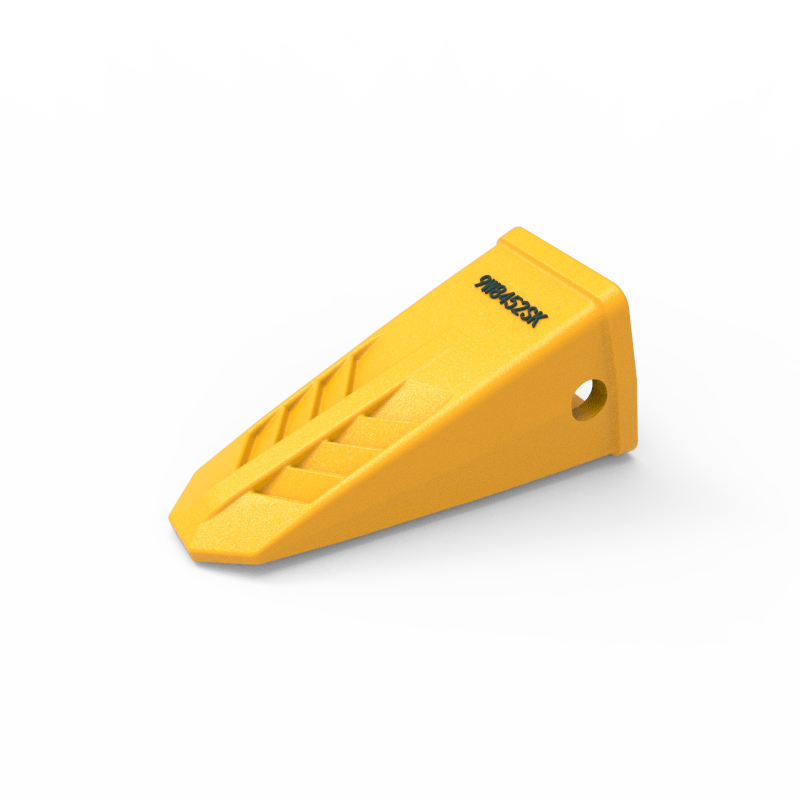
If you are evaluating bucket teeth OEM suppliers for a new program or replacing an existing one that has drifted in quality, our team can review your drawings, propose alloy and casting process, and provide a written quotation with pattern cost and lead time. To get the wear parts product catalog or to start a technical conversation about a specific part number like the 9W8452SK Caterpillar J460 bucket tooth, get in touch and we will respond within one business day.
Replacing a Drifting OEM? Or Building One from Scratch?
Send us your drawing, your customer’s duty profile, and your target annual volume. We will reply with sample availability, a written quotation, and a metallurgy lab overview.
Xin Jack has run OEM casting programs for European and American G.E.T. brand owners, dealers, and importers for 16+ years. He handles the technical and commercial side of custom programs—from drawing review through pilot batch, sample approval, and mass production—across Caterpillar, ESCO, Komatsu, Volvo, JCB, Doosan, and UNI-Z compatible parts.
Post time: Sep-10-2026