The Four Cost Contributors in a Bulk Bucket Teeth Quote
The unit price on a bulk bucket-teeth quote is the sum of four contributors, each with its own margin profile: material (steel grade, mill, chemistry, per-heat certificate), casting (process, yield assumption, per-piece labour), heat treatment (regime, furnace loading, per-batch test report), and logistics (Incoterm, port pair, packaging, demurrage risk). The right way to read a bulk quote is to ask the supplier to break each contributor out separately and to verify against the documents below. A supplier who refuses to break out the four contributors is hiding the margin profile.
Contributor 1: Material — The Steel Grade and the Mill
The steel grade on a bucket tooth is typically a low-alloy medium-carbon steel — 40Cr, 42CrMo, or the equivalent in the supplier’s catalogue. The grade is widely available and not proprietary; what differs between suppliers is the source mill and the per-heat certificate.
The material contributor to the unit price covers the raw steel bar or billet, the mill’s conversion cost, and the per-heat certificate fee. A quality-controlled mill in China, Korea, or Japan publishes a mill test certificate per heat that names the chemistry (carbon, manganese, chromium, molybdenum), the source batch, and the mechanical properties from the mill’s heat-treatment line. A supplier who can produce the per-heat certificate on request is buying from a quality-controlled mill; a supplier who cannot is buying from a small re-roller and passing the cost saving back as a price discount.
The per-heat certificate is also the first link in the audit trail that ties the finished tooth back to a specific steel heat. If a tooth fails in service and the failure investigation needs to trace the chemistry, the per-heat certificate is the only document that supports the trace. A supplier without per-heat traceability cannot support an investigation; the failure closes as “cause unknown”.
The steel grade on a bucket tooth is not proprietary — what differs between suppliers is the source mill and the per-heat certificate. A supplier who can produce the per-heat certificate is buying from a quality-controlled mill; a supplier who cannot is buying from a re-roller and passing the saving back as a price discount.
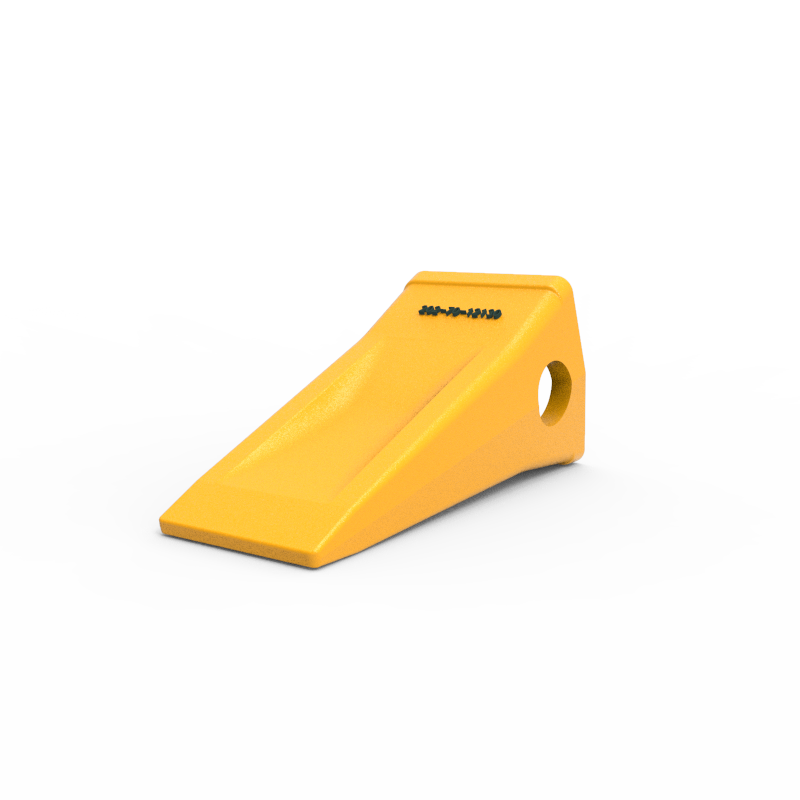
For an OEM-spec part like the 202-70-12130 Komatsu dozer standard long bucket tooth tip, the steel grade is set by the OEM drawing’s mechanical-property specification, and the supplier’s job is to match the grade and publish the per-heat certificate. A quote that names the grade but cannot produce the per-heat certificate is not OEM-spec — it is a grade-matching aftermarket part without the audit trail.
Contributor 2: Casting — Process, Yield, and Per-Piece Labour
The casting process on a bucket tooth is most often green-sand casting for high-volume parts, shell-mould casting for tighter tolerance, and lost-wax or investment casting for small parts or for the wear surface of a higher-class part. The choice of process is set by the part’s dimensional tolerance, the surface finish, and the buyer’s annual volume.
The hidden cost driver in the casting contributor is the yield assumption. A foundry running a 85 percent casting yield can quote a part at one price; the same foundry running at 60 percent yield (because the part geometry has thin sections or the steel chemistry is borderline) quotes a higher price to cover the scrap. The buyer cannot see the yield assumption in the quote, but the quote reveals it indirectly — a quote that is much lower than the field usually carries an optimistic yield assumption that does not survive the first production batch.
The per-piece labour is the second hidden driver. A foundry running a high-volume bucket tooth with a mechanised pour line and automated shake-out has a lower per-piece labour cost than a foundry pouring each batch by hand. The labour-cost difference between a mechanised and a manual line is roughly a third of the casting contributor — large enough to swing the quote by 15 to 20 percent between two otherwise equivalent foundries.
The casting yield assumption is the largest hidden driver in a bucket-teeth quote. A quote with an 85 percent yield is structurally lower-priced than a quote with a 60 percent yield; the difference shows up in the first production batch, not in the quote itself.
Contributor 3: Heat Treatment — Regime, Furnace Loading, and the Test Report
The heat-treatment regime is the contributor that determines the tooth’s in-service wear life and impact toughness. A through-hardened tooth is heat-treated so the HRC value is uniform from surface to core (typically HRC 38 to 45). A surface-hardened tooth is heat-treated so only the wear surface reaches that hardness band, while the core stays tougher (typically HRC 25 to 32 at the core).
Surface-hardened teeth are more common in mining and high-impact applications where shock loading would crack a brittle through-hardened tooth. The choice between the two regimes is a design decision driven by the application, not a price decision driven by the supplier. A quote that does not name the regime is ambiguous on the most important contributor.
The furnace-loading contributor is the second hidden driver in the heat-treatment line. A supplier with a single furnace batches teeth from multiple buyers into the same furnace run. The per-batch test report on a shared-furnace run is not per your batch — it is per the furnace load. A supplier with a dedicated or multi-furnace line can run your teeth in a dedicated furnace and publish a per-batch test report that genuinely tracks your batch.
The heat-treatment regime determines 70 to 80 percent of the in-service wear life of a bucket tooth. Two quotes that look similar on material and casting can diverge by 20 to 30 percent on the unit price because of the heat-treatment regime and the furnace loading.
The per-batch test report is the audit trail that proves the heat-treatment was actually performed. A supplier who can produce a per-batch hardness reading aligned to ASTM A370 or equivalent is supplying a controlled product; a supplier who can produce only a generic certificate of conformance is supplying hope. The hardness reading should sit at the OEM-specified range (HRC 38 to 45 for through-hardened, HRC 25 to 32 at the core for surface-hardened) and the report should name the heat number, the furnace run, and the date.
Contributor 4: Logistics — Incoterm, Port Pair, and Demurrage Risk
The logistics contributor covers the packaging, the inland freight from the factory to the port, the ocean freight to the destination port, the destination port charges, and the inland freight from the destination port to the buyer’s site (if applicable). The Incoterm determines who carries each of these costs and who carries the demurrage risk if a container is delayed at port.
The most common Incoterm on bulk bucket-teeth orders is FOB China, which puts the ocean freight and the destination port charges on the buyer. FOB China is the right Incoterm for a buyer with a freight forwarder who can consolidate the bucket-teeth container with other orders; it is the wrong Incoterm for a buyer without a forwarder, because the buyer ends up paying retail ocean freight instead of contract rates.
The port pair is the second hidden driver in the logistics contributor. A quote that defaults to a small or unfamiliar port pair will carry a higher ocean freight than a quote that defaults to Shanghai or Ningbo with a major-line carrier. The default in most Chinese foundry quotes is Shanghai or Ningbo; the buyer should confirm the port in writing before signing the PO.
The default Incoterm on a bulk bucket-teeth order should be FOB Shanghai or Ningbo with a major-line carrier. Deviations from that default cost the buyer 10 to 20 percent of the ocean freight and shift the demurrage risk in ways the quote does not surface.
The packaging is the third hidden driver. Bucket teeth are heavy, and a poorly packed container loses 1 to 3 percent of the order to transit damage. A quote that says “standard export packing” without specifying inner and outer packing is asking the buyer to absorb the transit-damage risk. The supplier’s ISO 9001:2015 and ISO 14001:2015 certifications are the audit trail that the packaging process is under control.
Why Two Quotes 30% Apart on the Surface Are Often Different in Specifications
The most common puzzle in a bulk bucket-teeth tender is two quotes that look 30 percent apart on the surface. In our experience, the gap is rarely 30 percent different in margin; it is usually 30 percent different in specifications. The four contributors usually distribute the gap roughly as follows: material 5 to 15 percent (mill, certificate, chemistry), casting 10 to 20 percent (process, yield, labour), heat treatment 10 to 25 percent (regime, furnace loading, test report), logistics 5 to 15 percent (Incoterm, port pair, packaging). The right way to read two quotes 30 percent apart is to ask both suppliers to break each contributor out, then verify against the documents below; the supplier who can produce the documents has the audit trail to support the price, and the one who cannot is offering the price on marketing, not engineering.
The Verification Protocol: Four Documents Before the PO
For a procurement officer committing to a 20 or 30 container bulk order, the verification protocol that catches the hidden gaps runs four documents — one per contributor, each writing a line on the receiving form so the audit trail survives the PO to the dock.
Document 1: Mill test certificate (Material). Request the per-heat mill test certificate on the steel — heat number, grade, chemistry, source mill. For cast steel, the closer reference is ISO 4991:2015 on steel castings for pressure purposes, which sets the chemistry and mechanical-property bands. For fastener companion parts, ISO 898-1:2013 on mechanical properties of fasteners is the comparator.
Document 2: Per-batch heat-treatment report. Ask for the report per batch — austenitising temperature, quench medium, tempering cycle, hardness reading. A supplier who cannot produce a per-batch heat-treatment report is quoting on hope, not on process control. The ASTM A370 standard on mechanical testing of steel products covers the test method; ISO 148-1:2016 on the Charpy pendulum impact test is the reference for impact toughness.
Document 3: Dimensional inspection report (Casting). Ask for a report against your drawing or the OEM drawing on a sample of teeth per batch — dimensions measured, tolerance band, actual readings, inspector signature. AQL 2.5 is the typical acceptance criterion for bulk G.E.T. orders. The ASTM A781 on steel castings general requirements covers the inspection framework.
Document 4: Supplier’s ISO 9001 certificate. Ask for it and read the scope line carefully. A certificate listing “cast ground-engaging tools” is a strong audit trail; one listing “import and export trade” is a red flag.
Four documents before the PO close the gap between the headline price and the engineering price. A supplier who can produce all four is supplying a controlled product; a supplier who cannot is supplying hope.
A buyer who runs the four documents before signing the PO catches the material-grade substitution, the heat-treatment regime change, the dimensional-tolerance miss, and the wrong-scope certificate before the order ships. A buyer who skips the protocol has no audit trail.
What the Bulk Discount Curve Actually Looks Like
Bulk discounts on bucket teeth follow a typical OEM-style volume curve. A single-digit-percent discount at container-load quantities, a low-double-digit-percent discount at three-container orders, and the deepest discount on annual contracted volume that fills a multi-month production slot. The discount curve compresses once the buyer’s order fills the factory’s full-week casting output, because the bottleneck shifts from casting capacity to heat-treatment furnace capacity.
The practical implication is that a buyer chasing the deepest discount should think in terms of furnace-loading volume rather than per-piece volume. A buyer ordering 20 containers spread across the year can usually negotiate a better unit price than a buyer ordering 60 containers in a single quarter, because the 20-container buyer fills the furnace consistently and the foundry can schedule the heat-treatment efficiently. The 60-container buyer fills the foundry for a quarter and leaves it idle for three.
The deepest bulk discount on bucket teeth comes from filling the foundry’s furnace-loading capacity consistently, not from buying the most pieces in a single quarter. A 20-container annual contract usually prices below a 60-container single-quarter order.
For EU-funded tenders the regulatory basis is set by EN 16228 on drilling and foundation equipment safety and the relevant CE directives, which the per-batch test report should reference to support the technical file.
How to Negotiate Where the Margin Actually Lives
The negotiation that moves the unit price most is the negotiation that targets the contributor with the highest margin. In our experience, the heat-treatment contributor is where the deepest margin usually lives — because the supplier knows the buyer cannot easily verify the per-batch test report without visiting the furnace.
The negotiation lever is the per-batch heat-treatment report. Ask for the report per batch, with the hardness reading per furnace run. A supplier who knows the buyer is checking the per-batch report will tighten the heat-treatment regime and the per-piece cost will reflect that tightening. A supplier who can deliver only a generic certificate of conformance is the supplier with the deepest margin in the heat-treatment contributor.
The second negotiation lever is the casting yield assumption. Ask for the per-batch casting yield on the last three production runs. A supplier with a controlled yield of 85 percent will publish the number; a supplier with an uncontrolled yield of 60 percent will refuse. The yield assumption drives the casting contributor and is the second-largest negotiation lever.
The negotiation that moves the unit price most is the negotiation that targets the contributor with the highest margin. In our experience, the heat-treatment contributor is where the deepest margin usually lives, and the per-batch test report is the lever that surfaces it.
The third negotiation lever is the logistics mode. Consolidate the bucket-teeth container with other orders through a freight forwarder, and the ocean freight drops by 10 to 20 percent. The buyer carries the consolidation cost in-house but recovers it on the freight rate. A supplier who offers CIF destination port at a low rate is recovering the freight margin in the unit price.
For buyers building the bulk-quote protocol from scratch, the Join Machinery bucket teeth and adapters product catalogue covers the high-volume part classes; the 202-70-12130 Komatsu dozer long bucket tooth tip page is the reference part for the worked example above; and the contact page opens the channel for a written per-contributor breakdown.
Need a Per-Contributor Price Breakdown on Your Next Bucket Teeth Order?
Send the part numbers, the annual volume, the destination port, and the Incoterm preference, and Join Machinery will come back with a written four-contributor breakdown — material, casting, heat treatment, and logistics — plus the four documents in the verification protocol. The bucket teeth and adapters catalogue covers the high-volume G.E.T. part classes and the 202-70-12130 Komatsu dozer long bucket tooth tip page is the worked example for one of the most-quoted part numbers in the G.E.T. market.
Bucket Teeth Bulk Price — Frequently Asked Questions
What is the typical bulk discount on bucket teeth?
Bulk discounts on bucket teeth follow a typical OEM-style volume curve: a single-digit-percent discount at container load quantities, a low-double-digit-percent discount at three-container orders, and the deepest discount on annual contracted volume that fills a multi-month production slot. The discount curve compresses once the buyer’s order fills the factory’s full-week casting output, because the bottleneck shifts from casting capacity to heat-treatment furnace capacity.
Why do bucket tooth prices vary so much between suppliers?
The variance comes from four places: the steel grade and the source mill, the casting process (sand cast vs. lost-wax vs. investment cast), the heat-treatment regime (through-hardened vs. surface-hardened vs. as-cast), and the logistics chain (FOB China vs. CIF destination port vs. DDP job site). Two quotes that look 30 percent apart on the surface often reflect different specifications rather than different margins.
Does OEM-spec bucket tooth steel actually outperform generic equivalents?
The steel grade itself (typically a low-alloy medium-carbon steel such as 40Cr or 42CrMo) is widely available and not proprietary. The performance difference comes from the heat-treatment regime — austenitising temperature, quench medium, tempering temperature, and tempering time — combined with the per-batch test report that proves the heat-treatment was actually performed. A supplier who can produce the per-batch test report is supplying an equivalent product.
What is the difference between a through-hardened and a surface-hardened bucket tooth?
A through-hardened tooth is heat-treated so the HRC value is uniform from surface to core (typically HRC 38 to 45). A surface-hardened tooth is heat-treated so only the wear surface reaches that hardness band, while the core stays tougher (typically HRC 25 to 32 at the core). Surface-hardened teeth are more common in mining and high-impact applications where shock loading would crack a brittle through-hardened tooth.
What hidden costs should I watch for in a bucket teeth quote?
Three: the casting yield assumption (if the supplier is quoting on 60 percent yield rather than 85 percent, the quote carries a hidden cost premium for waste), the heat-treatment furnace loading (if the supplier batches teeth from multiple buyers into one furnace, the per-batch test report may be shared and not per your batch), and the logistics mode (air freight on cast steel is uneconomical and most suppliers default to ocean, but the Incoterm and the port pair determine who carries the demurrage risk).
How can I verify a bucket teeth quote without visiting the factory?
Request four documents before signing the PO: the mill test certificate for the steel (showing the heat number and the chemistry), the per-batch heat-treatment report (showing the temperature cycle, the quench medium, and the resulting hardness), the dimensional inspection report against your drawing, and the supplier’s ISO 9001 certificate with the scope line confirming the supplier’s quality-management system covers the production of cast ground-engaging tools.
What is a typical OEM part number for a Komatsu dozer bucket tooth tip?
For the Komatsu D155-class dozer long bucket tooth tip, the OEM part number is 202-70-12130 (also cross-referenced to the ripper tooth tip). The aftermarket equivalent is sold under a manufacturer-specific part number but must match the OEM drawing on profile, dimensional tolerance, hardness range, and impact-toughness specification to be a true equivalent rather than a fitment gamble.
Xin Jack is the Export Sales Manager at Ningbo Yinzhou Join Machinery Co., Ltd., a specialised manufacturer of Ground Engaging Tools (G.E.T.) — bucket teeth, cutting edges, and adapters for excavators and construction equipment. Established in 2006 with 16 years of exporting experience, Join Machinery serves European and American markets and partners with world-leading brands such as BYG, JCB, and NBLF. Every product undergoes strict quality control from raw material to finished goods, and the engineering team supports a per-contributor breakdown on bulk orders on request.
Post time: Sep-21-2026