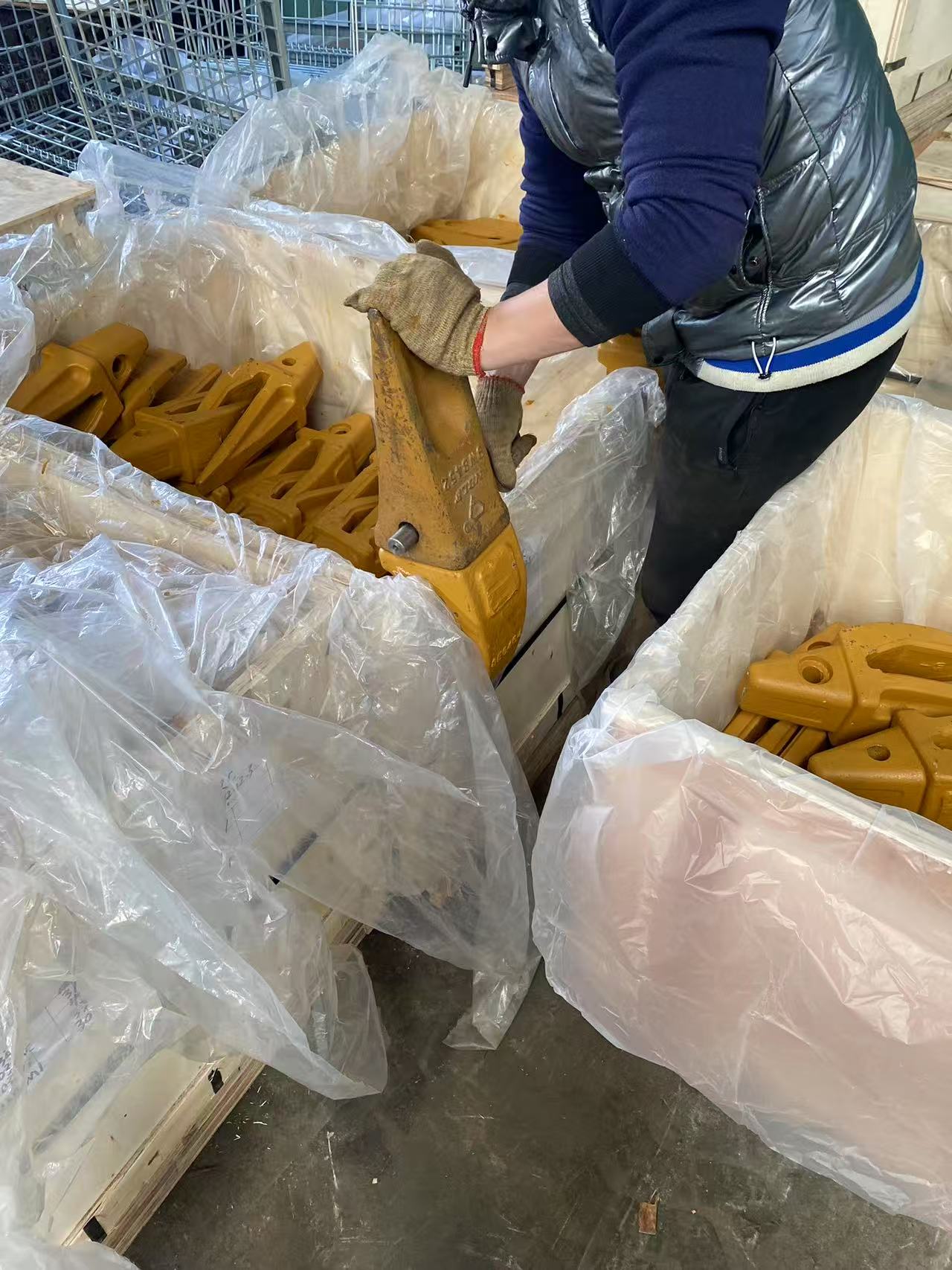
The short answer: if you are digging solid granite or quartzite with a 20–50 t class excavator, the best bucket teeth are precision-cast rock-chisel profiles in the HRC 46–50 band, mounted on a matching J-series adapter. The 1U3302RC J300 rock chisel is the workhorse we ship most often into European granite quarries for exactly this Mohs 6–7, SiO2 70–90% workload.
This guide is built for buyers who have to sign off on a PO — not for engineers who already know what they want. I will walk you through the rock identification step, the tooth-to-rock mapping, what is actually inside a rock chisel tooth like the 1U3302RC, the failure modes that show up first in granite, and the supplier checklist that keeps an audit-grade tooth audit-grade. Along the way I will lean on field data we have collected since 2006, on the ASTM E18-22 Rockwell hardness standard, and on geological references such as Geology.com’s granite page for the rock-property numbers.
Why “Hard Rock” Is Not One Category
If you only remember one thing from this guide, make it this: granite, basalt, quartzite, and gneiss all sit under the “hard rock” label, but they eat teeth in four different ways. Because Mohs hardness and SiO2 content move independently, two rocks at the same compressive strength can still demand different tooth profiles. Treating “hard rock” as a single category is how quarries end up buying a chrome-white-iron abrasion tooth for a tough-but-brittle quartzite face and wondering why it shatters.
Granite, in the geological reference sense, is an intrusive igneous rock dominated by quartz and feldspar — according to Geology.com, granite typically contains 20–60% quartz by volume and roughly 70% SiO2 by weight. Quartzite, by contrast, is a metamorphic rock that is essentially re-crystallised quartz, so it pushes 90%+ SiO2. Both are tough on teeth, but for different reasons — granite is tough because it is a hard, coarse-grained composite, quartzite is tough because it is almost pure quartz and refuses to cleave cleanly. Because the failure mechanism is different, the right tooth geometry is also different.
Basalt flips the picture. Lower quartz, lower SiO2, often around 50% by weight, but with high olivine and pyroxene content. It is dense, fine-grained, and tough, with strong abrasive wear on the nose but less chipping risk than granite. Limestone and dolomite, by the way, do not belong in this conversation — their Mohs is 3–4 and a standard dirt tooth handles them fine.
The two wear questions every buyer should answer first
Before you look at any tooth catalog, get answers to two questions about your face:
- What is the Mohs hardness? A field kit with mineral picks 2 through 9 is enough; a lab scratch test is better but slow.
- What is the SiO2 percentage? Send a 2 kg face sample to a local geotechnical lab; results typically come back in 3–5 working days.
With those two numbers you can stop guessing and start selecting. The mapping table in the next section is built exactly around that pair of inputs.
The Rock-Type → Tooth-Type → HRC Selection Map
This is the table I wish a customer had handed me on my first quarry visit ten years ago. The selection logic is straightforward: higher Mohs and higher SiO2 push you toward a rock-chisel geometry at higher HRC, while lower values give you more freedom to optimise for toughness over hardness. Use the SiO2 reading to confirm the wear mode (abrasive vs. impact-dominant), then choose the profile.
| Rock type | Mohs (typical) | SiO2 (% wt, typical) | UCS (MPa, typical) | Recommended profile | Recommended tooth HRC |
|---|---|---|---|---|---|
| Granite | 6–7 | 68–74% | 100–250 | Rock chisel (single point) | 46–50 |
| Quartzite | 7 | 85–95% | 150–300 | Rock chisel (single point, narrow nose) | 47–51 |
| Basalt | 5–6 | 45–55% | 100–300 | Rock chisel (medium nose) | 45–49 |
| Gneiss / Schist | 5–7 | 60–75% | 50–200 | Twin-tiger (twin penetrator) | 44–48 |
| Diorite / Gabbro | 6–7 | 50–60% | 120–280 | Rock chisel | 46–50 |
| Iron ore (hematite/magnetite) | 5–6.5 | 30–55% (Fe-rich) | 100–250 | Chrome-white-iron abrasion tooth | 58–62 (carbide-rich) |
| Limestone / Dolomite (for comparison) | 3–4 | <5% | 50–150 | Standard dirt tooth (not in scope) | 38–44 |
A few notes on how to read this map.
- Granite sits at the centre of this guide for a reason — it is the workload our customers ship most into Europe and the Americas. A rock chisel at HRC 46–50 is the workhorse. Going above HRC 50 sacrifices too much toughness for the limited wear-life gain on a 6–7 Mohs face.
- Quartzite deserves the narrow-nose variant because the rock resists crack initiation; a wider nose just mushrooms on you. Push to the upper end of the HRC window.
- Gneiss is fractured enough that a twin-tiger profile survives better than a single point. The two noses share impact load and reduce chip-out.
- Iron ore is a different conversation: high abrasion plus low impact means a chrome-white-iron composition (think ASTM A532 Class III) outperforms a standard rock chisel, even though the rock looks similar in a generic “hard rock” spreadsheet.
Field shortcut: if you only have time to do one test, get the SiO2 percentage. Because SiO2 directly drives abrasive wear rate, it is the single best predictor of tooth life on a given face. Granite and basalt have similar Mohs; their SiO2 gap is what tips the selection.
Inside a Rock Chisel Tooth — 1U3302RC J300 Anatomy and Why It Works on Granite
A rock chisel tooth looks deceptively simple — a pointed nose, a tapered shank, a retainer slot. Because every one of those features carries an engineering decision, the differences between a precision-cast rock chisel and a green-sand casting show up within the first 200 hours on a granite face.
The 1U3302RC J300 rock chisel tooth we ship into European and American quarries is built around three deliberate choices:
- Single-point rock chisel geometry. A rock chisel concentrates impact force on a narrow nose, which drives penetration into high-SiO2 granite with lower cycle-time energy than a wider dirt-tooth profile.
- Low-alloy abrasion-resistant cast steel, hardened through the nose. The wear face is held at HRC 47–50, with a measured Charpy impact toughness of at least 18 J at −20 °C on the production batch. Hardness is tested per ASTM E18-22 5 mm below the cast surface, not on a polished lab coupon.
- J300 adapter interface. The tooth locks onto the standard Caterpillar J300 family of adapters and pin retainers. Because the J300 interface is the most widely deployed G.E.T. platform in hard-rock mining, drop-in replacement on mixed fleets is straightforward and inventory stays simple.
What “precision cast” actually changes
I should be careful with this word, because it gets thrown around in our industry. Precision casting here means lost-wax investment casting with controlled cooling — not the green-sand or resin-sand process that most low-cost teeth are poured with. Three measurable differences matter to a quarry buyer:
- Tighter dimensional tolerance on the nose taper. A green-sand tooth typically varies +/- 1.5 mm on the nose-to-adapter taper; our production tolerance is held within +/- 0.3 mm on critical wear surfaces. A loose taper concentrates stress at the adapter nose and shortens the life of both parts.
- More consistent hardness across the casting. Because the cooling rate is controlled, the carbide distribution is repeatable from batch to batch. A green-sand casting may show a 6–8 HRC spread inside one tooth; our process keeps the spread inside roughly 2 HRC across the tested wear zone.
- Cleaner surface finish at the adapter seat. A rougher adapter seat means micro-gaps, micro-gaps mean adapter wear, and adapter wear is the silent budget killer on a granite face.
For context on what tolerance a buyer should expect when comparing suppliers, the relevant industry baseline is the ASTM E18-22 Rockwell hardness test method for HRC readings and ASTM E384-17 for the micro-indentation checks foundries use on coupons. If a supplier cannot show you a calibration certificate for the hardness tester, that is the first red flag — not the price.
If you are comparing the 1U3302RC against an equivalent from another supplier, the variables to compare are not just price. Look at the published hardness range, the documented tolerance on the adapter taper, and whether the foundry runs a batch-level MTC (mill test certificate) or only a once-per-quarter sample certificate.
A note on the broader G.E.T. line
The 1U3302RC is one rock chisel in a wider catalog. If you need to compare across J-series, K-series, Komatsu, Volvo, JCB, ESCO, or UNI-Z interfaces, the excavator bucket teeth complete selection page on our site groups by adapter family so you can match the tooth to your carrier class without juggling PDFs. For the rock chisel, twin-tiger, and abrasion-tooth geometries discussed in this guide, every profile has a J-series equivalent in stock; K-series and other families are made to order.
Reading the Battlefield — Wear Patterns That Tell You Your Tooth Is Wrong
Most premature tooth changes I have seen in granite quarries are not material failures. Because granite combines high SiO2 with coarse grain, it leaves a diagnostic wear signature that almost always points at one of three causes — wrong profile, wrong HRC, or a worn adapter.
1. Nose flattens faster than the shank wears
This is the classic “wrong profile” pattern. A dirt tooth or a twin-tiger dropped onto a granite face flattens within the first shift because the contact area is too large. Switch to a rock chisel and the same operator will see the nose wear at roughly half the rate. Because per-shift tooth consumption is the visible cost number on a quarry dashboard, profile selection is a finance decision as much as an engineering one.
2. Mushrooming on the nose shoulders
The nose is still hard, but the shoulders just behind the nose deform outward. This usually means the HRC window is at the bottom of the recommended range for your rock — or the casting has a hardness gradient that drops off too quickly behind the nose. Ask the foundry for a cross-section hardness map at 5 mm intervals from the nose back to the shank. A good rock chisel should stay above HRC 44 even 30 mm back from the nose.
3. Chip-out at the adapter neck
This is the dangerous one. A tooth snapped at the adapter neck usually points at one of three causes — over-hard tooth (HRC window too aggressive for the rock), impact overload (operator pushing the bucket into a boulder the carrier class cannot handle), or a worn adapter nose forcing the tooth to absorb misalignment. Pull the tooth, inspect the adapter nose taper for a 1–2 mm lip, and replace the retainer pin before changing the tooth brand.
4. Adapter-side wear before nose wear
If the adapter-side surface of the tooth is wearing faster than the nose, the retainer is loose or the adapter nose has deformed. Replacing the tooth will not fix this. Replace the retainer pin and inspect the adapter; only then evaluate whether the tooth hardness range is still right for your face.
Tooth, Adapter, and Bucket — How Mismatches Eat Through the Operating Budget
Buyers tend to focus on the tooth itself. In practice the operating cost story on a granite face is driven by three interfaces: tooth-to-adapter, adapter-to-bucket lip, and bucket-to-carrier. Because a tooth that is modestly cheaper but wears significantly faster will quietly inflate the per-ton cost of digging granite, the right comparison is per-ton cost, not unit price.
Tooth-to-adapter fit
A precision-cast rock chisel like the 1U3302RC is matched to the Caterpillar J300 adapter taper. If your existing fleet uses a non-OEM adapter with a slightly different angle, you will see uneven contact at the seat, leading to accelerated wear on one side of the nose. This is the single most common cause of “the tooth wore out on one side only” complaints I get from European customers. The fix is the adapter, not the tooth.
Adapter-to-bucket lip fit
The adapter welds onto the bucket lip with a specified leg length. If the weld leg is too short, the adapter flexes under impact and the retainer seat distorts. Because a distorted retainer seat wears both the adapter and the tooth prematurely, the bucket-side weld geometry matters as much as the tooth chemistry. We document the recommended adapter-to-bucket weld geometry in the technical sheet shipped with every order.
Bucket-to-carrier matching
Carrying a 1.2 m3 rock bucket on a 20 t excavator is fine for granite; the same bucket on a 13 t class machine will overload the boom and shorten tooth life. We see this most often when a fleet upgrades carriers but keeps the existing bucket. The tooth is not the problem — the bucket-to-carrier mass ratio is.
If you want to extend the comparison beyond Caterpillar J-series, the wider excavator bucket teeth selection on the Join Machinery site covers Komatsu K-series, Volvo, JCB, Doosan, ESCO, and UNI-Z interfaces. For a 20–50 t hard-rock excavator, J300 and K-series rock chisels cover roughly 80% of the in-service population we ship.
Sourcing Bucket Teeth From a Foundry You Can Audit
I will be direct: not every foundry that offers a “rock chisel” tooth is making the same thing. The price spread on a J300-class rock chisel between an audit-grade supplier and a commodity green-sand pourer is significant, and so is the per-ton wear-cost spread on the back end. Because the worst supplier decisions in our industry are made by looking at the unit price alone, this is the section I would hand to a procurement manager who has not bought G.E.T. before.
The seven-point supplier checklist
- Casting method disclosure. Lost-wax (investment) casting is the baseline for a precision-cast rock chisel; the supplier should be willing to name the process and the alloy.
- HRC range with test method. Specify “HRC 46–50, tested per ASTM E18-22, 5 mm below the cast surface”. If the supplier only quotes a single HRC number without location or standard, that is a yellow flag.
- Batch-level MTC. Every heat-treatment batch should carry a mill test certificate, not a once-per-quarter sample.
- Tolerance on the nose taper. A documented +/- 0.3 mm tolerance on the adapter taper is the precision-cast benchmark; green-sand casting rarely gets inside +/- 1.0 mm.
- Charpy impact data. A supplier running low-alloy abrasion-resistant cast steel should publish a minimum Charpy value (we target 18 J at −20 °C on the 1U3302RC). No impact number usually means the foundry has not tested for it.
- Third-party inspection option. SGS, BV, or TUV pre-shipment inspection is standard on European-bound containers from established Chinese G.E.T. foundries. If the supplier balks, ask why.
- Sample shipment before the full container. Run a 200–500 piece trial on your actual face before committing to a 40HQ.
What the audit actually looks like
For a new supplier relationship, we invite the customer’s quality team to Ningbo for a two-day visit: day one in the foundry for pouring, heat-treatment, and hardness-testing observation; day two at the packing line for batch traceability check. This is standard practice for European OEM-grade G.E.T. suppliers, including Join Machinery. Caterpillar’s genuine-parts page sets the same expectation, and Cat’s mining industry page treats G.E.T. as the wear-cost lever on hard-rock operations.
Shipping and logistics
For a 40HQ container of J300-class rock chisel teeth out of Ningbo, sea freight to North Europe runs roughly four weeks; to the US East Coast, roughly five weeks; to the US West Coast, roughly three weeks. To get a current estimate for your destination port, reach the export team through the Join Machinery contact page with your model, quantity, and port — itemised quotes usually come back inside one working day.
Frequently Asked Questions
- What HRC bucket tooth do I need for granite quarry work?
- For granite (Mohs 6–7, SiO2 around 70–72%, unconfined compressive strength roughly 100–250 MPa), a rock chisel tooth in the HRC 46–50 range is the practical working window. Going softer sacrifices wear life; going harder risks brittle failure when the adapter neck is hit.
- Is a rock chisel tooth better than a tiger tooth for granite?
- For most granite quarry benches, yes. A rock chisel concentrates impact energy into a narrow point and penetrates high-SiO2 rock with lower per-ton fuel cost. A twin-tiger (twin-penetrator) profile wins when the rock is more fractured and abrasive, such as a weathered gneiss face, because the wider footprint resists breakage on impact edges.
- Can I use one tooth profile for mixed granite and basalt loads?
- Practically, yes — a HRC 47–50 rock chisel such as the 1U3302RC covers granite, basalt, and quartzite without significant loss. The compromise shows up in highly abrasive iron ore, where a wider profile and higher-chromium white iron may outlast a standard rock chisel by a measurable margin.
- What tolerance should I require on a precision-cast rock tooth?
- For a J300-class rock chisel, ask the foundry for a nose-to-adapter taper tolerance within +/- 0.3 mm, a nose runout within 1.5 mm, and a documented Rockwell C reading taken 5 mm below the cast surface on the wear face. Hardness tested per ASTM E18-22 is the baseline; test reports should be batch-level, not sample-only.
- How do I tell my supplier I want audit-grade teeth, not commodity teeth?
- Send a short QA checklist: HRC range with test method and location, casting method (lost-wax vs. green sand), batch-level MTC, third-party inspection option, and a sample shipment before the full container. A foundry that already publishes these for European and American OEM customers will not see the request as unusual.
- Why does my rock tooth wear on the adapter side instead of the nose?
- Adapter-side wear usually means the retainer is loose or the adapter nose has deformed, not that the tooth itself is wrong. Pull a worn tooth and inspect the adapter nose taper for a 1–2 mm lip. Replace the retainer pin and inspect the adapter — then evaluate whether the tooth hardness range is still right for your face.
Closing Note
The best bucket teeth for a granite quarry are not the hardest teeth you can buy, and they are not the cheapest teeth on the supplier list. Because granite is a Mohs 6–7 rock with 70%+ SiO2, the right answer is a precision-cast rock chisel in the HRC 46–50 band, mounted on a clean J-series adapter, sourced from a foundry that publishes batch-level test data and lets you audit the pour line.
If you are working on a new quarry bid or auditing an existing tooth supplier, the 1U3302RC J300 rock chisel is the profile we ship most into European and American granite operations, and the full G.E.T. catalog covers the J, K, Komatsu, Volvo, JCB, Doosan, ESCO, and UNI-Z families. For a shipping estimate against your destination port, the Join Machinery export team replies to itemised enquiries within one working day.
About the Author
Xin Jack is the Export Sales Manager at Ningbo Yinzhou Join Machinery Co., Ltd., a specialized manufacturer of G.E.T. (Ground Engaging Tools) parts including bucket teeth, cutting edges, and adapters for excavators and construction equipment. Established in 2006, the company serves European and American markets with 16 years of exporting experience, partnering with world-leading brands such as BYG, JCB, and NBLF.
Browse the CAT J-series catalog or view the twin tiger J400 product page.
Post time: Sep-04-2026