Introduction
 How Silica-Rich Conditions Accelerate Tooth Wear
Silica (SiO2) particles in mining overburden have a Mohs hardness of 7, compared to 4.5 to 5.5 for typical clay-soil abrasives. When these particles are entrained in the material flow across a bucket tooth face, they act as millions of microscopic cutting tools, removing material through three-body abrasive wear. In Western Australian iron ore mines, the silica content of canga and pisolite overburden layers ranges from 25 to 45 percent by weight. Standard general-purpose bucket teeth manufactured from 40Cr carbon steel (35-39 HRC) lose 60 to 75 percent of their effective mass after 250 to 350 operating hours in these conditions.
Below 60 percent remaining mass, the tooth tip geometry changes sufficiently that digging efficiency drops by 20 to 30 percent, requiring the operator to apply higher breakout force, which accelerates both tooth and machine wear. The exponential wear curve in silica-rich material means that standard teeth become uneconomical beyond 350 hours, and the cost per operating hour rises sharply as teeth near end of life.
ESCO Super V V39SYL Tooth Specifications
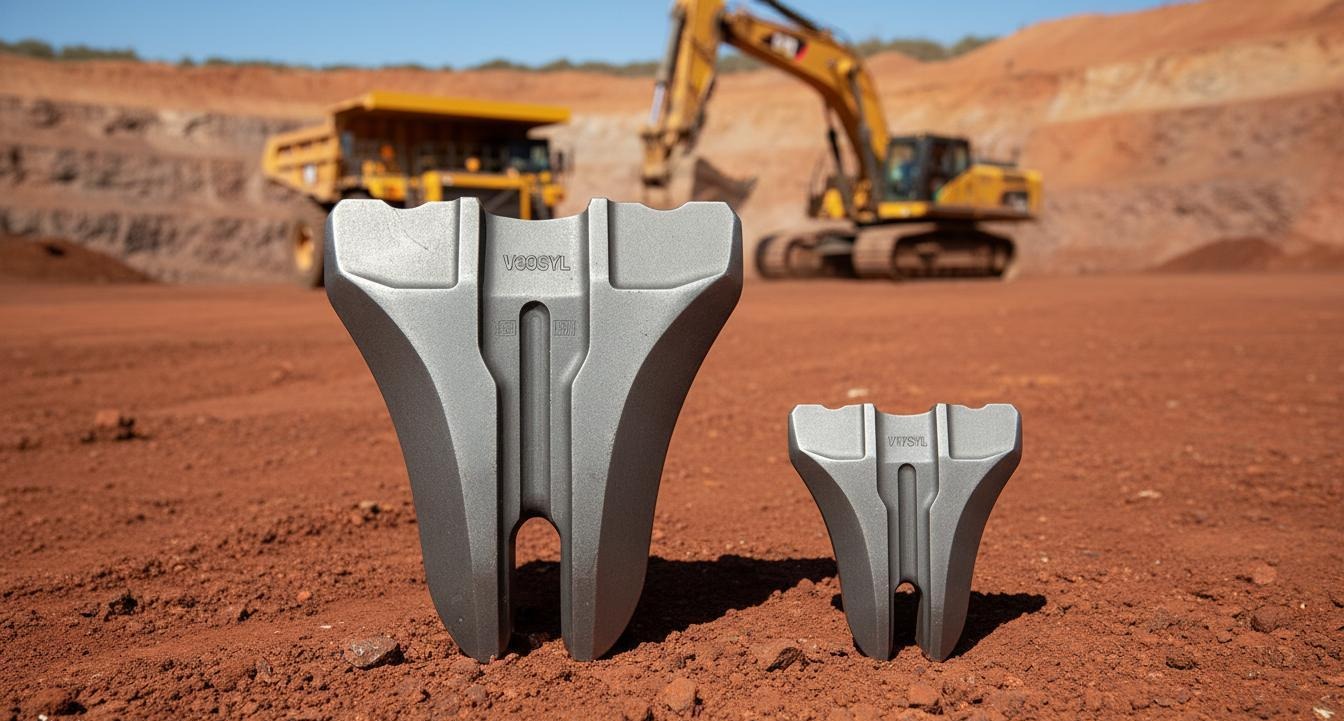
The V39SYL ESCO Super V digging tooth is a 9.6 kg general-purpose digging tooth designed for ESCO Super V adapters. It is manufactured from a proprietary through-hardened alloy steel achieving 48-52 HRC across the full cross-section. The Super V nose-to-toe locking geometry provides 24 percent more contact surface area between tooth and adapter compared to the previous generation ESCO Super Tooth design, distributing impact loads across a wider bearing surface. Key specifications include weight 9.6 kg, hardness 48-52 HRC, Charpy impact energy 21 J minimum at 20 deg C, tip width 75 mm, and overall length 235 mm. For smaller excavators in the 3-8 ton class, the V17SYL ESCO Super V digging tooth (1.2 kg) offers the same alloy steel construction and 48-52 HRC hardness.
Comparative Wear Data
Field testing conducted at three Western Australian mine sites over a 6-month period compared V39SYL teeth and standard 30Mn5B general-purpose teeth (38-42 HRC) operating on identical ESCO Super V adapters on 30-ton excavators. The material was banded iron formation overburden averaging 32 percent silica content. Standard teeth averaged 298 hours to 60 percent mass loss (the replacement threshold). V39SYL teeth averaged 715 hours to the same threshold, representing a 140 percent increase in service life. On a cost-per-operating-hour basis, the V39SYL delivered a 31 percent lower cost per hour despite carrying a 45 percent higher purchase price.
The break-even point was 420 operating hours. Any operation exceeding this threshold sees net savings with the V39SYL. The mechanism behind the extended life is the 48-52 HRC through-hardening: at this hardness level, the abrasive silica particles cannot embed in the tooth surface. Instead, particles roll across the surface, removing material at a linear rate rather than the exponential rate seen when particles embed and fracture the surface layer on softer 35-42 HRC teeth.
Fleet Productivity Impact
Beyond direct cost savings on teeth, the V39SYL reduces change-out frequency. For a fleet of five 30-ton excavators operating 20 hours per day, standard teeth require a change-out every 15 days per machine, consuming 8 hours of maintenance time per machine per change. This equals 146 maintenance hours per quarter per machine, or 730 hours across the fleet. At the V39SYL replacement interval of 715 hours, change-out frequency drops to one change every 36 days. Fleet maintenance hours drop to 278 hours per quarter. The fleet-wide savings of 452 maintenance hours per quarter translates to approximately AUD 54,000 to 68,000 per quarter in reduced labor and lost-production costs, based on a blended machine rate of AUD 120 to 150 per operating hour.
Metallurgical Foundation
The V39SYL achieves its wear resistance through a combination of alloy selection and heat treatment. The base material is a low-alloy manganese-chromium steel with 0.28-0.33 percent carbon, 1.2-1.6 percent manganese, and 0.4-0.6 percent chromium. The quench-and-temper cycle produces a tempered martensite microstructure with fine carbide precipitates dispersed throughout the matrix. In silica-rich environments, the key performance attribute is not maximum hardness (60+ HRC) but optimized hardness-toughness balance. Teeth harder than 55 HRC become brittle and suffer spalling when impacted by large rock particles. The V39SYL’s 48-52 HRC range provides sufficient hardness to resist silica abrasion while maintaining the Charpy impact toughness (21 J minimum) needed to survive high-energy impacts of hard-rock digging. ISO 6508-1 specifies the Rockwell hardness test method used to verify these values on every production batch.
Recommendations for Australian Contractors
We recommend that any mining contractor operating in material above 20 percent silica content run a side-by-side trial of V39SYL teeth against their current standard tooth on two matched excavators working in the same face for one month. Measure mass loss at 100-hour intervals and record change-out frequency. Our data shows that operations exceeding 300 hours per tooth set see a positive ROI within the first quarter. Ningbo Yinzhou Join Machinery Co., Ltd. supplies V39SYL and V17SYL ESCO Super V compatible teeth directly to Australian mining operations with bulk pricing for fleet contracts. Our bucket adapters are manufactured to the same 48-52 HRC hardness and verified for dimensional accuracy against ESCO reference specimens. Standards Australia provides reference guidelines for GET procurement in mining applications, and we align our quality documentation with these standards.
FAQ
How long do V39SYL teeth last in silica-rich conditions? V39SYL teeth last 600-900 operating hours in silica-rich mining overburden, achieving 2-3 times longer life than standard 35-42 HRC teeth.
Can V39SYL teeth fit standard ESCO adapters? Yes, the V39SYL is designed for standard ESCO Super V adapters and is fully interchangeable with OEM ESCO teeth within plus or minus 0.1 mm tolerances.
What excavator size is the V39SYL designed for? The V39SYL (9.6 kg) is designed for 20-35 ton excavators. The V17SYL (1.2 kg) fits 3-8 ton machines.
Application-Specific Wear Rate Analysis
Not all silica-rich materials produce the same wear rate. Our field data differentiates between three material types commonly encountered in Australian mining. Type 1 is banded iron formation (BIF) overburden with 25-35 percent silica content and significant hematite content. In BIF, V39SYL teeth wear at an average rate of 0.085 kg per operating hour, reaching the 60 percent mass loss threshold at approximately 680 hours. Type 2 is chert-rich conglomerate with 35-45 percent silica content and variable particle size up to 300 mm. In chert, V39SYL wear rate increases to 0.11 kg per hour, reducing service life to approximately 520 hours. Type 3 is quartz-rich saprolite with 20-28 percent silica content but finer particle size below 2 mm. V39SYL teeth in saprolite achieve 850 hours to the replacement threshold. For mining operations planning procurement, matching expected wear rates to material type enables more accurate inventory planning and reduces the risk of stockouts during peak production periods.
Troubleshooting Premature V39SYL Wear Patterns
When V39SYL teeth fail to achieve expected service life, the cause is usually identifiable from the wear pattern geometry. Uneven wear with one side wearing faster than the other indicates the tooth is operating at an incorrect digging angle, often caused by a worn or incorrect adapter nose profile that shifts the tooth alignment. Rapid tip blunting with minimal sidewall wear suggests the adapter nose is not properly seated, reducing the tooth-to-adapter contact area and concentrating digging forces at the tip. Surface pitting or spalling indicates the hardness has been compromised by overheating during the casting process or incorrect heat treatment. And accelerated bore wear suggests the locking pin is not maintaining adequate preload, allowing fretting movement between the pin and boss. Each wear pattern maps to a specific corrective action that can be applied without changing the tooth specification. Documenting wear patterns during change-out provides the data needed to optimize both adapter condition and operating technique for maximum tooth life.
Fleet-Wide Implementation Roadmap
Transitioning an Australian mining fleet from standard teeth to V39SYL teeth follows a proven implementation sequence. Month 1 involves a two-machine trial with mass loss measurements every 100 hours and full documentation of operating conditions, material type, and change-out intervals. Month 2 is data analysis: calculate cost per operating hour for both tooth types, document break-even point, and prepare the fleet-wide business case. Months 3-4 execute phased rollout starting with the highest-wear machines (typically those working in the most abrasive faces), maintaining stock of both tooth types during transition. Month 5 onward is full standardization, with optimized inventory levels based on the wear rate data collected during the trial phase. The Ningbo production and Zhuozhou warehousing support this transition with continuous supply of trial quantities through full fleet coverage.
Retrofitting V39SYL Teeth to Existing Adapter Systems
Mining contractors evaluating the V39SYL upgrade often ask whether it requires new adapters. The V39SYL is compatible with any existing ESCO Super V adapter in good condition. The adapter nose must be inspected for wear before installing V39SYL teeth: the nose width must be within 0.3 mm of the original 59.5 mm specification, the nose-to-toe locking surface must be free of galling or step wear, and the pin bore must not be ovalized by more than 0.2 mm. If the existing adapters pass these checks, the V39SYL teeth will seat properly and achieve full retention performance. If adapters show excessive wear, they should be replaced with new ESCO Super V adapters before transitioning to V39SYL teeth. The cost of adapter replacement is recovered within the first 6 to 8 months of V39SYL operation through reduced tooth consumption alone, even before factoring in the maintenance time savings from less frequent change-outs.
Quality Control Protocol for ESCO-Compatible GET Manufacturing
Manufacturing ESCO Super V compatible teeth requires precision tooling and rigorous quality control because the Super V locking geometry is a registered design with tight dimensional tolerances. Our manufacturing process begins with chemical analysis of every raw material batch using optical emission spectrometry to verify the alloy composition meets the 0.28-0.33 percent carbon, 1.2-1.6 percent manganese, 0.4-0.6 percent chromium specification. The casting process uses investment casting with ceramic shell molds for dimensional accuracy, followed by controlled cooling to prevent micro-shrinkage. After heat treatment, every tooth passes through a coordinate measuring machine station that verifies 14 critical dimensions against the ESCO Super V reference model, including nose pocket width (plus or minus 0.1 mm), locking wedge angle (38 degrees plus or minus 0.5 degrees), pin bore diameter (plus or minus 0.05 mm), and tip radius (plus or minus 0.3 mm). Any tooth exceeding the dimensional tolerance in more than one measurement point is rejected and returned to the foundry. This process consistently achieves a first-pass yield above 92 percent and ensures full interchangeability with OEM ESCO adapters in the field.
Long-Term Contract Structure for Australian Mining Operations
For Australian mining operations requiring consistent V39SYL supply over extended periods, we offer three contract structures. Annual fixed-price contracts lock in pricing for 12 months with quarterly volume adjustments of plus or minus 15 percent, reducing price uncertainty for both parties. Consignment stock arrangements place inventory at the mine site warehouse with ownership transferring only when teeth are drawn, a model that works well for remote sites where a supply disruption would cause expensive downtime. Strategic partnership agreements for large-scale operations combine fixed-price supply with technical support including quarterly wear pattern analysis, on-site training for installation and inspection procedures, and joint R&D for application-specific tooth modifications. All three structures are supported by our global logistics network including export documentation, customs clearance support for Australian import regulations, and Incoterms flexibility to match the mine’s preferred procurement framework.
Supply Chain and Delivery for Australian Mining Operations
Ningbo Yinzhou Join Machinery maintains a dedicated supply chain for the Australian mining sector. Our standard delivery to Perth or Brisbane ports is 28 to 32 days from order confirmation for full container loads (20-foot container holding approximately 12,000 V39SYL teeth). Express air freight from Shanghai Pudong to Perth Airport delivers trial quantities of 50 to 100 teeth within 7 to 10 days. All shipments include full export documentation and material certificates required for Australian customs clearance. V39SYL teeth are packed in plywood cases of 36 pieces per case with foam separation between layers.
For further technical information including V39SYL specification datasheets, wear rate calculation tools, and fleet ROI modeling templates, contact our Australian mining support team. We provide tailored recommendations based on your specific material type, excavator fleet configuration, and consumption patterns.
For further technical information including V39SYL specification datasheets, wear rate calculation tools, and fleet ROI modeling templates, contact our Australian mining support team. We provide tailored recommendations based on your specific material type, excavator fleet configuration, and consumption patterns.
The transition to V39SYL teeth represents a proven upgrade path for any mining contractor experiencing premature tooth wear in silica-rich overburden. The field data from Western Australian mine sites demonstrates a 140 percent increase in service life and a 31 percent reduction in cost per operating hour when switching from standard 35-42 HRC teeth to the V39SYL’s 48-52 HRC through-hardened alloy steel construction. For fleet operations exceeding 300 hours per tooth set in material above 20 percent silica content, the V39SYL delivers positive ROI within the first quarter of adoption. Contact our sales team for a consultation on V39SYL pricing and stock availability for your operation.
Post time: Jun-15-2026