2026 Supply Chain Update for Caterpillar Bucket Teeth
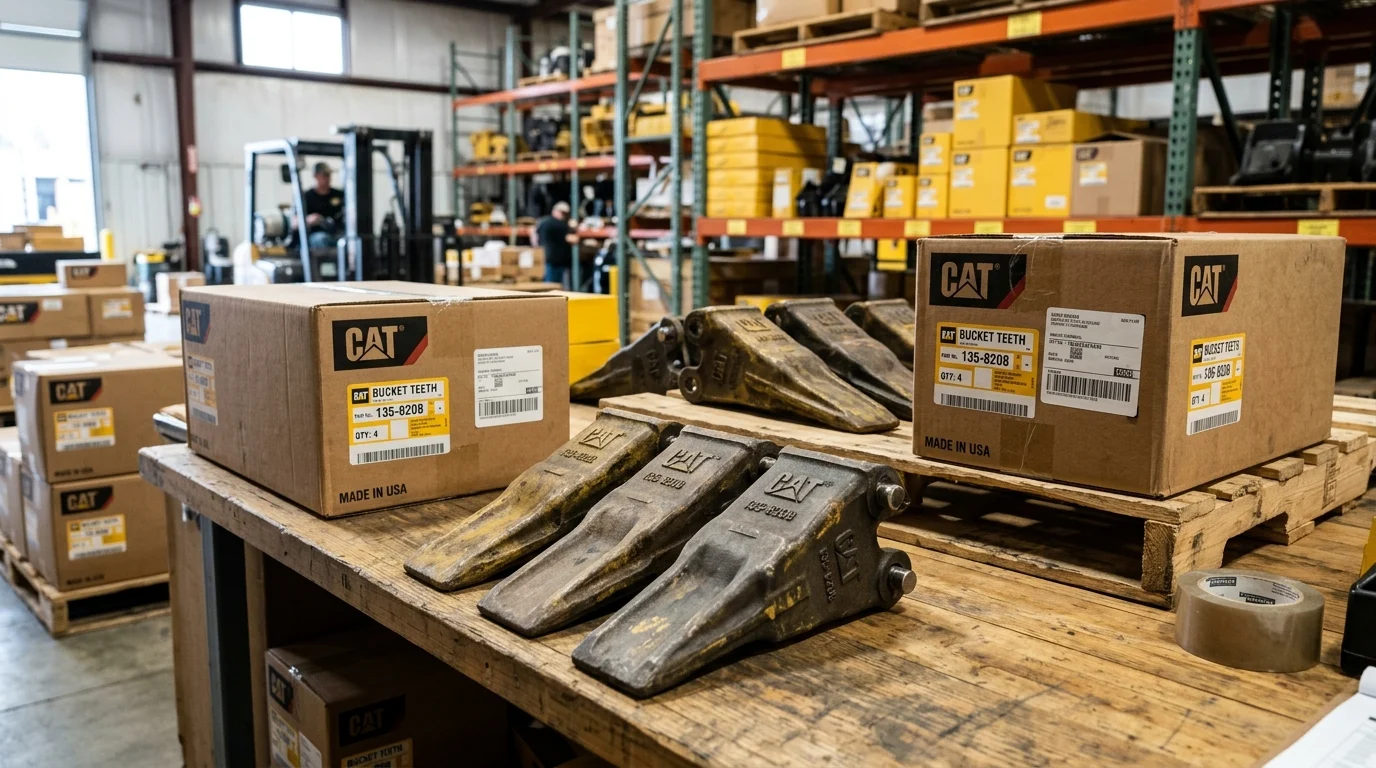
Navigating this market requires more than just finding a cheap price per kilogram. We have to consider how geopolitical shifts, raw material availability, and changing foundry regulations are impacting the Caterpillar G.E.T. supply. Staying competitive means anticipating these market movements before they eat into our margins. I always remind my team that buying bucket teeth is an investment in machine uptime. When we analyze the 2026 market, it’s clear that wholesale buyers who secure reliable, high-quality casting partners now will be the ones dominating regional aftermarket sales. Let’s break down exactly what is driving this market and how we can adapt our purchasing strategies. The biggest risk I see for 2026 is supply chain bottlenecks at the foundry level. Environmental regulations in major manufacturing hubs are forcing older, less efficient foundries to close or upgrade, temporarily tightening capacity. For mining and heavy construction channels, where a broken tooth can halt an entire operation, these delays are unacceptable. We need to diversify our supplier base to mitigate the risk of sudden lead-time extensions. Right now, three main factors are dictating our landed costs: scrap steel prices, energy costs for heat treatment, and ocean freight volatility. Energy-intensive processes like quenching and tempering are getting more expensive. When foundries pass these costs down, our distributor margins shrink unless we negotiate long-term volume agreements or optimize our shipping container utilization to lower the per-piece freight cost. While Caterpillar remains the gold standard in many fleets, end-users are increasingly looking for cross-brand compatibility. We are seeing a massive spike in demand for aftermarket replacements for leading brands—such as Caterpillar, Volvo, Bofors, ESCO, Hensley, and Liebherr—that offer reliable quality at reasonable prices. Offering a consolidated portfolio of these profiles under one reliable sourcing strategy is becoming a major competitive advantage for distributors. When evaluating different bucket teeth, I never rely solely on a supplier’s marketing brochure. Two teeth might look identical right out of the mold, but their performance in the dirt can be entirely different. Comparing options means digging into the metallurgy and the physical design of the tooth system itself. I always tell my procurement staff to look at the total cost of ownership rather than the unit price. A tooth that costs 10% less but wears out 30% faster is a terrible deal for our end-users and will ultimately hurt our brand reputation. We have to balance hardness for wear life with impact toughness to prevent catastrophic breakage. Whether you are dealing with the classic J-Series side-pin systems or the newer K-Series twist-on designs, understanding the granular specifications is what separates a professional buyer from an amateur. Let’s look at the specific metrics we need to compare. The critical specs start with the fitment system. You need to verify the adapter gap and pin hole alignment; even a millimeter of play will cause premature adapter wear. Next, look at the alloy composition—typically a low-carbon alloy steel like 30CrMnSi or similar. Finally, check the hardness (usually measured in HRC), which should be carefully balanced with the core’s impact toughness. A high HRC (e.g., 48-52 HRC) gives excellent wear life in abrasive sand, but if the tooth is too brittle, it will shatter on rock. This balance dictates the replacement efficiency. End-users want teeth that hold their sharpness longer and don’t snap, reducing the labor hours spent hammering out broken pins in the field. You have to match the tooth profile to the machine’s tonnage. Putting a standard dirt tooth on a 50-ton excavator working in a quarry will result in failure within days. Always categorize your options by machine class (e.g., 20-ton vs. 40-ton) and track the expected service intervals to ensure you are selling the right part for the right job. Finding a reliable Bucket teeth manufacturer is arguably the most critical step in this entire process. Over the years, I’ve audited dozens of foundries, and I can tell you that the difference between a top-tier factory and a subpar one usually comes down to their internal process controls. I don’t just want a supplier who can pour liquid metal into a mold; I want a partner who understands the engineering behind ground engaging tools. A great supplier will invite you to see their testing labs and will be completely transparent about their scrap rates and heat treatment processes. When evaluating a new factory, I always look past the front office. I want to see the condition of their casting lines, how they handle sand reclamation, and most importantly, their quality assurance lab. If they don’t have a spectrometer on-site, I walk away. The best suppliers use automated lost-wax or advanced resin sand casting methods for precise fitment. Heat treatment is the real secret sauce—look for foundries with continuous mesh belt furnaces that offer precise quenching and tempering. For QA, they must have spectrometers for chemical analysis, Brinell/Rockwell hardness testers, and Charpy impact testing machines. For wholesale buyers, terms matter. Typical MOQs range from 1 to 3 tons per order, or roughly 50-100 pieces per specific SKU. Always ask for samples before a bulk order. If you’re building your own brand, check their private label capabilities—can they cast your logo directly into the metal or do they only offer painted stencils? Watch out for visible porosity (tiny holes) on the surface of sample teeth, which indicates trapped gas during casting and leads to weak points. Poor paint adhesion is another red flag, as it leads to rust during ocean transit. Finally, if a supplier hesitates to provide ISO 9001 certificates or lacks an experienced export team, they aren’t ready for your business. Nothing kills a profitable quarter faster than having a container stuck at customs or receiving a batch of defective parts with no recourse. I’ve learned the hard way that rigorous documentation is just as important as the physical product itself. When we issue a purchase order, we make it conditional on receiving a full suite of quality and compliance documents. This paperwork creates a verifiable trail of accountability. If a customer in the field experiences a snapped tooth, I need to be able to trace that exact part back to the specific furnace batch that produced it. You must train your receiving team to cross-check these documents before the final balance is paid to the supplier. Let’s go over the non-negotiable paperwork you need for every shipment. Every batch should come with a material test report (MTR). The supplier must stamp a heat number or batch code onto every single tooth. This traceability record ensures that if a defect is found, you can isolate the specific batch rather than recalling your entire inventory. Demand a 3.1 material certificate detailing the exact chemical composition of the steel melt. Alongside this, require a hardness testing report showing readings from multiple points on the tooth (surface vs. core). Dimensional inspection reports are also vital to prove the adapter gap meets OEM tolerances before shipping. Customs clearance requires flawless export documentation: commercial invoice, packing list, bill of lading, and certificate of origin. Because bucket teeth are incredibly heavy, they are usually shipped on wooden pallets or in plywood cases. If solid wood is used, an ISPM-15 fumigation certificate is absolutely mandatory to clear international borders. Logistics planning is where importers either make their money or lose it entirely. Bucket teeth are high-density, heavy freight. You will hit a shipping container’s weight limit long before you run out of physical volume. Factoring in International shipping G.E.T. rates for 2026, we have to be incredibly strategic about how we pack and consolidate our orders. Shipping half-empty containers because we hit a weight limit due to poor packing is a rookie mistake I see all the time. Furthermore, inventory planning has to account for regional seasonality. Spring construction booms require massive stocks of standard dirt teeth, while winter mining operations might chew through rock chisels. Balancing this inventory against shipping lead times is a constant juggling act. The industry standard is heavy-duty plywood cases reinforced with steel wire, usually holding about 1 to 1.5 tons each. They stack neatly and don’t require fumigation. For mixed-SKU shipments, ensure the supplier physically separates and clearly labels different models within the same case to save your warehouse team hours of sorting. Always aim for Full Container Loads (FCL). Shipping heavy metal via Less than Container Load (LCL) will destroy your unit margins due to high terminal handling charges. I recommend holding a 60-day safety stock for your fastest-moving items to buffer against unexpected port strikes or vessel delays, absorbing the holding cost to guarantee availability. Use your historical sales data to identify the 80/20 rule—usually, 20% of your SKUs (like the standard 1U3302 or 1U3352) will drive 80% of your volume. Keep heavy stock of these fast movers, and order specialized rock or penetration profiles on a just-in-time basis depending on your specific regional demand. Once the inventory lands in your warehouse, you need a strategy to sell it profitably. Selling bucket teeth isn’t a one-size-fits-all game. The guy renting a mini-excavator for a weekend landscaping job has completely different needs and price sensitivities than a quarry manager running a fleet of D9 dozers. I recommend segmenting your sales channels and creating distinct pricing tiers for each. By understanding who is buying the part and what their pain points are, you can position your products to maximize margins without losing volume. It’s also about how you position the brand. Are you selling a premium aftermarket replacement that rivals the OEM, or are you selling a budget-friendly consumable? That positioning dictates your entire sales approach. I use a tiered wholesale model based on annual volume commitments. You can also bundle teeth with pins, retainers, and adapters to increase the average order value. If you import under your own private label, back it up with a strong warranty against premature breakage (not normal wear). Positioning your brand as a “premium aftermarket” option allows you to charge 10-20% more than unbranded generic imports, provided your factory’s quality holds up. I never jump straight into a 20-foot container order with a new supplier. Risk mitigation is about taking small, calculated steps to verify quality, communication, and logistical competence before committing serious capital. Let’s walk through the exact steps my procurement team uses to onboard a new foundry and ensure our 2026 supply lines remain rock solid. Start by identifying 3-5 potential foundries. Request samples of a common profile (like a J350 tooth). Cut the sample in half to check for internal porosity and test the core hardness. If the sample passes, place a pilot order of 1-2 tons. This tests their production consistency, packaging quality, and export document accuracy. Before issuing the final PO, attach a strict checklist: For 2026, you need to decide whether to lock in pricing with long-term contracts or float with the market. Given the volatility in steel prices, I recommend negotiating a base processing fee with your foundry, allowing the raw material cost to fluctuate based on an agreed-upon public steel index. To wrap things up, let’s look at some of the most common questions that come across my desk. Whether you are a seasoned buyer or newly tasked with managing Construction machinery parts, these are the day-to-day operational queries you’ll need to answer. My team uses these FAQs as a quick-reference guide when dealing with new regional sales reps or when qualifying new overseas suppliers. If you understand the nuances behind these answers, you’ll be well-equipped to handle the majority of procurement challenges in the G.E.T. space. Always use the standard OEM part numbers (e.g., 1U3352) as your baseline for interchangeability. To reduce claims, require your supplier to use a physical adapter gauge on the production line to test the fit of every batch before painting. Most reputable foundries require a minimum order of 1 to 2 tons total, with at least 50 pieces per specific model. They need this volume to justify setting up the molds and running a dedicated heat treatment cycle. OEM teeth guarantee exact fitment and consistent metallurgy but come at a premium price. High-tier aftermarket teeth (from vetted foundries) can offer 90-95% of the OEM performance at 50-60% of the cost. The key to comparing them is asking for the aftermarket’s Akv (impact) and HRC (hardness) specs to ensure they match the OEM baseline for your specific work environment. Related reading: Caterpillar G.E.T. supply
Why the 2026 Caterpillar Bucket Teeth Market Matters for Wholesale Buyers
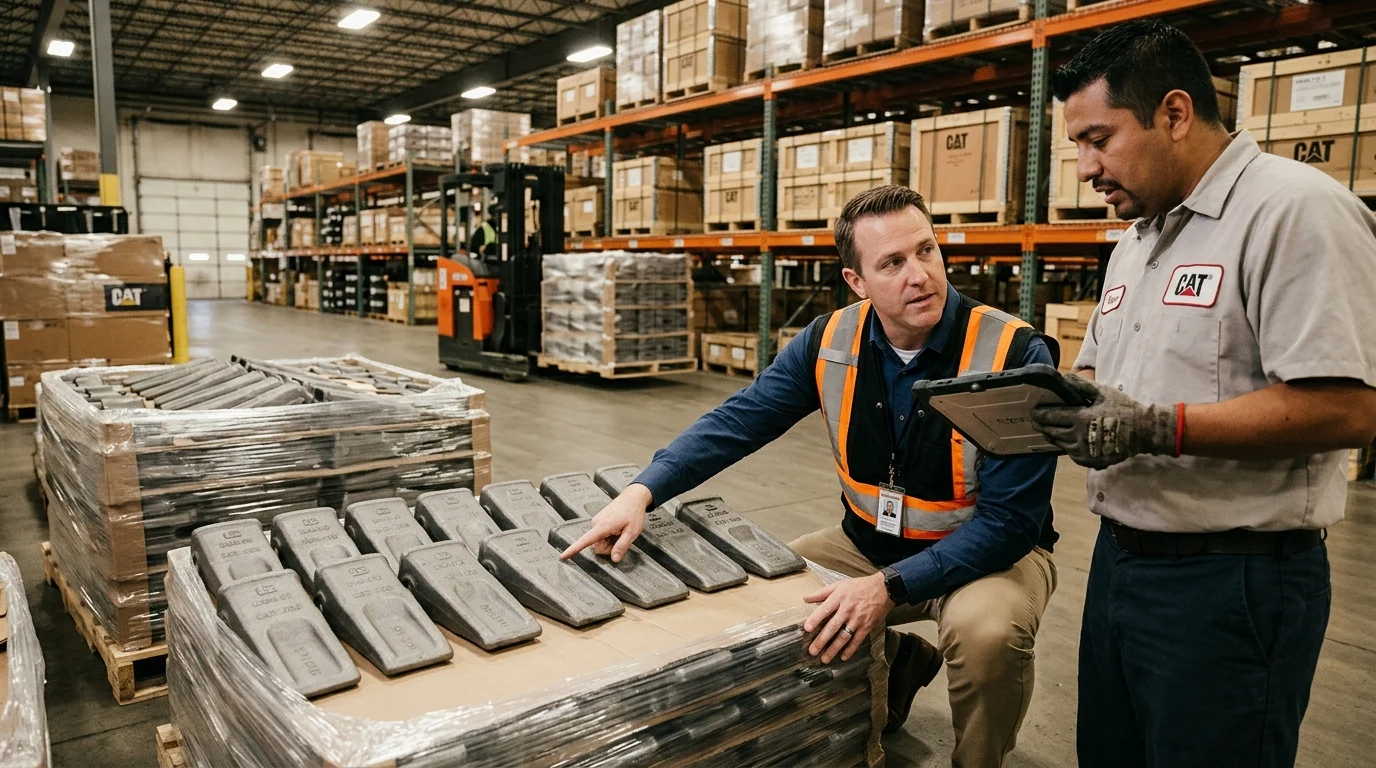
2026 procurement risks across construction and mining channels
Cost drivers affecting importer and distributor margins
Replacement demand trends by brand and application
How to Compare Caterpillar Bucket Teeth Options
Key specifications: tooth system, adapter fit, pin lock, alloy, hardness
Wear life, impact resistance, and replacement efficiency
Application Type
Ideal Hardness (HRC)
Impact Toughness (Akv)
Standard Dirt / Loam
47 – 50
> 18 J
High Abrasion (Sand)
50 – 53
> 15 J
Heavy Rock / Mining
45 – 48
> 25 J
Part compatibility, machine class, and service interval
How to Evaluate Caterpillar Bucket Teeth Suppliers
Foundry, machining, heat treatment, and QA capabilities
MOQ, samples, lead times, and private label options
Red flags in quality control and export readiness
Required Quality and Compliance Documents
Test reports and traceability records
Material certificates, hardness data, and dimensional inspections
Packaging, labeling, and export documents
Freight, Packaging, and Inventory Planning for 2026
Best packaging formats for bulk and mixed-SKU shipments
Freight, consolidation, and safety stock impact on landed cost
Inventory planning for fast movers and regional demand
Sales Channels and Pricing Strategies for Distributors
Channel segmentation: dealers, aftermarket, rental, and mining
Pricing models: markup, tiered wholesale, contracts, and bundles
Customer Tier
Annual Volume
Pricing Strategy
Tier 1 (Mining/Large Fleet)
> 50 Tons
Cost + 15% (Long-term contract)
Tier 2 (Regional Dealers)
10 – 50 Tons
Standard Wholesale (Tiered discounts)
Tier 3 (Walk-in / End User)
< 10 Tons
MSRP (Highest markup)
Branding, warranty, and quality positioning
Practical Buying Steps to Reduce Order Risk
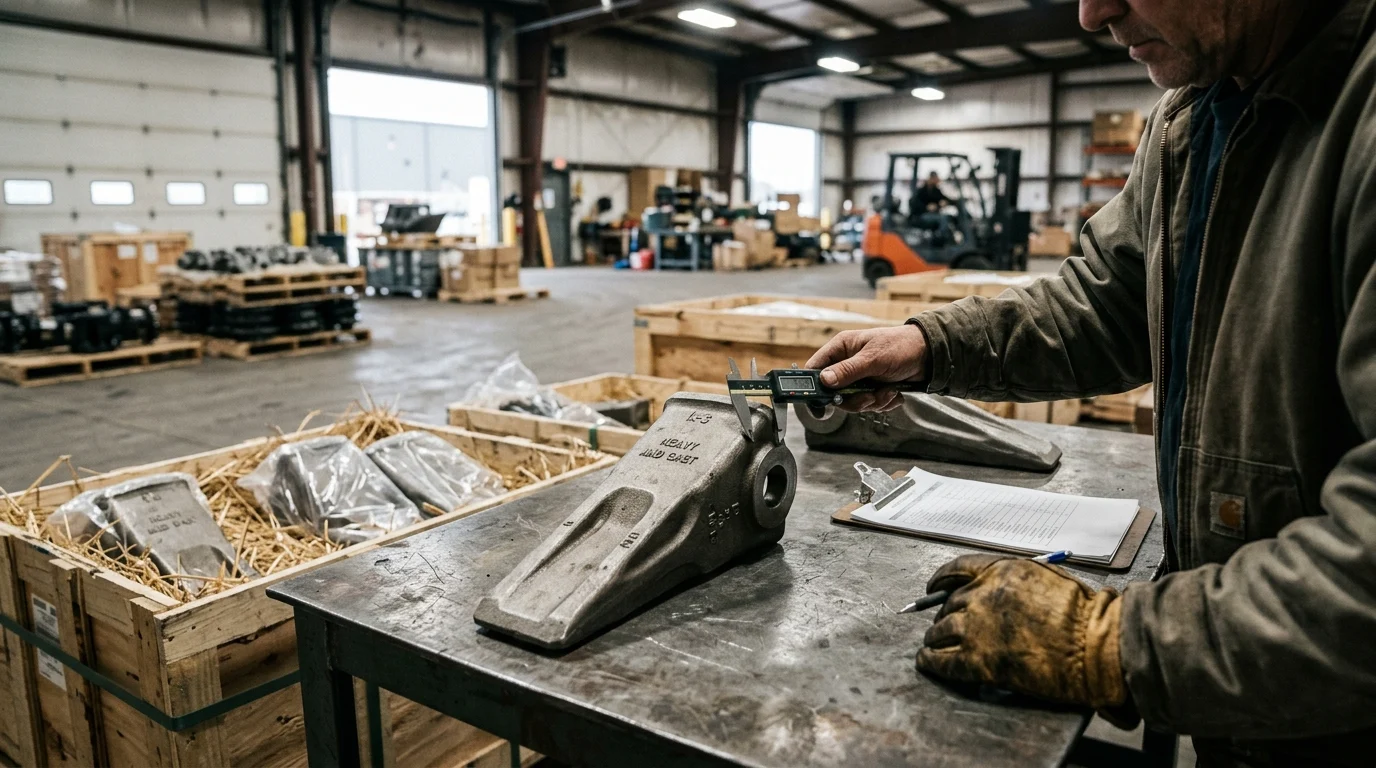
Build a supplier shortlist and run sample or pilot orders
Order checklist for specs, packaging, inspection, and delivery
Key decision points for 2026 sourcing
Caterpillar Bucket Teeth FAQ
How to verify interchangeability and reduce fitment claims
Typical MOQ for mixed models
How to compare OEM and aftermarket options
Key Takeaways
Post time: Apr-15-2026