TL;DR
- For frozen ground, choose a rock tooth rather than a general-purpose tooth, because the failure mode in frozen material is impact fracture rather than gradual wear.
- Hardness alone is the wrong specification, because a tooth hard enough to resist abrasive wear is also brittle enough to shatter on a hidden frozen block, so impact energy matters as much as HRC.
- Published rock tooth specifications for this duty carry a tensile strength of at least 1400 N/mm², an impact requirement of at least 20 J, and a hardness of 48 to 52 HRC.
- The adapter is the part most buyers forget, and it is deliberately specified softer than the tooth at 40 to 45 HRC so that it is the sacrificial element that absorbs shock load.
- Plan on replacing the adapter after seven to ten tooth changes rather than treating it as a permanent component, because the adapter is designed to wear before the tooth does.
- Frozen conditions change the loading pattern far more than they change the material, so tooth count on the bucket is the lever most operators overlook.
The short answer: a rock tooth, specified with an impact figure
For frozen ground, specify a rock tooth rather than a general-purpose tooth, and specify its impact value alongside its hardness rather than hardness alone. Those two decisions account for most of what matters, and everything else in this article is detail underneath them.
The reason is that frozen ground changes the failure mode, not just the rate of wear. In thawed soil a bucket tooth meets material that yields progressively: the tip penetrates, the material deforms around it, the load builds gradually and predictably, and the tooth wears slowly at the tip face. In frozen ground the tooth meets a material that behaves like rock until it suddenly does not. The tip strikes a solid block, load builds to a peak far above the normal working load, and then the block releases in a chunk and the load vanishes. That profile — slow build, sudden peak, sudden release — repeated thousands of times a shift is what breaks teeth, and it is why a tooth that lasts four seasons in summer soil can shatter in a week of January digging.
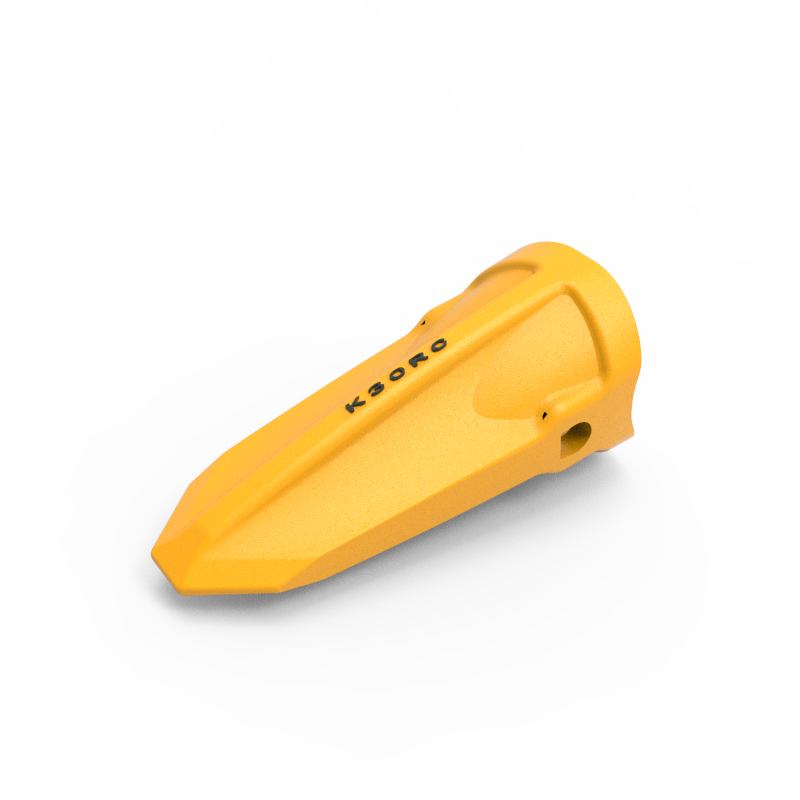
A general-purpose tooth is built to spread load across a broad tip so that soil excavation is efficient, and that geometry is exactly wrong for the frozen case, because a broad tip turns the strike of a hidden frozen block into a distributed shock across the whole edge rather than a concentrated load the tip can carry. A rock tooth uses a chisel or pointed profile for the opposite reason: it concentrates the same force onto a smaller area, and it is heat treated for hardness with an explicit impact requirement behind it.
Why quoting hardness alone is a specification error
Hardness and toughness move in opposite directions, so a specification that quotes only hardness describes a part that is good at one job and bad at another, and in frozen ground the bad job is the one that causes the failure.
Hardness resists abrasion. A harder tooth face wears more slowly against soil and rock, which is why hard teeth win in long high-wear campaigns. But hardness also reduces the material’s ability to absorb energy before it fractures, which is why a very hard tooth is also a brittle one. In thawed ground, where every load is gradual and bounded, that trade costs nothing. In frozen ground, where the peak load is several times the working load and arrives without warning, the trade is the whole problem.
This is why a winter specification should always carry an impact figure next to the hardness figure, on the same line, as one requirement rather than two. The published rock tooth specification for the K-Max series teeth we manufacture is a tensile strength of at least 1400 N/mm², an impact value of at least 20 J, and a hardness of 48 to 52 HRC. The hardness range is not unusually high for a wear part. What matters is that the impact value is specified at all, because a 50 HRC tooth with no impact requirement and a 50 HRC tooth tested to absorb at least 20 J are not the same part.
There is a second treatment detail worth knowing about, because it is not obvious from the hardness figure alone. Our rock teeth are processed to give an inner hardness of 48 HRC and an outer hardness of 50 HRC. That gradient is intentional: the outer layer is harder because it is the surface that meets the ground and takes the wear, while the tougher core underneath is what stops the tooth snapping when a peak load arrives.
The manufacturing process is the other half of this story. Our teeth are produced by lost-wax investment casting only, with no sand casting and no forging, and we state that as a positive specification rather than leaving it implied. Casting process affects grain structure, and grain structure affects how a shock load propagates through the part, so this is a specification with a mechanical consequence rather than a production detail.
The adapter is the part most buyers forget, and it is meant to fail
The bucket adapter is deliberately specified softer than the tooth, at 40 to 45 HRC against the tooth’s 48 to 52 HRC, because the adapter is designed to be the sacrificial element that absorbs shock before the tooth does.
This design decision is worth understanding properly, because it looks backwards to anyone reading a hardness table. A softer component adjacent to a harder one would normally sound like an engineering defect. In a wear assembly it is the opposite: the adapter is the part that absorbs impact load and wears, and it is intended to be replaced before it becomes the thing that fails unpredictably. When an adapter is allowed to wear past its limit it stops holding the tooth positively, and the failure it then produces is a tooth detaching in the bucket rather than a tooth wearing out. A detaching tooth in a working bucket is a serious safety event, and it is why adapter condition belongs on the inspection list rather than only the tooth.
Our published service guidance is that after changing the bucket teeth seven to ten times, the adapter should be replaced. Two practical points follow from that figure.
- Plan against the shorter end of the range in frozen duty. The seven-to-ten figure applies to normal working. Frozen ground produces more shock load per cycle than normal working, so the adapter is consuming its life faster even when the tooth change count looks on schedule. Treat seven as the working number for winter, not ten.
- Count adapter replacement as a consumable in the budget, not as a repair. If adapter replacement only appears on your breakdown list, it will always be deferred in favour of the machine running, which is precisely the condition that leads to an adapter releasing a tooth.
| Property | Published value | Why it matters for frozen-ground digging |
|---|---|---|
| Material | High standard alloy steel | Base material; actual alloy grade should be confirmed against a certificate rather than a description |
| Tensile strength | At least 1400 N/mm² | Carries the working load without yielding under peak frozen-ground load |
| Impact energy | At least 20 J | The figure that governs shatter resistance; the reason a hardness-only specification is inadequate |
| Tooth hardness | 48 to 52 HRC | Wear resistance at the tip face against soil and rock |
| Hardness distribution | 48 HRC inner, 50 HRC outer | Harder wear surface over a tougher core that resists shock |
| Adapter hardness | 40 to 45 HRC | Deliberately softer so the adapter absorbs shock first and is replaceable |
| Adapter replacement | After 7 to 10 tooth changes | Plan against 7 in frozen duty; treat as a consumable, not a repair |
| Production process | Lost-wax investment casting only | No sand casting or forging; casting process affects how shock propagates |
| K30RC weight | 10.8 kg | Komatsu PC300 class rock tooth |
| K50RC weight | 13.7 kg | Komatsu PC600 class rock tooth, the heavier end of the range |
| Certification | ISO9001:2008 | Quality management certification for the manufacturing operation |
| Warranty | Any breakage replaced free of charge | Documented against the part numbers you are fitting, before you fit them |

Fitment is where most winter orders go wrong
A tooth that is correct for the machine is not automatically correct for the bucket, and the difference between a good order and a wasted one is usually decided at the point of fitting rather than at the point of ordering.
Two things have to match. The tooth has to interlock with the adapter it is fitted to, and the tooth has to seat on the lip of the specific bucket it goes into. Buckets differ in lip width even within a single machine class, so a tooth specified as fitting a PC300 may be correct for one PC300 bucket in your fleet and wrong for another. This is not a defect in the tooth; it is a consequence of there being more than one bucket design in service for the same machine.
For aftermarket parts the practical test is interchangeability. We check fitment against the two most widely used fitment standards in this market, BYG and NBLF, because a tooth that fits one but not the other will not interchange with parts a workshop already holds, and a fleet that has stocked one standard will find it has bought two sets. Ask a supplier to confirm which fitment standards their parts have been checked against, and ask them to show you the interlock rather than describing it.
There is one more detail that pays for the asking. Each tooth design carries both a part number and a mould number, and the design is not changed between orders. This matters because when you fit a bucket over several teeth in sequence, mixed part numbers wear unevenly and produce a cutting edge that no longer follows the original profile, and tracking that back to a supplier three years later is much harder than tracking back to a mould number that has never changed.
Fit the set before you fit the bucket. Confirm that the tooth and adapter from the same set interlock on the bench before anything goes into the machine. A fitment problem found on the bench costs a few minutes; the same problem found after the bucket is on the machine costs the changeover, and if it is discovered with the bucket in the ground it costs the shift.
Tooth count is a variable to test, not a default to increase
Adding teeth to the cutting edge in frozen ground raises the share of cutting force each tooth carries, and that is a genuine trade rather than a free improvement.
The argument for more teeth is geometric. A well-populated edge cuts more cleanly, breaks material away in smaller pieces, and improves the machine’s behaviour through the cut. The argument against is that the total force is roughly unchanged while the number of teeth sharing it has increased, so each tooth sees a higher peak load per cycle and the point contact is more frequent. Against thawed soil that is a reasonable trade. Against a frozen material that delivers sudden peak loads, it is a trade you should make deliberately.
The practical advice is to treat tooth count as something you change and then observe, rather than something you change because a competitor has more teeth on their bucket. Run one configuration for a test period, record what actually fails and where, and change one variable at a time. If you change tooth profile, tooth count and adapter condition in the same week, you will not be able to attribute the result to any of them.
The operational changes that matter as much as the tooth
A correctly specified rock tooth on a badly operated machine in frozen ground will still break, and the operational changes below often pay for themselves before the tooth does.
- Reduce the working breakout force rather than increasing tooth capacity. A tooth that is being overloaded is one that has met something it could not move. Trimming the cut depth or the width of the pass is often the correct answer, because a smaller peak load on a correctly specified tooth beats a larger tooth that will shatter later.
- Watch for hidden frozen blocks rather than for the general hardness of the face. The failure that breaks teeth is almost always a buried block or a frozen lens that the bucket encountered unexpectedly, not the uniform frozen face. Where a face is known to contain lenses, working the face back from a shallow angle reduces the impact.
- Do not treat frozen and thawed ground as the same job at different effort. A machine that can dig thawed ground at a given depth and cycle time will not necessarily do the same in frozen ground, and the operator who learned the machine in summer has no calibration for what the winter version feels like.
- Inspect adapters on a schedule, not on a tooth change count alone. Adapter wear is the item that is easiest to defer and most expensive to defer, because a worn adapter produces a tooth release rather than a tooth wear.
A safety point that belongs in this article rather than in a manual. Bucket teeth are stored energy when they are under load, and a shattered tooth or a released tooth in a bucket is a projectile hazard to anyone working in the dig face. This is why attachments and material handling equipment are covered by their own regulatory requirements in the United States, including the equipment provisions of the federal construction standards published by OSHA at 29 CFR 1926.602, and the wider mechanized equipment requirements in 29 CFR Part 1926 Subpart O. Those provisions set out general requirements for equipment; they do not specify bucket teeth, and they are not a tooth-selection guide. They are cited here because the reason a tooth should be specified with an impact value is not primarily commercial.
Supply, lead time and the winter reorder point
The most common seasonal failure in this category is not a broken tooth, it is a machine standing in a frozen face at the end of a long lead time. Our published lead times are about seven days for samples, 20 to 30 days for mass production after the deposit payment is received and final product approval is given, and 30 to 40 days for one container of the K30RC rock tooth. The clock starts when both conditions are met, which means a specification still being revised when the deposit is paid is additional delay that does not appear on any quoted date.
Two practical consequences follow. Set the winter reorder point in autumn: if your service level is one set on the machine plus one on the shelf, and the shelf set is ordered when the first tooth breaks, you will spend the busiest weeks of the season waiting. And get the specification settled before the deposit, because lead time starts on final approval as well as on payment, so an unresolved question about profile, fitment or impact requirement is a lead time risk. Fitment across machines is worth answering before ordering, since the tooth that fits your PC300 bucket may not fit your PC200 bucket, and a fleet order that assumes they are the same has an inconsistency in it.
On the commercial side, the standard terms for this category are a 30 percent deposit with the balance against a copy of the bill of lading, and the shipping cost depends on the method and the consignment size. Documentation is available where a buyer requires it, including certificates of analysis or conformance, insurance and origin documents. Our warranty position is that any breakage of teeth or adapters is replaced free of charge, and because that position is only worth what the documentation behind it is worth, ask for it to be stated against the specific part numbers before the parts are fitted.
Where this advice has limits
There is no universally correct tooth for frozen ground, and any supplier who names one without knowing your machine, your bucket and your ground is guessing. Several honest limitations follow.
First, the published mechanical figures describe the part, not the result in your ground. A tooth specified at 48 to 52 HRC with an impact value of at least 20 J will resist shatter better than a general-purpose tooth, and it will still break if you drive it into a rock it should never have been aimed at. The specification raises the threshold; it does not remove the failure mode.
Second, the seven to ten adapter replacement figure is a service interval, not a measurement. Adapter wear depends on ground conditions and on how much shock the machine is absorbing, so the interval is a planning figure and the actual condition is a visual one.
Third, tooth count advice is genuinely contested in this industry, and the honest answer is that it depends on the machine, the bucket and the operator’s reaction to the machine. We would rather a buyer test one change properly than change three things and attribute the outcome to the wrong one.
Fourth, and most importantly, none of this replaces the judgement of the operator who knows the ground. The person who has cut this face for six winters knows where the lenses are, and a specification guide that pretends otherwise is not being useful.
A winter specification checklist
Seven items, checked before the order is placed, are the difference between teeth that last a season and teeth that last a week.
- Tooth profile specified as rock or chisel rather than general purpose, with the reason written down.
- Hardness and impact energy quoted on the same line, never hardness alone.
- Adapter hardness confirmed as lower than the tooth, and adapter replacement planned as a scheduled consumable rather than a repair item.
- Fitment confirmed against the specific bucket and against the fitment standards your workshop already stocks.
- Part numbers recorded so that a repeat order produces the same tooth and the same mould.
- Tooth count treated as a tested variable, changed deliberately with one change per test period.
- Reorder point set for winter consumables before the season starts, allowing for a lead time measured in weeks rather than days.
Sizing the tooth to the machine
Because tooth size is matched to machine class as well as to material, it is worth looking at the range rather than a single part. The K-Max series rock teeth we manufacture run from the K15RC and K20RC through the K25RC and K30RC to the K40RC and K50RC, covering excavator classes from roughly the PC200 through to the PC600, with published weights from around 8 kg to 13.7 kg at the K50RC. The full ground engaging tool range, including Caterpillar J and K series, Doosan, Volvo, ESCO and UNI-Z fitments and the corresponding cutting edges and adapters, is in the complete ground engaging tools selection section.
For the specific dimensions and material data on one part, the K30RC Komatsu K-Max series rock tooth specification page carries the full published table including the 10.8 kg weight, the 1400 N/mm² tensile strength, the 20 J impact value and the 48 to 52 HRC range referenced throughout this article. If you are weighing up the tooth selection itself rather than a particular part number, our tooth selection FAQ covers fitment, design consistency, adapter replacement and warranty, and it is worth reading before sending an enquiry because most of the questions that generate back-and-forth are answered there.
Telling us what you are digging
If you send us the machine class, the bucket, and a description of the ground and the depth you are working at, we will tell you which tooth we would specify and why, including where we would tell you that a standard tooth is the right answer.
- Machine make, model and class, and whether the bucket is OEM or aftermarket.
- Ground type and how frozen it actually gets at working depth, in your coldest weeks rather than on average.
- Whether you are in general excavation or in a pipeline or utility trench, since trench work loads the tooth differently.
- Your current tooth count and what has been failing, and whether it has been wearing, cracking or detaching.
We will come back with a part number, the published specification, and an honest note on whether you need a rock tooth at all.
Xin Jack — contact Join Machinery or reach us at info@nbjm-china.com.
Frequently asked questions
Which bucket teeth should I use for frozen ground?
A rock tooth rather than a general-purpose tooth. Frozen ground changes the failure mode rather than merely the rate of wear. A general-purpose tooth distributes load across a broad tip for efficient soil excavation, and in frozen material that broad tip turns the strike of a hidden frozen block into a distributed shock across the whole edge. A rock tooth uses a chisel or pointed profile that concentrates the same force onto a smaller area, and it is heat treated to a higher hardness with an explicit impact requirement behind it. Published rock tooth specifications for this duty carry a tensile strength of at least 1400 N/mm², an impact value of at least 20 J, and a hardness of 48 to 52 HRC.
Why is hardness alone the wrong specification for frozen digging?
Because hardness and toughness move in opposite directions. A harder material resists abrasion better, which is what you want against soil and rock wear, but it is also more brittle, and a hard brittle tooth struck against a frozen block absorbs less energy before fracturing. This is why a winter specification should quote an impact value alongside the hardness figure. Our published specification requires at least 20 J together with 48 to 52 HRC, and the two together are the specification, because quoting one without the other tells the supplier only half of what the part has to do.
How often do I need to replace the adapter when digging frozen ground?
Plan on replacing it after seven to ten tooth changes rather than treating it as a permanent component. Our adapters are specified at 40 to 45 HRC, deliberately softer than the 48 to 52 HRC of the tooth, because the adapter is meant to absorb shock load and wear first so that the tooth and the bucket lip are protected. Published guidance is that after seven to ten tooth changes the adapter should be replaced, and in frozen-ground duty you should plan against the shorter end of that range, because frozen ground produces more shock per cycle than normal working. Adapter wear is also the item most easily deferred and most expensive to defer, because a worn adapter releases the tooth rather than wearing out.
Does tooth count on the bucket matter in winter?
More than most operators expect, and it is the adjustment most often left out of a winter plan. Adding teeth reduces the area each tooth covers, so each tooth takes a larger share of the total cutting force and experiences a higher peak load per cycle. That improves the geometry of the cut and reduces the impact from material breaking away in large pieces, but against a hard material it also raises the load each tooth carries. It is therefore a deliberate change with a test period behind it, not a free improvement, and you should change one variable at a time so that you can attribute the result.
Can I keep using summer teeth through a winter if I am careful?
For occasional work in light frost, possibly. For sustained excavation in genuinely frozen ground, no, because the loads are not the same loads. In thawed ground the tooth meets soil that yields progressively and the peak force per cycle is moderate and predictable. In frozen ground it meets a material that releases in chunks, so the peak arrives suddenly and without warning, several times the working load the tooth was designed around. A lower-specification tooth in those conditions does not shorten its life gradually; it produces a sudden failure, usually a shatter at the tip or a crack at the shank, and a shattered tooth in a bucket is a projectile hazard for anyone working in the dig face.
What does fitment mean when ordering replacement teeth?
It means the tooth has to match the adapter and the bucket lip it will be fitted to, not merely the machine model. A tooth specified as fitting a Komatsu PC300 is correct for the machine but may not fit every bucket in the fleet, because buckets differ in lip width even within one class. The verification worth asking for is that the tooth and the adapter have been checked against the two most widely used fitment standards in the aftermarket, BYG and NBLF, since a tooth fitting one but not the other will not interchange with parts your workshop already holds. Part numbers and mould numbers are retained against each design so repeat orders produce the same fitment, which matters when fitting a bucket over several teeth in sequence.
How long does it take to get replacement teeth out of season?
Samples take about seven days. Mass production runs 20 to 30 days after the deposit payment is received, with the clock starting once both the deposit has been paid and final approval of the product has been given, so an unresolved specification at the point of payment is additional delay that does not appear on any quoted date. A full container of the K30RC rock tooth takes 30 to 40 days. The practical implication for winter planning is that ordering when the first frost arrives leaves the machine under-equipped for the part of the season that matters most, so the reorder point for winter wear parts should be set before the season starts rather than in response to the first breakage.
What should I check when teeth arrive, before fitting them?
Check the part number against what you ordered and confirm every tooth in the set carries the same number, because a mixed set wears unevenly and is hard to diagnose later. Confirm the tooth and adapter from the same set interlock on the bench before anything goes into the machine, since a fitment problem found on the bench costs minutes and the same problem found with the bucket on the machine costs the changeover. Check the tip and the retention lugs for casting defects. And confirm your warranty position before fitting, because our position is that any breakage is replaced free of charge, and you want that documented against the part numbers you are about to install.
Should I fit a heavier tooth in winter to get more tooth life?
A heavier tooth carries more section through the shank and the tip, which is what allows it to survive the repeated peak loads a larger machine applies, and matching tooth size to machine class is part of matching the tooth to the material. The K50RC at 13.7 kg sits at the heavy end of the K-Max series and covers the PC600 class, while the K30RC at 10.8 kg covers the PC300 class. What a heavier tooth does not do is rescue an undersized tooth on a small machine, and what it will do is unbalance a bucket that was balanced for a different fitment. Size the tooth to the machine class first, then to the ground.
About the author
Xin Jack is the Export Sales Manager at Ningbo Yinzhou Join Machinery Co., Ltd., a manufacturer of ground engaging tool parts including bucket teeth, cutting edges and adapters for excavators and construction equipment. Established in 2006, the company has 16 years of exporting experience serving European and American markets and partners with brands including BYG, JCB and NBLF.
Every product goes through strict quality control from raw material through to finished goods, with the aim of maximising cost performance for construction and mining customers worldwide.
For direct project discussion, contact Join Machinery or email info@nbjm-china.com. Machine class, bucket type, ground conditions and what has been failing are the four details that produce a useful answer rather than a catalogue reply.
References cited in this article: 29 CFR 1926.602 material handling equipment requirements, and 29 CFR Part 1926 Subpart O motor vehicles and mechanized equipment.
Related reading from Join Machinery
- The complete ground engaging tools range covering Caterpillar, Komatsu, Doosan, Volvo, ESCO and UNI-Z fitments is in the ground engaging tools complete selection section.
- For the full material and dimensional data on one part, see the K30RC Komatsu K-Max series PC300 rock tooth product specification.
- Fitment, design consistency, adapter replacement and warranty questions are answered on the tooth selection FAQ page.
Last verified: 2026-10-23 · Mechanical specifications reviewed against Join Machinery published product data on 23 October 2026.
Post time: Oct-23-2026