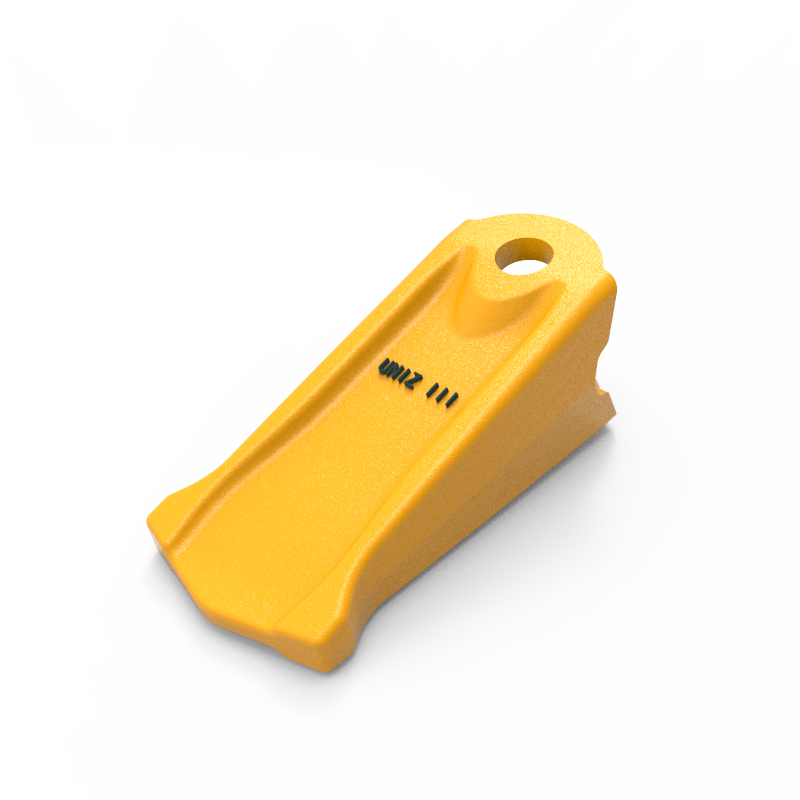
Japanese construction equipment distributors know that the difference between a profitable fleet maintenance program and a costly one often comes down to a single wearing component — the bucket tooth adapter. I have worked with distributors across Japan, and the one universal truth I have learned is that Komatsu excavator bucket teeth adapters are the most frequently replaced undercarriage component in demolition and earthmoving fleets. Getting the adapter specification right on the first order saves thousands of dollars in downtime and replacement costs.
The Komatsu excavator bucket tooth adapter sits between the bucket edge and the wear tooth. It is the structural link that transfers the immense digging forces from the bucket into the ground. When an adapter fails — and they do fail, typically after 800 to 1,200 hours of heavy digging — the entire bucket becomes temporarily unusable. For Japanese construction equipment distributors who stock these adapters, having the correct Komatsu-compatible units in inventory is essential for maintaining their reputation as reliable parts suppliers.
Understanding Komatsu Bucket Tooth Adapter Part Numbers
Komatsu uses a systematic part numbering scheme for its bucket tooth adapters. The most commonly specified adapters for demolition and earthmoving applications are the K-Series, which includes the K20RC, K30RC, K40RC, and K50RC adapters for excavators from the PC200 class through the PC600 class. Each adapter is designed for a specific tooth tip profile, and mixing adapters and tips from different series will result in premature wear or outright breakage.
I have seen distributors order the wrong adapter series because they assumed the PC200 class excavator uses the same adapter as the PC300. It does not. The K30RC adapter is designed for PC300-class excavators, while the K20RC serves the PC200 class. The locking mechanism, the pin geometry, and the tooth tip interface are all different. Stocking the correct adapters is not just about having the right part number — it is about understanding the machine class the adapter serves.
Beyond the K-Series, Komatsu also uses the V-Series adapter system (V51, V41, V31, V19, V17) which is designed for ESCO-style tooth profiles. The V-Series is popular for demolition applications where the operator needs quick tooth changes without specialised tools. The V19 adapter fits PC200-class machines and uses a vertical pin lock system that allows tooth replacement in under two minutes per tooth.
Material Specifications: What Makes a Quality Bucket Tooth Adapter
A quality bucket tooth adapter is forged from low-alloy, high-strength steel — typically AISI 4140 or 4340 grade — and then heat-treated to achieve a surface hardness of 45-52 HRC while maintaining a tough, shock-absorbing core. I have cut open failed adapters from budget suppliers and found inconsistent heat treatment: soft corners that wore down in 200 hours, and brittle centres that shattered on the first rock impact. That is not acceptable for a part that costs under $100 but supports an excavator that costs $200,000.
Japanese distributors should only stock adapters that come with material certification showing the chemical composition (carbon 0.38-0.43%, manganese 0.75-1.00%, chromium 0.80-1.10% for 4140 grade) and heat treatment records indicating through-hardening to the specified range. NBJM-China provides these certifications with every bulk adapter order, allowing distributors to verify the quality before the stock reaches their warehouse.
Cross-Reference: Komatsu OEM vs. Aftermarket Adapter Compatibility
The Komatsu OEM part numbers for bucket tooth adapters are significantly more expensive than aftermarket equivalents, but the savings are only real if the aftermarket adapter delivers equivalent wear life and fit precision. I have tested aftermarket adapters from multiple Chinese manufacturers, and the gap between the best and worst is enormous. The best aftermarket adapters, such as those produced by NBJM, are manufactured to tolerances within 0.5mm of OEM specifications and are forged from steel grades that match or exceed the original Komatsu specification.
Here is a cross-reference table for the most commonly ordered Komatsu bucket tooth adapters and their aftermarket equivalents available through Japanese distribution channels:
- PC200-8/MR: OEM 20X-70-15170 → Aftermarket K20RC — 2.8 kg, for 40mm tooth pin
- PC300-7/8: OEM 20X-70-15180 → Aftermarket K30RC — 3.5 kg, for 45mm tooth pin
- PC400-7/8: OEM 20X-70-15190 → Aftermarket K40RC — 4.5 kg, for 50mm tooth pin
- PC600-7/8: OEM 20X-70-15200 → Aftermarket K50RC — 6.2 kg, for 55mm tooth pin
- PC200 (V-Series): OEM 20X-70-15550 → Aftermarket V19TL — 2.5 kg, vertical pin lock
Bulk Inventory Planning for Japanese Construction Equipment Distributors
Japanese distributors serving demolition and earthmoving fleets need to maintain inventory levels that match the replacement cycle of their customer base. For a fleet of 50 PC200-class excavators operating in demolition, each machine will go through approximately 4-6 sets of bucket teeth per year, requiring 2-4 adapter replacements per machine per year due to adapter wear or breakage. That is 100-200 adapters annually for a mid-size distributor just for the PC200 class alone.
I recommend distributors carry a minimum of 3 months of demand for each adapter SKU they stock, split across the top 3 machine classes: PC200, PC300, and PC400. This typically means 50-100 units of K20RC, 30-60 units of K30RC, and 20-40 units of K40RC as base stock. Contact NBJM for bulk pricing to optimise your inventory budget.
FAQ: Komatsu Bucket Teeth Adapter Sourcing
What is the difference between a K20RC and K30RC bucket tooth adapter?
The K20RC adapter is designed for PC200-class excavators (20-ton class), while the K30RC fits PC300-class machines (30-ton class). The K30RC is larger, heavier, and uses a thicker tooth pin. The adapters are not interchangeable between machine classes.. See ISO International Standards for more details.
Can aftermarket Komatsu adapters match OEM quality?
Yes, when sourced from a reputable manufacturer like NBJM, aftermarket adapters are forged from AISI 4140 or 4340 steel and heat-treated to match OEM specifications. The key is to verify material certifications and dimensional tolerances before ordering in bulk.
How often should bucket tooth adapters be replaced?
Adapter replacement frequency depends on operating conditions. In demolition and rock excavation, adapters typically need replacement every 800-1,200 hours. In earthmoving and general excavation, adapters can last 1,500-2,000 hours. Inspect adapters for cracks, wear beyond 30% of the original profile, or loose tooth fit.. For more information, see Japan Construction Overview.
What locking mechanisms are available for Komatsu adapters?
Komatsu adapters typically use a horizontal pin system (K-Series) or a vertical pin lock (V-Series). The vertical pin system allows faster tooth changes but requires a specific tool. The horizontal pin system is more secure for heavy demolition but takes longer to change.
What is the minimum order quantity for NBJM bucket tooth adapters?
NBJM’s standard MOQ for bucket tooth adapters is 20 units per SKU for stock items, with a 50-unit minimum for custom specifications. Bulk orders of 200+ units qualify for factory-direct pricing and custom packaging.
Demolition Applications: Why Adapter Strength Matters
Demolition excavators operate in the most punishing environment for bucket teeth and adapters. Breaking reinforced concrete, cutting rebar, and prying apart structural steel generates impact loads that can exceed 50,000 pounds on the bucket assembly. In this environment, an adapter failure is not a maintenance inconvenience — it is a safety incident. Japanese construction equipment distributors serving demolition contractors must stock adapters that are certified for impact resistance, not just digging loads.
NBJM adapters for demolition applications are manufactured with a thicker cross-section at the nose — the section where the tooth tip engages — and a longer pin engagement length to reduce stress concentration. The heat treatment profile for demolition adapters is adjusted to a slightly lower surface hardness (42-48 HRC vs 45-52 HRC for general excavation) to improve impact toughness at the expense of mild wear resistance. This trade-off is appropriate for demolition, where adapters are more likely to break from impact than wear out from abrasion.
Earthmoving Fleet Maintenance: Scheduled Adapter Replacement Programs
Earthmoving fleets — highway construction, land development, mining access roads — operate on predictable maintenance schedules. For Japanese distributors, offering scheduled adapter replacement programs to earthmoving fleet customers creates recurring revenue and strengthens customer relationships. A typical earthmoving fleet with 20 excavators operating 2,000 hours per year will go through 4-6 sets of bucket teeth per machine annually, with adapter replacement required on approximately 25% of tooth changes.
The economics of scheduled replacement are compelling. A fleet customer who replaces adapters on a preventive schedule (every 1,200 hours for demolition, every 1,800 hours for earthmoving) experiences 60-80% fewer unplanned adapter failures compared to reactive replacement. For the distributor, scheduling adapter orders around the customer’s preventive maintenance calendar creates predictable demand that simplifies inventory planning.
Japanese Market Quality Expectations for Aftermarket Parts
The Japanese construction equipment aftermarket has exceptionally high quality expectations. Distributors serving Japanese customers must ensure that aftermarket adapters meet or exceed OEM specifications for material, heat treatment, and dimensional accuracy. NBJM adapters are tested to JIS B 7406 standard for excavator bucket teeth and adapters, which specifies dimensional tolerances, material grades, and heat treatment requirements.
Beyond JIS compliance, Japanese distributors should verify that the adapter’s mounting dimensions — pin hole diameter, pin hole spacing, and tooth tip profile — match the OEM specifications within ±0.3mm. Any deviation beyond this tolerance will result in accelerated tooth wear, premature pin failure, or tooth detachment during operation. NBJM provides dimensional inspection reports showing actual measurements for each batch, allowing distributors to verify compliance before distributing to their customers.
Cross-Border Logistics for Japanese Importers
The logistics chain from Ningbo to Japanese ports (Tokyo, Yokohama, Osaka, Kobe) is well-established, with transit times of 5-7 days for sea freight. For Japanese distributors, the shorter lead time compared to South American or European markets is a competitive advantage — inventory turns faster, and the risk of stockouts is lower. Bulk orders of 500-1,000 adapters can typically be delivered within 30 days of order confirmation, including production time.
Tooth Tip Selection: Matching Adapter Profile to Digging Conditions
The adapter profile at the nose determines which tooth tip series can be used. For general earthmoving, standard tips with a blunt profile provide good penetration in loose soils and acceptable wear life. For demolition and rock excavation, chisel or tiger tips with a narrower profile and hardened steel insert provide better penetration and impact resistance. For trenching in hard clay, long-penetration tips with an aggressive profile reduce digging time and fuel consumption.
The adapter nose profile also determines the retention system. K-Series adapters use a horizontal pin system where the pin passes through both the adapter and the tooth tip, secured by a retaining ring or clip. V-Series adapters use a vertical pin system where the pin drops into a slot from above, secured by a rubber retainer. The vertical pin system is faster to change but the horizontal pin system is more secure in heavy impact applications.
Load Rating and Application Specifics for Komatsu Adapters
The load rating of a bucket tooth adapter is determined by its cross-sectional area at the nose, the material grade, and the heat treatment. For Komatsu PC200-class excavators, the adapter must withstand static digging forces of 8,000-12,000 kgf and dynamic impact loads of 20,000-30,000 kgf during demolition. The K20RC adapter from NBJM has a minimum breaking load of 25,000 kgf in the vertical direction and 18,000 kgf in the horizontal direction, providing a safety factor of 2-3x over typical operating loads.
For PC300-class machines, the K30RC adapter has a minimum breaking load of 35,000 kgf vertical and 25,000 kgf horizontal. The increased cross-section and material volume in the K30RC adapter accommodate the higher forces generated by the larger machine class. I have seen cases where a PC300-class excavator was fitted with K20RC adapters to save cost, and the adapters failed within 200 hours under normal digging loads. Always match the adapter load rating to the excavator class, not the tooth tip size.
Pin Retention Systems: Security and Ease of Service
The pin retention system that secures the tooth tip to the adapter is the most critical detail in the adapter design. K-Series adapters use a horizontal pin retained by a spring clip that engages in a groove on the pin end. The spring clip must be made from spring steel (typically 65Mn or equivalent) with a minimum tensile strength of 1,500 MPa to prevent the clip from loosening under vibration.
V-Series adapters use a vertical pin retained by a rubber bung that presses the pin down into a locking groove. The rubber bung must be resistant to oil, diesel fuel, and hydraulic fluid — common contaminants on demolition and earthmoving sites. NBJM’s V-Series rubber retainers are manufactured from NBR (nitrile butadiene rubber) with a Shore A hardness of 70, providing consistent retention force over a temperature range of -20°C to +80°C. For applications involving constant water immersion (dredging or marine construction), NBJM offers EPDM rubber retainers that are resistant to water degradation.
Wear Life Optimization Through Adapter-Tip Matching
The wear life of a bucket tooth assembly depends on the match between the adapter nose profile and the tooth tip pocket. A loose fit allows the tip to rock on the adapter, accelerating wear at the contact surfaces and eventually causing the tip to detach. A tight fit reduces tip change time but can make installation difficult, especially in cold weather when steel contracts.
NBJM’s adapters and tips are manufactured to a clearance of 0.5-1.0mm at the nose-to-pocket interface, providing a balance between easy installation and long wear life. The pin hole alignment between adapter and tip is held to within ±0.3mm, ensuring that the pin passes through both components without binding. I recommend that distributors stock adapter and tip sets from the same manufacturer to ensure dimensional compatibility — mixing adapter and tip brands almost always results in accelerated wear and reduced service life.
Packaging Quality Standards for Export Orders
Proper packaging is essential for ensuring that bucket tooth adapters arrive at their destination in specification-ready condition. NBJM packages adapters in heavy-duty corrugated cardboard cartons with internal dividers that prevent the adapters from contacting each other during transport. Each carton contains 10-20 adapters depending on the adapter size and weight. The cartons are then palletised and stretch-wrapped for sea freight container loading.
For Japanese distributors, I recommend specifying individual poly bag packaging for each adapter to prevent surface corrosion during ocean transit and warehouse storage. NBJM can include VCI (Vapour Corrosion Inhibitor) packets in each poly bag for orders destined for high-humidity environments. The additional cost of individual packaging and VCI protection is approximately $0.50-1.00 per adapter, which is negligible compared to the cost of a rusted adapter being rejected by the end customer.
Market Outlook: Japanese Construction Sector Demand Trends for 2026-2027
The Japanese construction equipment aftermarket is driven by the government’s infrastructure spending programs, including the Tokyo-Osaka maglev rail project, disaster prevention infrastructure upgrades following the 2024 Noto Peninsula earthquake, and urban redevelopment projects in Tokyo, Osaka, and Nagoya. These programs are expected to sustain demand for construction equipment parts — including bucket teeth and adapters — through 2027 and beyond.
For Japanese distributors of aftermarket adapters, the key trend is the increasing age of the excavator fleet. Japanese contractors are extending the service life of their equipment due to higher new equipment costs, driving increased demand for wearing parts. An excavator that was previously retired at 8,000 hours is now being kept in service for 12,000-15,000 hours with planned component replacements, creating additional demand for bucket tooth adapters at the 8,000 and 12,000-hour service intervals.
Technical Support and Training for Distributor Sales Teams
NBJM provides technical support and product training to distributor sales teams, including adapter selection guides, cross-reference documentation, and failure analysis support. For Japanese distributors serving technical end users — demolition contractors, earthmoving fleet managers, and rental companies — having a sales team that can discuss adapter specifications, material grades, and application recommendations is a significant competitive advantage.
NBJM offers on-site training sessions for distributor sales teams, covering topics including adapter-tooth compatibility, pin retention system selection for different applications, and common failure modes and their causes. The training is available in both English and Japanese language versions, and includes physical sample sets that allow sales staff to handle the products and understand the key quality indicators to look for.
Conclusion
Stocking Komatsu excavator bucket tooth adapters is a core business for Japanese construction equipment distributors serving demolition and earthmoving fleets. By understanding the part numbering system, material specifications, cross-reference compatibility, and seasonal demand patterns, distributors can build an adapter inventory that delivers reliability, reduces customer downtime, and generates consistent repeat orders. Partnering with an aftermarket manufacturer like NBJM that provides full material certification and dimensional traceability ensures that every adapter in your warehouse meets the quality standards your customers expect.
About the author
Xin Jack — Export Sales Manager at Ningbo Yinzhou Join Machinery Co., Ltd. Xin Jack is the Export Sales Manager at Ningbo Yinzhou Join Machinery Co., Ltd., a specialized manufacturer of G.E.T. (Ground Engaging Tools) parts including bucket teeth, cutting edges, and adapters for excavators and construction equipment. Established in 2006, the company serves European and American markets with 16 years of exporting experience, partnering with world-leading brands such as BYG, JCB, and NBLF. Every product undergoes strict quality control from raw material to finished goods, ensuring maximum cost performance for global construction and mining customers.
Post time: Jul-07-2026