
- Material — the alloy system that determines the as-cast toughness and the response to heat treatment
- Hardness — the through-hardness versus case-hardness treatment that determines the wear-life-versus-impact-resistance trade-off
- Fitment — the geometry and tolerance envelope that determines whether the end bit mounts cleanly on the mouldboard cutting edge and stays on through the wear cycle
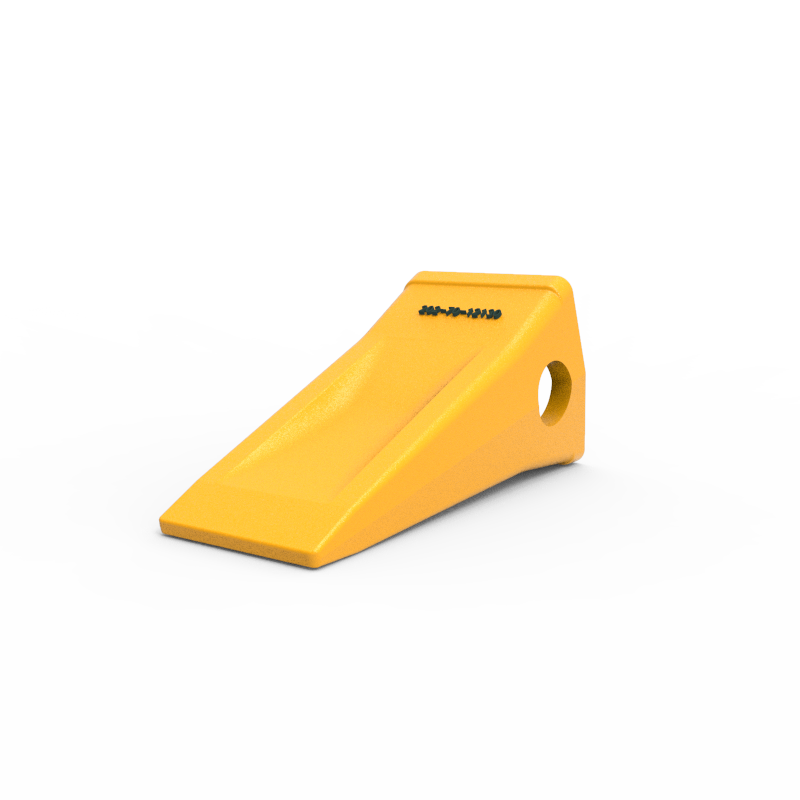
A supplier who can document all three is an engineering-grade G.E.T. partner. A supplier who quotes a per-piece price without documenting the three is a trading-grade supplier, and the 5 to 15 percent savings on the per-piece price is the difference between an end bit that wears evenly across the 200 to 400-hour envelope and one that cracks, spalls, or breaks the retaining weld inside the first 100 hours. The reference part for the engineering discussion below is the 202-70-12130 Komatsu Dozer Excavator Standard Long Bucket Tooth Tip Ripper — a long-tip end bit in the Komatsu D-class and PC-class fitment that exercises all three engineering decisions in a single part.
Why a dozer end bit is a three-decision engineering document, not a per-piece price
A dozer end bit looks like a single forged or cast component. It is — but the engineering that determines whether it lasts 200 hours or 600 hours is distributed across three independent decisions the supplier makes at the production stage. A procurement team that treats the end bit as a per-piece commodity and negotiates the unit price down 10 percent is reading the wrong page, because the 10 percent per-piece saving is wiped out by one extra unscheduled replacement cycle. The three-decision engineering document is the page that drives the total cost of ownership.
The three decisions are:
- Decision 1 — Material — the alloy system, typically a high-chrome white cast iron, a low-to-medium chrome alloy, or a manganese steel, each with a different as-cast toughness and a different response to heat treatment.
- Decision 2 — Hardness — the heat-treatment process, typically through-hardening (the entire cross-section is hardened) or case-hardening (only the wear surface is hardened, the core remains tough). The two approaches deliver different wear-life-versus-impact-resistance trade-offs.
- Decision 3 — Fitment — the dimensional tolerance, the mounting geometry, and the retainer design (weld-on, bolt-on, or pin-on) that determines how the end bit mounts on the mouldboard cutting edge and how the wear profile develops.
The three decisions are not independent. A supplier who specifies a through-hardened high-chrome white iron end bit at 62 to 65 HRC has a very different wear profile than a supplier who specifies a case-hardened low-chrome alloy at 55 to 58 HRC surface / 35 to 40 HRC core. Both designs are valid for different duty cycles, but the supplier must document both the material and the hardness, not just the per-piece price, for the procurement team to make a defensible RFQ comparison. The wear-life and hardness envelopes for the seven common G.E.T. alloy classes are also cross-referenced in the ASTM A532 abrasion-resistant cast-iron standard, the ISO 21988 abrasion-resistant cast-iron classification, and the Caterpillar G.E.T. systems handbook, all three of which a procurement team can use as a baseline reference when evaluating a supplier’s chemistry and hardness claims.
Quick Read
The three engineering decisions: (1) material — the alloy system (low-to-medium chrome, high-chrome white iron, or manganese steel), (2) hardness — through-hardening versus case-hardening, (3) fitment — mounting design (bolt-on, weld-on, or pin-on) and dimensional tolerance.
The four end-bit service classes: light-duty motor-grader end bits (low-chrome alloy, 50 to 58 HRC, bolt-on), medium-duty crawler dozer end bits (medium-chrome alloy, 55 to 62 HRC, bolt-on or weld-on), heavy-duty mining end bits (high-chrome white iron, 60 to 65 HRC, weld-on), and impact-heavy ripper end bits (manganese steel, work-hardened, pin-on).
The wear-life envelope: 400 to 600 hours per end for light-duty, 200 to 400 hours per end for medium-duty, 150 to 300 hours per end for heavy-duty mining, and 80 to 200 hours per tip for impact-heavy ripper applications.
The three documentation items that separate an engineering-grade supplier from a trading-grade supplier: a mill certificate for the alloy chemistry, a per-piece hardness test certificate, and a dimensional drawing with the mounting design and per-piece weight. A supplier who can document all three is an engineering-grade G.E.T. partner; a supplier who documents only the per-piece weight is a trading-grade supplier and the per-piece savings are not worth the field risk.
The one question that converts a per-piece RFQ comparison into a total-cost-of-ownership comparison: “What is the wear-life envelope in hours per end, and what is the warranty hour-envelope if the end bit fails before the wear-life envelope?” A supplier who quotes a 400-hour wear-life and a 200-hour warranty is the same engineering-grade supplier as one who quotes a 200-hour wear-life and a 100-hour warranty — the supplier who quotes a 400-hour wear-life and no warranty is the trading-grade supplier to avoid.
The 3-decision end bit matrix
The table below gives the 2026 envelope for the three engineering decisions across four common end-bit service classes: light-duty motor-grader end bits, medium-duty crawler-dozer end bits, heavy-duty mining-end-bit applications, and impact-heavy ripper end bits. The HRC (Rockwell C) hardness numbers are the published envelope from the major G.E.T. manufacturers and the wear-life data is the field envelope from the major mining and construction fleets.
| Decision | Light-Duty (Motor Grader) | Medium-Duty (Crawler Dozer) | Heavy-Duty (Mining) | Impact-Heavy (Ripper) | |—|—|—|—|—| | Decision 1 — Material | Low-to-medium chrome alloy (12 to 18% Cr) | Medium-chrome alloy (15 to 22% Cr) | High-chrome white iron (22 to 28% Cr) | Manganese steel (12 to 14% Mn) | | Decision 2 — Hardness — Through-hardening | 50 to 56 HRC | 55 to 60 HRC | 60 to 65 HRC | Not recommended (work-hardens to 50 to 55 HRC in service) | | Decision 2 — Hardness — Case-hardening | 55 to 58 HRC surface, 35 to 40 HRC core | 58 to 62 HRC surface, 38 to 42 HRC core | 60 to 64 HRC surface, 40 to 45 HRC core | 50 to 55 HRC surface, 25 to 30 HRC core (not case-hardened, work-hardened) | | Decision 3 — Fitment | Bolt-on with retainer clip | Bolt-on with retainer clip OR weld-on | Weld-on (heavy-duty mounting) | Pin-on (replaceable tip) | | Typical wear life (hours) | 400 to 600 hours per end | 200 to 400 hours per end | 150 to 300 hours per end | 80 to 200 hours per end (per tip, multi-tip ripper) | | Typical impact-loading tolerance | Low (smooth grading) | Moderate (push-loading) | High (rock-impact) | Very high (ripper shock loads) |
Reading the table, the right combination of decisions for a crawler dozer in general earthmoving is the medium-chrome alloy at 58 to 62 HRC case-hardened surface with a 38 to 42 HRC tough core, bolt-on with a retainer clip. The right combination for a mining end bit on a Caterpillar D10 or a Komatsu D275 is a high-chrome white iron at 60 to 64 HRC case-hardened, weld-on mounting. The right combination for a ripper is manganese steel work-hardened, pin-on tip design. A supplier who offers one “universal” end bit for all four service classes is a trading-grade supplier, not an engineering-grade supplier.
Decision 1 — Material (the alloy system)
The material decision is the first of the three engineering decisions, and it is the one that most directly determines the as-cast toughness and the response to heat treatment. The three common alloy systems in 2026 G.E.T. manufacturing are:
- Low-to-medium chrome alloy (12 to 18% Cr, 2.5 to 3.5% C). The workhorse alloy for general earthmoving end bits. The chromium content delivers moderate abrasion resistance; the carbon content delivers the hardness response. This alloy is the most cost-effective for light-to-medium duty and is the alloy most commonly stocked by G.E.T. distributors.
- Medium-to-high chrome alloy (18 to 22% Cr, 2.8 to 3.5% C). The upgrade alloy for medium-to-heavy duty crawler dozers. The higher chromium content delivers better abrasion resistance in rocky or abrasive soil conditions. The alloy is more expensive to cast and to heat-treat, but the wear-life envelope in rock-impact conditions is typically 30 to 50 percent longer than the low-to-medium chrome alternative.
- High-chrome white iron (22 to 28% Cr, 2.5 to 3.5% C). The premium alloy for mining-class end bits. The very high chromium content delivers a hard, abrasion-resistant matrix with chromium-carbide reinforcement. The alloy is the most expensive to cast and to heat-treat, and the as-cast brittleness means it is not suitable for impact-heavy applications — it works best in continuous abrasion with low-to-moderate impact.
- Manganese steel (12 to 14% Mn, 1.0 to 1.4% C). The impact-resistant alloy for ripper tips and rock-breaker applications. Manganese steel is unique in that it is supplied in a soft, ductile condition (180 to 220 HB) and work-hardens under impact loading to 50 to 55 HRC at the wear surface. The alloy is unsuitable for general earthmoving because the as-cast hardness is too low to resist abrasive wear; it shines only in impact-heavy applications. The manganese-steel work-hardening envelope is documented in the ASTM A128 manganese-steel casting standard, which is the reference baseline a procurement team can use to evaluate a supplier’s manganese-steel ripper-tip claim.
The procurement team should ask the supplier which alloy system the end bit is cast from, and the supplier should be able to document the chemistry with a mill certificate or a spectrographic analysis. A supplier who answers “high-chrome white iron” without a chemistry document is a trading-grade supplier. A supplier who answers “high-chrome white iron, 24 to 26 percent chromium, 2.8 to 3.2 percent carbon, 0.4 to 0.6 percent molybdenum” with a mill certificate is an engineering-grade supplier.
Decision 2 — Hardness (the through-hardness versus case-hardness treatment)
The hardness decision is the second of the three engineering decisions, and it is the decision that determines the wear-life-versus-impact-resistance trade-off. The two common heat-treatment approaches in 2026 G.E.T. manufacturing are:
- Through-hardening. The entire cross-section of the end bit is hardened to a uniform HRC value, typically 50 to 65 HRC depending on the alloy. The uniform hardness delivers the longest possible wear life in continuous abrasion, but the uniform hardness also means the core is brittle and the end bit is vulnerable to impact fracture. Through-hardening is the standard heat treatment for high-chrome white iron mining end bits and for low-to-medium chrome end bits in low-impact service.
- Case-hardening. Only the wear surface is hardened to 55 to 64 HRC, while the core remains at 35 to 45 HRC tough. The hardened surface delivers the wear life; the tough core delivers the impact resistance. Case-hardening is the standard heat treatment for medium-to-high chrome end bits in mixed-service conditions (abrasion plus impact), and for the bolt-on end bit design where the mounting area must remain tough to avoid cracking at the retainer hole.
The trade-off between through-hardening and case-hardening is the engineering decision that drives the end-bit envelope. A through-hardened end bit wears longer in pure abrasion but breaks faster in rock-impact; a case-hardened end bit wears slightly less in pure abrasion but survives the rock-impact event that would fracture a through-hardened bit. The procurement team should ask the supplier which heat-treatment process the end bit uses, the surface hardness range, and the core hardness range. A supplier who answers “through-hardened to 62 HRC” with a hardness-test certificate is an engineering-grade supplier. A supplier who answers “hardened” without the test certificate is a trading-grade supplier.
The procurement team should also ask about the heat-treatment equipment. A modern sealed-quench furnace with a controlled-atmosphere hardening line and a tempering furnace delivers a more consistent hardness envelope than an open-flame or salt-bath line, and the consistency matters for the wear-life uniformity across a 100-piece or 1,000-piece production run. The ASTM A532 abrasion-resistant cast-iron standard and the ISO 21988 abrasion-resistant cast-iron classification are the two reference standards the supplier should be able to quote against for the heat-treatment envelope. The SAE J451 ground vehicle hardness testing standard and the ASTM E18 standard test methods for Rockwell hardness are the two reference standards the supplier’s hardness test certificate should reference for the surface and core hardness numbers.
Decision 3 — Fitment (the geometry and tolerance envelope)
The fitment decision is the third of the three engineering decisions, and it is the decision that determines whether the end bit mounts cleanly on the mouldboard cutting edge and stays on through the wear cycle. The fitment decision has three sub-decisions:
- Mounting design — bolt-on with a retainer clip, weld-on, or pin-on. The mounting design is determined by the dozer class and the operating duty cycle. Bolt-on is the standard for general earthmoving crawler dozers because the retainer clip allows quick field replacement; weld-on is the standard for mining-class end bits because the weld joint is more robust under rock-impact; pin-on is the standard for ripper tips because the tip can be rotated or replaced in the field without welding.
- Dimensional tolerance — the end-bit profile, the retainer-hole position, and the retainer-hole diameter must all be within the OEM specification. A 1 mm tolerance stack-up across the retainer hole can mean a retainer clip that does not seat properly, a retainer clip that pops off under vibration, or a retainer clip that cannot be installed at all. The supplier should document the dimensional tolerance envelope against the OEM specification, typically ±0.5 mm on the critical mounting dimensions.
- Wear profile — the shape of the end bit as it wears. A well-designed end bit wears in a self-sharpening pattern that maintains the cutting edge throughout the wear cycle; a poorly-designed end bit wears to a flat profile that requires the operator to change the bit before the wear material is fully consumed. The wear profile is set by the supplier’s forging or casting geometry and is a design IP that the supplier should be able to describe in the RFQ response.
The procurement team should ask the supplier for the dimensional drawing, the mounting design (bolt-on / weld-on / pin-on), the per-piece weight, and the per-piece hardness test certificate. A supplier who provides all four is an engineering-grade supplier. A supplier who provides only the per-piece weight is a trading-grade supplier.
The 202-70-12130 Komatsu end bit in the Komatsu ripper and bucket teeth selection line is a long-tip bolt-on design in the medium-chrome alloy, case-hardened to 58 to 62 HRC surface / 38 to 42 HRC core. The dimensional tolerance is held to ±0.5 mm on the mounting surfaces, and the wear profile is designed to maintain the cutting edge through the full 200 to 400-hour envelope. A procurement team that asks for the 202-70-12130 by part number should expect the supplier to provide the dimensional drawing, the mounting design, the per-piece weight (typically 8 to 12 kg per piece for the long-tip design), and the per-piece hardness test certificate. A supplier who can provide all four in the RFQ response is an engineering-grade supplier for the Komatsu aftermarket. The cross-reference baseline for the Komatsu end-bit fitment envelope is the Komatsu parts catalogue G.E.T. section, and the Caterpillar G.E.T. systems product page is the cross-reference baseline for the Caterpillar-fit end-bit envelopes. The ESCO (Astec) G.E.T. systems product page is the cross-reference baseline for the high-impact end-bit envelopes, and the BYG wear-parts product page is the cross-reference baseline for the European-spec end-bit envelopes.
The supplier-qualification framework
A procurement team that is evaluating two or three end-bit suppliers for a fleet contract should use a five-criterion supplier-qualification framework, with the three engineering decisions above as criteria 1 to 3 and two commercial / service criteria as criteria 4 and 5:
- Criterion 1 — Material documentation. Does the supplier provide a mill certificate or a spectrographic analysis for the end-bit chemistry? Is the chemistry within the OEM-specified envelope? A “yes” on both is a 3/3 score; a “yes” on chemistry only is a 2/3 score; a “no” on either is a 1/3 score.
- Criterion 2 — Hardness documentation. Does the supplier provide a hardness test certificate with the surface HRC and the core HRC? Is the heat-treatment equipment a modern sealed-quench line or an older open-flame line? A “yes” on both is a 3/3 score; a “yes” on hardness only is a 2/3 score; a “no” on either is a 1/3 score.
- Criterion 3 — Fitment documentation. Does the supplier provide a dimensional drawing, the mounting design, the per-piece weight, and the wear-profile description? A “yes” on all four is a 3/3 score; a “yes” on three of four is a 2/3 score; a “yes” on two or fewer is a 1/3 score.
- Criterion 4 — Warranty coverage. Does the supplier provide a written warranty that covers premature wear, cracking, and retainer-clip failure within a stated hour envelope? The warranty coverage framework at the supplier’s FAQ page is the reference baseline for the warranty terms. A “yes” with a stated hour envelope is a 3/3 score; a “yes” without a stated hour envelope is a 2/3 score; a “no” is a 1/3 score.
- Criterion 5 — Lead time and minimum order quantity. Does the supplier hold stock of the common end-bit part numbers for a 2 to 4 week delivery? Does the MOQ accommodate a 100-piece or 1,000-piece trial order? A “yes” on both is a 3/3 score; a “yes” on stock only is a 2/3 score; a “no” on either is a 1/3 score.
The maximum score is 15/15. A supplier who scores 12/15 or higher is an engineering-grade G.E.T. partner. A supplier who scores 9/15 to 11/15 is a mid-grade supplier who can deliver for a less-demanding application. A supplier who scores 8/15 or below is a trading-grade supplier and the per-piece savings are not worth the engineering and field risk.
How Ningbo Yinzhou Join Machinery maps to the three engineering decisions
Ningbo Yinzhou Join Machinery Co., Ltd. operates as a specialised G.E.T. manufacturer with 16 years of exporting experience to the European and American markets, partnering with world-leading brands such as BYG, JCB, and NBLF. The factory’s Komatsu ripper and bucket teeth selection line covers the major Komatsu D-class and PC-class fitments, with the 202-70-12130 Komatsu Dozer Excavator Standard Long Bucket Tooth Tip Ripper as the reference part for the long-tip bolt-on design.
The factory documents all three engineering decisions at the RFQ stage:
- Material. The factory uses a medium-chrome alloy (18 to 22% Cr, 2.8 to 3.2% C) for the general earthmoving end bits and a high-chrome white iron (24 to 28% Cr, 2.5 to 3.2% C) for the mining-class end bits. The chemistry is documented with a mill certificate for every production batch.
- Hardness. The factory operates a sealed-quench furnace line with controlled-atmosphere hardening and a tempering furnace. The standard case-hardening envelope is 58 to 62 HRC surface / 38 to 42 HRC core for the medium-chrome alloy and 60 to 64 HRC surface / 40 to 45 HRC core for the high-chrome white iron. The hardness is documented with a per-piece test certificate.
- Fitment. The factory provides a dimensional drawing, a mounting-design description, the per-piece weight, and the wear-profile description in the RFQ response. The dimensional tolerance is held to ±0.5 mm on the critical mounting surfaces.
The combination of the three engineering decisions, the warranty coverage framework at the factory’s FAQ page, and the per-piece documentation makes the factory an engineering-grade G.E.T. partner for the Komatsu aftermarket and the wider construction-equipment end-bit market.
About the Author
Xin Jack is the Export Sales Manager at Ningbo Yinzhou Join Machinery Co., Ltd., a specialized manufacturer of G.E.T. (Ground Engaging Tools) parts including bucket teeth, cutting edges, and adapters for excavators and construction equipment. Established in 2006, the company serves European and American markets with 16 years of exporting experience, partnering with world-leading brands such as BYG, JCB, and NBLF. Every product undergoes strict quality control from raw material to finished goods, ensuring maximum cost performance for global construction and mining customers.
Connect: Facebook
Reference products: Komatsu ripper and bucket teeth selection · 202-70-12130 Komatsu Dozer Excavator Standard Long Bucket Tooth Tip Ripper · Warranty coverage FAQ
Frequently Asked Questions
Q1: What is the difference between an end bit and a cutting edge on a dozer?
Q2: How often should a dozer end bit be inspected?
Q3: Can a through-hardened end bit be welded to a worn cutting edge?
Q4: How does the alloy chemistry affect the end-bit price?
Q5: Is a bolt-on end bit better than a weld-on end bit?
Post time: Oct-14-2026