TL;DR — Five Points Before You Read On
- Side cutters and sidebar protectors are two different wear parts, not the same part. A side cutter is a small, replaceable cutting edge welded to the corner of the bucket lip. A sidebar protector is a longer wear part that runs along the entire side of the bucket, protecting the bucket wall from abrasion. The two are bought, quoted, and stocked as separate lines.
- The buying decision is heat treatment, not steel grade. A side cutter or sidebar protector can be made from the same nominal steel grade (e.g., low-alloy boron steel) and still have a 2 to 4× difference in wear life, depending on the heat treatment cycle. The supplier who controls the heat treatment controls the wear life.
- JCB-compatible part numbers are a real category, not a knockoff category. A JCB-compatible part number (e.g., 333D8456 side cutter) is a part that fits the JCB bucket geometry, not a part that pretends to be a JCB part. The OEM-brand fitment, the OEM-brand warranty, and the aftermarket fitment are three different procurement lines.
- The supplier-evaluation checklist has 7 points. Material traceability, heat treatment certificate, hardness test report, dimensional inspection report, forging process (closed-die vs cast), welding procedure, and packaging protection. A supplier who supplies all 7 is a supplier who can be audited. A supplier who supplies 3 of the 7 is a supplier who should be sampled before the first PO.
- The hidden cost is fitment, not unit price. A side cutter that does not match the bucket geometry costs the buyer 1 to 2 hours of welding rework per bucket, which is more expensive than the price difference between a USD 18 part and a USD 22 part. The supplier who supplies a dimensional inspection report for every batch is the supplier who saves the buyer the welding rework.
A bucket side cutter and a sidebar protector are two different wear parts, and the procurement line for each is different. A side cutter is a small, replaceable cutting edge welded to the side corner of the bucket lip, sized to match the OEM part geometry, and replaced typically 2 to 4 times per bucket life. A sidebar protector is a longer wear part welded along the entire side of the bucket, sized to match the OEM profile, and replaced typically once per bucket life. The two are bought from JCB-compatible wear parts catalogs and similar OEM-equivalent catalogs, and the buying decision for each is heat treatment and dimensional fitment, not steel grade and unit price. A reader who runs a fleet, a rental operation, or a mining operation and is sizing a sourcing program for 333D8456 JCB side cutter point specs and pricing and the matching sidebar protector line should be able to read this article and identify the supplier-evaluation criteria that catch the field failures and the cost items that are hidden in the unit price.
What Side Cutters and Sidebar Protectors Actually Are
Before a buyer can write a sourcing program, the buyer has to understand the two parts physically. The side cutter and the sidebar protector look similar in a catalog photograph, but they are two different wear parts with two different failure modes, two different replacement cycles, and two different sourcing constraints.
A side cutter (sometimes called a side cutter point, a corner protector, or a side tooth) is a small, replaceable cutting edge welded to the side corner of the bucket lip. The side cutter is the part that takes the first impact when the bucket digs into a corner or a vertical face, and it is the part that wears out first in any digging application. The side cutter is typically replaced 2 to 4 times per bucket life, depending on the application (a digging application in rocky ground wears out the side cutter faster than a loading application in soft ground), and the replacement is a 30 to 60 minute welding job in the field. The OEM part number for a JCB side cutter is 333D8456 (or one of the related JCB side cutter part numbers for specific bucket geometries).
A sidebar protector is a longer wear part welded along the entire side of the bucket, typically running from the side cutter position back to the bucket’s heel. The sidebar protector is the part that protects the bucket wall from the side abrasion that happens when the bucket is dragged through rocky ground or used to scrape a vertical face. The sidebar protector is replaced typically once per bucket life (it is a long-life wear part compared to the side cutter), and the replacement is a 1 to 2 hour welding job in the field. The sidebar protector does not have a JCB-specific part number in the same way that the side cutter does; the sidebar protector is a more standardised wear part, and the JCB-compatible sidebar protector is typically sized to match the JCB bucket side profile across multiple JCB bucket models.
The reference product for the sourcing discussion is the 333D8456 JCB replacement excavator side cutter point — a specific side cutter SKU that illustrates the JCB-compatible part number convention and the heat-treatment specification that the buyer has to verify. The 333D8456 part is one specific SKU in the broader JCB-compatible wear parts catalog, which also includes the side cutter’s matched sidebar protector, the bucket teeth, the cutting edges, and the adapter lines.
Reference Product — 333D8456 JCB Side Cutter
The reference SKU for the sourcing discussion is the 333D8456 JCB replacement side cutter point. This is a representative example of a JCB-compatible side cutter that illustrates the three lines of evidence a buyer should require from a supplier: the dimensional drawing, the heat treatment certificate, and the batch hardness test report.
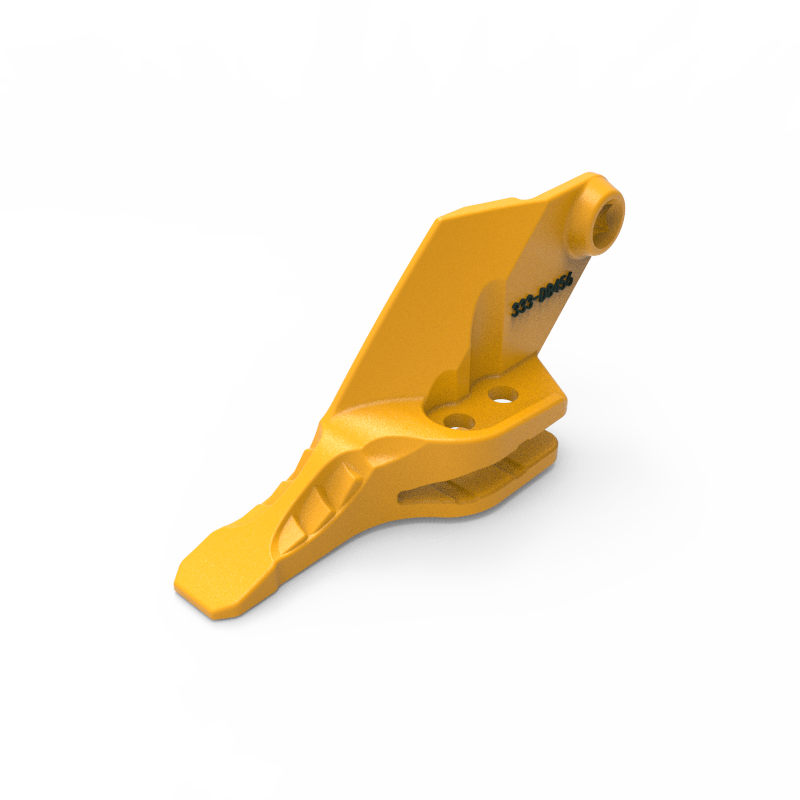
The SKU-level data on the reference side cutter is the data that a sourcing program has to verify, not assume. The data points are: the OEM part number (333D8456 for the JCB part; the equivalent ESCO, CAT, Komatsu, Volvo part numbers for the same function in those OEM lines), the forging process (closed-die forging is the standard for side cutters; cast is the cheaper alternative that wears faster; fabricated is the cheapest alternative that wears the fastest), the steel grade (low-alloy boron steel is the standard for side cutters; manganese steel is the lower-cost alternative; high-chromium white iron is the higher-cost alternative for high-abrasion applications), the heat treatment cycle (a typical side cutter is quenched and tempered to a surface hardness of 46 to 52 HRC and a core hardness of 32 to 38 HRC, with the case depth typically 8 to 15 mm), and the dimensional drawing (the side cutter has to match the OEM geometry within ±0.5 mm on the critical weld-prep dimensions, or the welding rework time dominates the per-unit cost).
Why Heat Treatment Is the Buying Decision
The single most important specification on a side cutter or sidebar protector is the heat treatment, not the steel grade. A side cutter made from the same nominal low-alloy boron steel can have a 2 to 4× difference in wear life, depending on the heat treatment cycle that the supplier uses. The supplier who controls the heat treatment controls the wear life, and the supplier who controls the wear life controls the per-hour operating cost of the bucket.
| Heat Treatment Variant | Surface Hardness (HRC) | Core Hardness (HRC) | Case Depth (mm) | Typical Wear Life (hours) |
|---|---|---|---|---|
| Water-quenched and tempered (low-alloy boron steel) | 48 to 52 | 32 to 36 | 10 to 15 | Reference baseline |
| Oil-quenched and tempered (low-alloy boron steel) | 46 to 50 | 34 to 38 | 8 to 12 | 0.7 to 0.9× baseline |
| Polymer-quenched and tempered (low-alloy boron steel) | 50 to 54 | 30 to 34 | 15 to 20 | 1.3 to 1.6× baseline |
| Cast, no heat treatment (low-alloy cast steel) | 38 to 42 | 38 to 42 | Through-thickness | 0.3 to 0.5× baseline |
| Fabricated weldment, no heat treatment (mild steel) | n/a (no through-thickness hardness) | n/a | n/a | 0.15 to 0.25× baseline |
The wear life column is a working range, not a single number, and the exact ratio depends on the application. A digging application in granite wears the side cutter faster than a loading application in limestone, and the heat treatment that gives 1.6× the life in limestone might give 1.3× the life in granite (because the granite’s abrasive quartz is harder than the case depth of the heat treatment). The buyer who specifies the heat treatment without specifying the application is the buyer who ends up with a part that is over-engineered for one site and under-engineered for the next.
JCB-Compatible Part Numbers — What “Compatible” Actually Means
A JCB-compatible part number is a part that fits the JCB bucket geometry, not a part that pretends to be a JCB part. The JCB 333D8456 is a specific part number that JCB assigns to a specific side cutter geometry; the JCB-compatible 333D8456 is a part manufactured by a non-JCB supplier (such as NBJM) that matches the same geometry, with the same weld-prep dimensions, the same forging profile, and the same heat treatment specification. The JCB-compatible part is sold under the JCB part number because the buyer (a fleet, a dealer, a rental operation) needs to be able to cross-reference the part against the JCB catalog without ambiguity.
| JCB Part Number | Function | OEM vs Aftermarket |
|---|---|---|
| 333D8456 | Side cutter point (corner) | JCB OEM; aftermarket JCB-compatible available |
| 333D8455 | Side cutter, 2CX / 3X fish scale | JCB OEM; aftermarket available |
| 333D8457 | Side cutter, backhoe skid steer | JCB OEM; aftermarket available |
| 332/C4388 | Standard bucket tooth | JCB OEM; aftermarket available |
| 332/C4389 | Fish scale side bucket tooth | JCB OEM; aftermarket available |
| 332/C4390 | Corner point | JCB OEM; aftermarket available |
| Sidebar protector (JCB series-specific) | Sidebar protector (length varies by bucket model) | JCB OEM; aftermarket available |
The aftermarket JCB-compatible part is a real category, not a knockoff category. The aftermarket supplier (such as NBJM) is typically a specialist G.E.T. (Ground Engaging Tools) manufacturer that has done the engineering work to match the JCB geometry and has a long-term supply relationship with the JCB dealer network or the JCB fleet customers. The aftermarket part is sold at a meaningful discount to the OEM part, with the same wear life (assuming the heat treatment is the same), and the aftermarket part is the part that a fleet operation specifies when the per-bucket operating cost is the design constraint.
Supplier Evaluation — The 7-Point Checklist
The supplier-evaluation checklist is the buyer’s first line of defense against a bad batch. The 7 points are the points that a reliable supplier can document in writing, and a less-reliable supplier cannot.
| # | Check Point | What the Supplier Must Provide |
|---|---|---|
| 1 | Material traceability | Mill certificate (chemical composition) for each heat of steel, matched to the batch number on the part |
| 2 | Heat treatment certificate | Quench medium, tempering temperature, resulting hardness range, case depth — per batch |
| 3 | Hardness test report | Vickers or Rockwell test results on 3 parts per batch, with the test location identified |
| 4 | Dimensional inspection report | Critical weld-prep dimensions measured on 3 parts per batch, with the tolerance called out |
| 5 | Forging process declaration | Closed-die forged vs cast vs fabricated, with the process steps described |
| 6 | Welding procedure | Pre-heat temperature, filler metal specification, post-weld stress-relief procedure (if any) |
| 7 | Packaging protection | Anti-rust coating, individual wrapping, palletisation, container loading |
The 7-point checklist is a buyer-side tool, but the supplier can help. A specialist G.E.T. manufacturer with 16+ years of exporting experience, with heat treatment FAQ documentation on the website, and with an in-house metallurgy team can typically fill in 6 of the 7 points in the table from the catalog data, leaving the buyer to confirm 1 of the 7 (typically the dimensional inspection report on the specific batch, which the supplier generates for the buyer’s PO). A supplier who cannot fill in 6 of the 7 points is a supplier that does not have the engineering depth to support a sourcing program, regardless of how low the unit price is.
The Hidden Cost of Fitment — Why Unit Price Is Not the Buying Decision
The unit price of a side cutter is the most visible line on the quote, but it is not the most important line. The most important line is the per-bucket operating cost, which includes the unit price, the wear life, the replacement labour, and the welding rework. A side cutter that is 20% more expensive at the unit price level but 50% longer in wear life is the cheaper side cutter on a per-bucket operating cost basis.
| Cost Component | Cheaper Side Cutter | Pricier Side Cutter with Better Heat Treatment |
|---|---|---|
| Unit price (illustrative) | USD 18 | USD 22 |
| Wear life (typical hours in digging application) | 120 hours | 200 hours (1.67× wear life) |
| Side cutters consumed per 1,000 bucket hours | 8.3 | 5.0 |
| Side cutter cost per 1,000 bucket hours | USD 150 | USD 110 |
| Replacement labour per side cutter (hours) | 0.75 | 0.75 |
| Replacement labour cost per 1,000 bucket hours | USD 6.25 | USD 3.75 |
| Total cost per 1,000 bucket hours (side cutter + labour) | USD 156 | USD 114 |
The per-bucket operating cost in the table is illustrative, not a specific quote, but the shape of the comparison is the same for any side cutter line: the higher unit price is more than offset by the longer wear life, and the total cost per bucket hour is lower for the better-heat-treated part. The savings are larger in digging applications (where wear life dominates) and smaller in loading applications (where the wear life of the cheaper part is closer to the wear life of the better part because the abrasive load is lower).
Sample Testing — The 4-Week Plan Before the First PO
The sample testing plan is the buyer’s first chance to validate a supplier before the first PO. A 4-week sample test on a new supplier covers the four things that the unit price cannot tell the buyer: dimensional accuracy, heat treatment quality, welding compatibility, and field wear life in a controlled test.
| Week | Activity | Acceptance Criteria |
|---|---|---|
| 1 | Dimensional inspection on 5 sample parts | All critical weld-prep dimensions within ±0.5 mm of the OEM drawing |
| 2 | Hardness test on 3 sample parts (surface and core) | Surface hardness within supplier’s stated range; core hardness within ±3 HRC of stated value |
| 3 | Welding compatibility test (weld one side cutter to a sample bucket section, then macro-etch the weld interface) | No cracking at the weld interface; no porosity in the weld; full penetration of the weld into the parent material |
| 4 | Field trial on one bucket (one side cutter, one sidebar protector, run for 100 hours in a typical application) | No cracking at the weld interface; wear pattern consistent with the supplier’s stated wear life; no dimensional distortion |
The 4-week sample test is the buyer’s investment in a reliable sourcing program. The cost of the sample test is the cost of 5 sample parts (typically USD 90 to 110 for 5 side cutters) plus 1 hour of metallurgist time (typically USD 100 to 200) plus 100 hours of bucket operating time (the cost of which is internal to the buyer). The total out-of-pocket cost is roughly USD 200 to 300, which is a small fraction of the cost of a single bad batch that fails on the field.
Five Common Sourcing Mistakes
Across the side cutter and sidebar protector sourcing programs that fail in year one, the same five mistakes appear most often. The list is ordered by how often the mistake appears, not by how dramatic the failure is when it happens.
1. Buying on unit price alone
The buyer specifies the side cutter by unit price, not by per-bucket operating cost. The cheaper side cutter wins the PO, and the per-bucket operating cost is 27% higher. The fleet operations VP sees the per-bucket operating cost at the end of the year and the buyer’s reputation takes the hit. The fix: convert the conversation from unit price to per-bucket operating cost at the RFQ stage, not at the year-end review.
2. Skipping the heat treatment certificate
The buyer accepts the supplier’s generic “heat treated” claim without asking for the heat treatment certificate. The heat treatment is inconsistent across batches, and the wear life varies by 2 to 4× from one batch to the next. The buyer discovers the inconsistency at the first bucket in the field. The fix: require the heat treatment certificate as a per-batch deliverable, not a one-time document.
3. Skipping the sample test
The buyer skips the sample test and goes straight to the first PO. The first batch arrives, the buyer welds the first side cutter, and the side cutter cracks at the weld interface after 50 hours. The fix: run the 4-week sample test on a new supplier before the first PO. The cost of the sample test is USD 200 to 300, and the cost of a bad batch on the field is the cost of a fleet downtime event.
4. Accepting the off-brand dimensional drawing
The buyer accepts an off-brand dimensional drawing that is “close enough” to the JCB OEM drawing, and the off-brand side cutter does not seat properly on the bucket. The first bucket takes 1 to 2 hours of welding rework, and the off-brand supplier is not able to fix the dimensional mismatch on the second batch. The fix: require the dimensional inspection report on the first batch, and refuse the batch if the critical weld-prep dimensions are outside ±0.5 mm of the OEM drawing.
5. Skipping the welding procedure specification
The buyer does not specify the welding procedure, and the field welder uses the default procedure. The default procedure does not include pre-heating, and the side cutter develops hydrogen-induced cracking at the weld interface. The fix: write the welding procedure into the buyer-side spec, and train the field welder on the procedure before the first side cutter is welded.
Implementation — A 90-Day Sourcing Program
The implementation of a side cutter and sidebar protector sourcing program typically runs over 90 days, with three phases. The buyer who tries to compress the timeline below 90 days typically skips the sample test and pays for the skip in year one.
| Phase | Days | Activity |
|---|---|---|
| 1. Specification | 1 to 30 | Write the specification: OEM part numbers (JCB 333D8456 for side cutter, equivalent for sidebar protector), the heat treatment cycle, the dimensional tolerance, the welding procedure, the packaging protection. The output is a buyer-side spec document that can be sent to multiple suppliers for parallel quotation. |
| 2. Sample | 31 to 60 | Receive samples from 2 to 3 candidate suppliers. Run the 4-week sample test on each sample. The output is a ranked list of suppliers, with the supplier who passes all 4 weeks of the sample test ranked first. |
| 3. First PO | 61 to 90 | Issue the first PO to the top-ranked supplier. The first PO is the test order that validates the supplier’s on-time delivery, the per-batch documentation, and the per-batch dimensional inspection. The output of this phase is the ongoing supply relationship that the buyer runs for the next 12 to 24 months. |
The 90-day plan is the realistic timeline for a sourcing program that covers one OEM line (JCB or CAT or Komatsu or Volvo) and the matching sidebar protector line. A multi-line sourcing program that covers two or three OEM lines needs a 120 to 150 day timeline. The timeline scales with the number of OEM lines and the number of candidate suppliers, not with the per-batch quantity.
Working With the Supplier — The Practical Next Step
For a procurement manager ready to engage a JCB-compatible wear parts supplier, the practical next step is to send the 7-point checklist to 2 to 3 candidate suppliers and ask for a 5-part sample of the 333D8456 side cutter and the matching sidebar protector. A specialist G.E.T. manufacturer with 16+ years of exporting experience, with heat treatment FAQ documentation on the website, and with a track record of partnership with world-leading brands, can typically fill in 6 of the 7 points on the checklist and ship a 5-part sample within 7 to 10 working days. The buyer who engages 2 to 3 suppliers in parallel and runs the 4-week sample test on each is the buyer who closes the sourcing program in 90 days with a reliable supplier at a fair per-bucket operating cost.
The reference SKU for the sourcing program is the 333D8456 JCB side cutter point — a specific side cutter SKU that illustrates the JCB-compatible part number convention, the heat-treatment specification, and the dimensional fitment that the sourcing program has to verify. The 333D8456 is one of the JCB-compatible wear parts in the NBJM catalog, and a sourcing program that starts with the 333D8456 can extend to the other JCB-compatible part numbers (333D8455, 333D8457, 332/C4388, 332/C4389, 332/C4390) on the same supplier relationship.
Frequently Asked Questions
Q1. What is the difference between a side cutter and a sidebar protector?
A side cutter is a small, replaceable cutting edge welded to the side corner of the bucket lip, sized to match the OEM part geometry, and replaced typically 2 to 4 times per bucket life. A sidebar protector is a longer wear part welded along the entire side of the bucket, sized to match the OEM profile, and replaced typically once per bucket life. The two are bought as two separate procurement lines with two different replacement cycles and two different unit prices.
Q2. What does the JCB 333D8456 part number refer to?
The 333D8456 is a JCB OEM part number for a specific side cutter geometry (the corner side cutter point) that fits a specific JCB bucket. The aftermarket JCB-compatible 333D8456 is a part manufactured by a non-JCB supplier that matches the same geometry, with the same weld-prep dimensions, the same forging profile, and the same heat treatment specification, sold under the JCB part number for cross-reference clarity.
Q3. What is the typical wear life of a side cutter in a digging application?
A water-quenched and tempered low-alloy boron steel side cutter in a typical digging application has a wear life in the 100 to 250 hour range, depending on the rock type (granite wears the part faster than limestone) and the bucket operating pressure. An oil-quenched part runs 70 to 90% of that range; a polymer-quenched part runs 130 to 160% of that range. A cast part (no heat treatment) runs 30 to 50% of the water-quenched baseline.
Q4. Why is heat treatment more important than steel grade for a side cutter?
A side cutter made from the same nominal low-alloy boron steel can have a 2 to 4 times difference in wear life, depending on the heat treatment cycle. The steel grade is a starting point; the heat treatment is what determines the wear life. The supplier who controls the heat treatment controls the wear life, and the supplier who controls the wear life controls the per-bucket operating cost.
Q5. What is the difference between OEM and aftermarket JCB-compatible parts?
The OEM part is sold through the JCB dealer network at the OEM list price, warranted by JCB. The aftermarket JCB-compatible part is sold through a specialist G.E.T. manufacturer (such as NBJM) at a meaningful discount, warranted by the aftermarket manufacturer. The aftermarket part matches the OEM geometry and heat treatment specification but is sold at a lower per-unit price. A fleet operation typically runs the aftermarket part for 80 to 90% of the wear-part consumption and the OEM part for the remaining 10 to 20%.
Q6. What is the 7-point supplier evaluation checklist?
The seven-point checklist covers: (1) material traceability (mill certificate per heat), (2) heat treatment certificate (quench medium, tempering temperature, hardness, case depth per batch), (3) hardness test report (Vickers or Rockwell on 3 parts per batch), (4) dimensional inspection report (critical weld-prep dimensions within plus or minus 0.5 mm of the OEM drawing), (5) forging process declaration (closed-die forged vs cast vs fabricated), (6) welding procedure (pre-heat temperature, filler metal, post-weld stress relief), and (7) packaging protection (anti-rust coating, individual wrapping, palletisation). A supplier who supplies all 7 per batch is auditable; a supplier who supplies 3 of the 7 should be sampled before the first PO.
Q7. What is the 4-week sample test plan?
The 4-week sample test plan covers: week 1, dimensional inspection on 5 sample parts; week 2, hardness test on 3 sample parts; week 3, welding compatibility test (weld one side cutter to a sample bucket section, then macro-etch the weld interface); week 4, field trial on one bucket for 100 hours. The total out-of-pocket cost is roughly USD 200 to 300, and the cost of a bad batch on the field is the cost of a fleet downtime event.
Q8. What is the per-bucket operating cost saving of a better-heat-treated side cutter?
A side cutter that costs 22% more at the unit price and lasts 67% longer in service costs 27% less on a per-bucket-hour basis, including the replacement labour. The savings are larger in digging applications (where wear life dominates) and smaller in loading applications (where the wear life of the cheaper part is closer to the wear life of the better part because the abrasive load is lower).
Sourcing side cutters and sidebar protectors?
Send the 7-point checklist and a request for a 5-part sample of the 333D8456 side cutter and the matching sidebar protector. A 1 to 2 week reply with a per-batch documentation package and a sample shipping schedule.
Xin Jack
Export Sales Manager at Ningbo Yinzhou Join Machinery Co., Ltd.
Xin Jack is the Export Sales Manager at Ningbo Yinzhou Join Machinery Co., Ltd., a specialized manufacturer of G.E.T. (Ground Engaging Tools) parts including bucket teeth, cutting edges, and adapters for excavators and construction equipment. Established in 2006, the company serves European and American markets with 16 years of exporting experience, partnering with world-leading brands such as BYG, JCB, and NBLF. Every product undergoes strict quality control from raw material to finished goods, ensuring maximum cost performance for global construction and mining customers.
Related NBJM resources: JCB-compatible wear parts · 333D8456 JCB side cutter point specs and pricing · heat treatment FAQ · Ningbo Yinzhou Join Machinery
Post time: Oct-15-2026